 flip
flipNon-i Toki (Pit-Baked Bread)
Non-i Toki (Pit-Baked Bread)
Why this dish? Non (flatbread) is the sacred foundation of every Central Asian meal — it is never cut with a knife, but broken by hand. Khoja Ahrar, whose hagiographic texts report that he shared his table with the humblest, began each meal by breaking the non. His estates in the Tashkent region (Chach) produced the wheat that fed him.
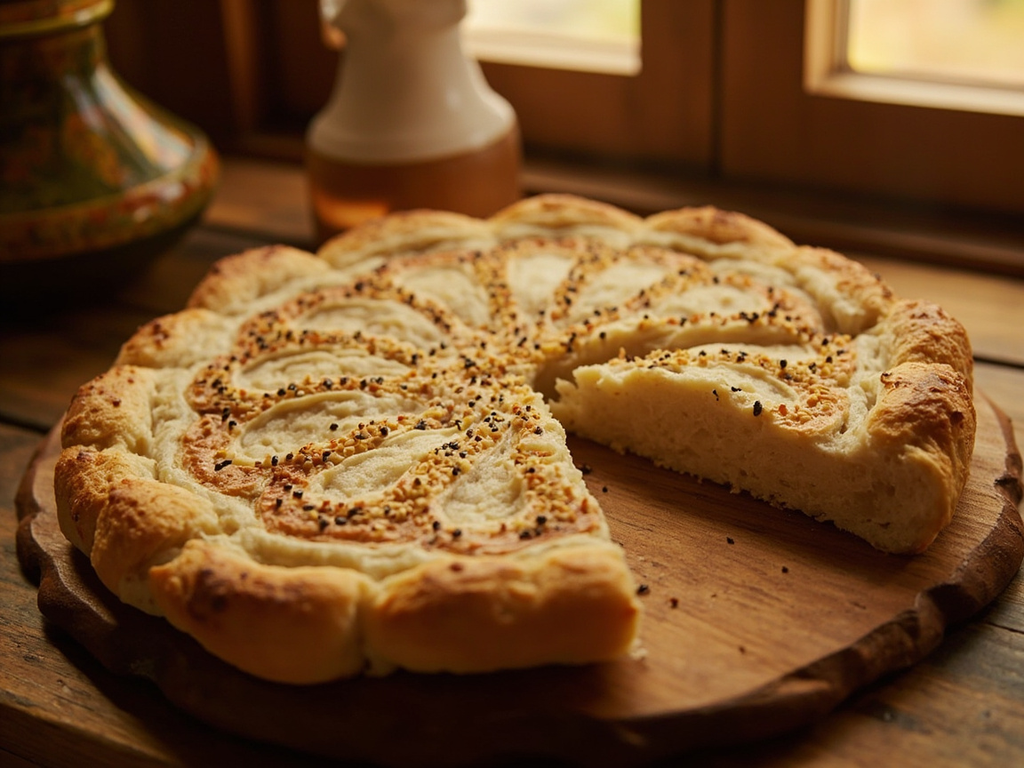
Round flatbread baked stuck to the burning walls of a tandyr (pit oven), decorated with stamped patterns in the center and sprinkled with sesame and nigella seeds. Crispy outside, soft inside, it is the indispensable companion of every Central Asian meal.
Non is the baraka of the table. Before breaking the bread, I pronounce the name of God, and my guests do likewise. My baker lowers each flatbread into the tandyr with bare hands — the heat no longer reaches him, his palms so hardened by use. He stamps the center with the chekich so that the bread bakes flat without puffing, and he sprinkles the kalonji seeds that my gardener in Chach has harvested. When the non comes out of the oven, golden like the dome of the Registan, I always place it decorated side facing heaven, for turning bread face-down is an affront to Providence.
- •Wheat flour — abundant (Base)
- •Warm water — sufficient (Hydration)
- •Natural sourdough — a piece of yesterday's dough (Leavening)
- •Salt — a pinch (Flavor)
- •Sour milk (qatiq) — a little (Softness)
- •Sesame and nigella seeds (kalonji) — a handful (Decoration and flavor)
Non-i Toki (Pit-Baked Bread)
Round flatbread baked stuck to the burning walls of a tandyr (pit oven), decorated with stamped patterns in the center and sprinkled with sesame and nigella seeds. Crispy outside, soft inside, it is the indispensable companion of every Central Asian meal.
Why this dish? Non (flatbread) is the sacred foundation of every Central Asian meal — it is never cut with a knife, but broken by hand. Khoja Ahrar, whose hagiographic texts report that he shared his table with the humblest, began each meal by breaking the non. His estates in the Tashkent region (Chach) produced the wheat that fed him.
Non is the baraka of the table. Before breaking the bread, I pronounce the name of God, and my guests do likewise. My baker lowers each flatbread into the tandyr with bare hands — the heat no longer reaches him, his palms so hardened by use. He stamps the center with the chekich so that the bread bakes flat without puffing, and he sprinkles the kalonji seeds that my gardener in Chach has harvested. When the non comes out of the oven, golden like the dome of the Registan, I always place it decorated side facing heaven, for turning bread face-down is an affront to Providence.
Ingredients (period version)
- Wheat flour — abundant (Base)
- Warm water — sufficient (Hydration)
- Natural sourdough — a piece of yesterday's dough (Leavening)
- Salt — a pinch (Flavor)
- Sour milk (qatiq) — a little (Softness)
- Sesame and nigella seeds (kalonji) — a handful (Decoration and flavor)
Ingredients
- Bread flour (T65) — 500 g (Base)
- Warm water — 280 ml (Hydration)
- Active dry yeast — 5 g (Leavening)
- Salt — 1 teaspoon (Flavor)
- Plain yogurt — 3 tablespoons (Softness)
- Vegetable oil — 2 tablespoons (Flexibility)
- Sesame seeds — 2 tablespoons (Decoration)
- Nigella seeds — 1 tablespoon (Flavor)
- Egg yolk beaten with a little milk — 1 (Egg wash)
Method
- Dissolve the yeast in warm water and let it foam for 5 minutes.
- In a large bowl, mix the flour and salt. Add the yogurt, oil, and yeast water. Knead for 10 minutes until a soft, smooth dough forms.
- Cover and let rise for 1 hour in a warm place until doubled in volume.
- Preheat the oven to 230°C with a pizza stone or inverted baking sheet inside.
- Divide the dough into 2 or 3 balls. Flatten each ball into a 20-25 cm disc, leaving the edge slightly thicker than the center.
- Prick the center of each flatbread with a fork in a regular pattern (or use a chekich if available), leaving a 3 cm unpricked border.
- Brush with egg wash and sprinkle with sesame and nigella seeds.
- Bake directly on the hot stone for 12 to 15 minutes until golden and the edge has puffed.
- Cool slightly on a rack. Serve by tearing by hand, never cutting.
How it was made : Non has been baked in a tandyr (clay oven, pit or semi-pit) for millennia in Central Asia. The flatbreads are slapped against the burning wall by a specialized baker (nonvoy). The chekich, a wooden or bone prick-stamp, creates decorative patterns in the center that also prevent the bread from puffing unevenly. Placing a non face-down is considered disrespectful in Uzbek culture. Each city had its variants: Samarkand non was renowned for its long shelf life.
The contemporary twist : Bake the non on a very hot pizza stone and serve on a carved wooden board with a small bowl of cumin-flecked butter.
Sources : Glenn Randall Mack and Asele Surina, Food Culture in Russia and Central Asia, Greenwood Press, 2005 · UNESCO, Flatbread: Preparation and Sharing of Lavash, Katyrma, Jupka, Yufka (Intangible Cultural Heritage), 2016
Khoja Ahrar · Charactorium