 flip
flipMead of Brocéliande
Mead of Brocéliande
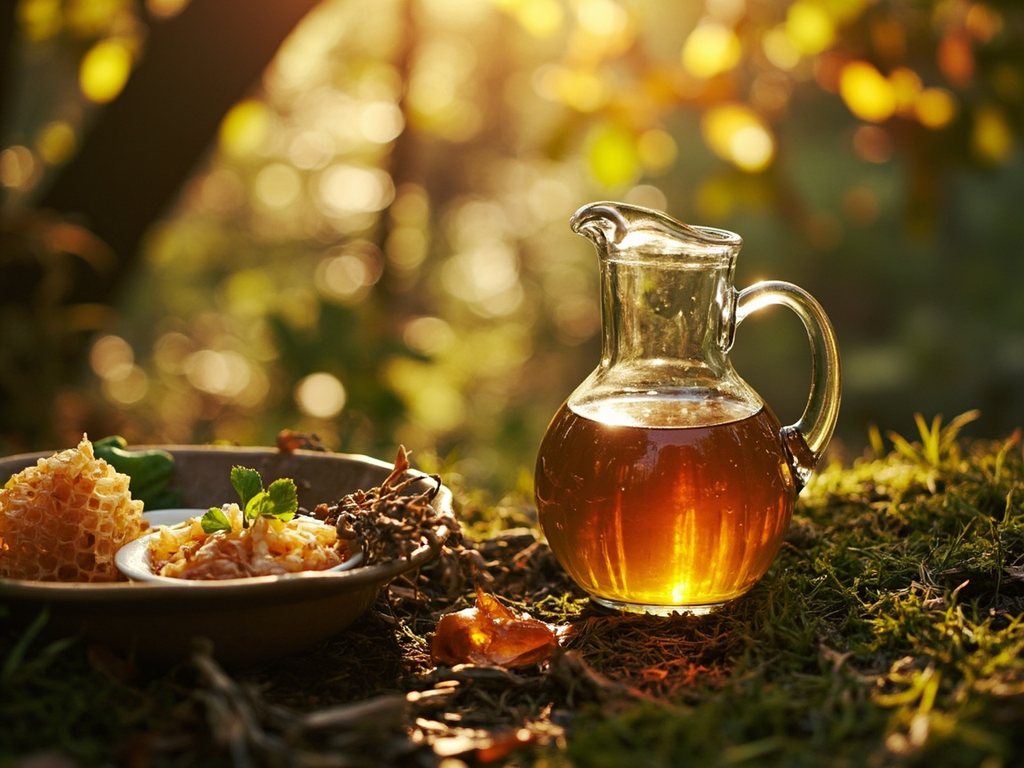
Why this dish? Offerings of honey and sweet drink were left for the fairies of the forest and springs to win their favor. Mead, the most ancient drink made from wild honey, is the ideal offering for the Lady of Brocéliande, guardian of waters and spells.
Sweet golden drink born from fermented honey, scented with forest herbs — a beverage poured in homage to the ladies of the springs. (Version inspired by folkloric offerings, not a reproduced ritual.)
Would you win my favor, traveler? Then pour a little of this golden liquor near the fountain of Barenton, and drink not the first sip without dedicating it to me. The wild honey of my hives, the clear water of my springs, a sprig of woodruff for the scent of the undergrowth: let time do its work, for patience is the first of magics. He who knows how to honor a fairy never thirsts for long.
- •Wild honey — a good part (fermentable sugar)
- •Spring water — three parts (dilution)
- •Sweet woodruff / woodland herbs — a handful (fragrance)
- •Natural leaven (lees, wild yeasts) — a touch (fermentation)
Mead of Brocéliande
Sweet golden drink born from fermented honey, scented with forest herbs — a beverage poured in homage to the ladies of the springs. (Version inspired by folkloric offerings, not a reproduced ritual.)
Why this dish? Offerings of honey and sweet drink were left for the fairies of the forest and springs to win their favor. Mead, the most ancient drink made from wild honey, is the ideal offering for the Lady of Brocéliande, guardian of waters and spells.
Would you win my favor, traveler? Then pour a little of this golden liquor near the fountain of Barenton, and drink not the first sip without dedicating it to me. The wild honey of my hives, the clear water of my springs, a sprig of woodruff for the scent of the undergrowth: let time do its work, for patience is the first of magics. He who knows how to honor a fairy never thirsts for long.
Ingredients (period version)
- Wild honey — a good part (fermentable sugar)
- Spring water — three parts (dilution)
- Sweet woodruff / woodland herbs — a handful (fragrance)
- Natural leaven (lees, wild yeasts) — a touch (fermentation)
Ingredients
- Honey — 250 g (sugar to ferment)
- Spring water — 1 liter (base)
- Baker's yeast or mead yeast — 2 g (fermentation)
- Zest of untreated lemon — 1 (acidity and nutrient)
- A few juniper berries or a sprig of thyme — optional (forest fragrance)
Method
- Warm the water (do not boil) and dissolve the honey; let cool to room temperature.
- Add the lemon zest and aromatics, then the yeast rehydrated in a little of the warm liquid.
- Pour into a bottle or jar fitted with an airlock (or a pierced balloon), away from light.
- Let ferment for 2 to 3 weeks at room temperature, until bubbling stops.
- Rack carefully to leave sediment behind, filter, and bottle.
- Age in a cool place for a few weeks before serving chilled. (Slightly alcoholic: for adults only; for the family table, see the twist below.)
How it was made : Mead is arguably the oldest alcoholic beverage in Europe, predating wine and beer, made by spontaneous fermentation of diluted honey. In the Middle Ages it remained prized in Celtic and forested regions like Brittany, where the vine grows poorly. Breton folklore closely associates fairies, springs (like Barenton), and food offerings.
The contemporary twist : For a family and school table, make a non-alcoholic "fairy water": spring water, honey, lemon, and a cold infusion of lemon balm, served sparkling — magic without fermentation.
Sources : Folklore of the Forest of Brocéliande (Fountain of Barenton) · Medieval treatises on mead-making
The Lady of the Lake · Charactorium