 flip
flipJowar Bhakri and Metkut
Jowar Bhakri and Metkut
Why this dish? When the Rani took command of the fighting and shared the rations of her horsemen — from Jhansi to Kalpi then Gwalior — food became that of a soldier: a sorghum millet flatbread that keeps and travels, eaten with a spiced lentil powder (metkut) that does not spoil on campaign. The deliberate contrast between queen and warrior.
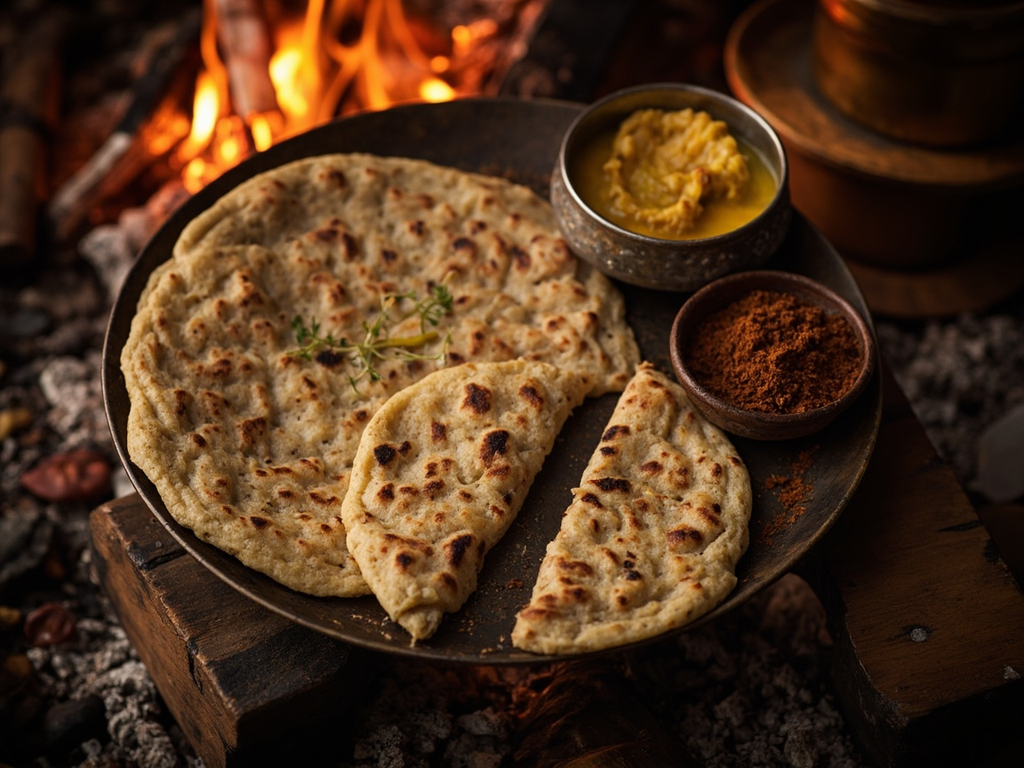
A rustic unleavened flatbread of sorghum flour, cooked on the flame until it puffs. It is broken and dipped in ghee sprinkled with metkut, a brown powder of roasted lentils and spices — sober, dense food that sustains the body on the road.
Do not think that a queen cannot break the poor man's bread. On the roads of Kalpi, I ate like my horsemen: the jowar bhakri, that grey bread that needs no leaven and stays in the knapsack for days. You flatten it with your palm, slap it on the embers until it swells with hot air. Dip it in toop dusted with metkut — that roasted lentil powder that never spoils — and you will have the strength to ride until dawn. The soldier's belly and the Rani's belly demand the same courage.
- •Sorghum flour (jowar) — for the flatbreads (travel bread)
- •Hot water and salt — for kneading (binder)
- •Metkut (roasted lentil and spice powder) — to sprinkle (preserved accompaniment)
- •Ghee — a little (fat, energy)
Jowar Bhakri and Metkut
A rustic unleavened flatbread of sorghum flour, cooked on the flame until it puffs. It is broken and dipped in ghee sprinkled with metkut, a brown powder of roasted lentils and spices — sober, dense food that sustains the body on the road.
Why this dish? When the Rani took command of the fighting and shared the rations of her horsemen — from Jhansi to Kalpi then Gwalior — food became that of a soldier: a sorghum millet flatbread that keeps and travels, eaten with a spiced lentil powder (metkut) that does not spoil on campaign. The deliberate contrast between queen and warrior.
Do not think that a queen cannot break the poor man's bread. On the roads of Kalpi, I ate like my horsemen: the jowar bhakri, that grey bread that needs no leaven and stays in the knapsack for days. You flatten it with your palm, slap it on the embers until it swells with hot air. Dip it in toop dusted with metkut — that roasted lentil powder that never spoils — and you will have the strength to ride until dawn. The soldier's belly and the Rani's belly demand the same courage.
Ingredients (period version)
- Sorghum flour (jowar) — for the flatbreads (travel bread)
- Hot water and salt — for kneading (binder)
- Metkut (roasted lentil and spice powder) — to sprinkle (preserved accompaniment)
- Ghee — a little (fat, energy)
Ingredients
- Jowar (sorghum) flour — 200 g (flatbread)
- Hot water — about 150 ml (binder)
- Salt — 1 pinch (seasoning)
- Metkut (store-bought or homemade Indian blend) — 3 tbsp (accompaniment)
- Ghee — 2 tbsp (serving)
Method
- Mix jowar flour with salt, add hot water little by little and knead into a soft dough (it remains slightly crumbly, that is normal).
- Shape into a ball, flatten with the palm on a floured surface into a thick disc.
- Cook on a very hot griddle/pan, then place directly on the flame for a few seconds to puff.
- Prepare the metkut: mix 3 tbsp powder with 1 tbsp melted ghee (and a little salt) for a flavored paste.
- Break the warm bhakri and dip it in the ghee with metkut.
How it was made : Jowar and bajra (sorghum and pearl millet), hardy grains of the Deccan and Bundelkhand, yielded unleavened breads that kept better than wheat on campaign. Metkut, a powder of roasted dal and spices, was a classic Marathi Brahmin preparation precisely because it kept for months without spoiling — ideal for travel.
The contemporary twist : Bhakri broken into thick chips, metkut served as a ghee dip — a 'campaign appetizer' that tells the double life of queen/warrior.
Sources : K. T. Achaya, Indian Food: A Historical Companion, Oxford University Press · Kamalabai Ogale, Ruchira (metkut)
Lakshmi Bai · Charactorium