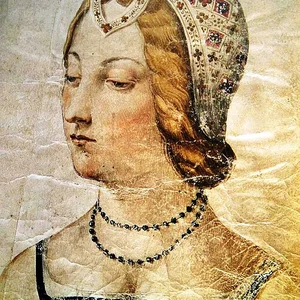

A fourteenth-century noblewoman of the Comtat Venaissin, traditionally identified as the Laura celebrated by the Italian poet Petrarch in his collection the Canzoniere. A literary muse whose beauty and virtue inspired one of the high points of Western love poetry.
Laure de Noves(1310 — 1348)
Laure de Sade
Royaume de France
6 min read
Frequently asked questions
Key Facts
- Born around 1310 in the Comtat Venaissin, descended from the Provençal nobility (the de Noves family, possibly the de Sade family)
- According to tradition, Petrarch first caught sight of her on 6 April 1327 in the church of Saint Clare in Avignon
- She became the inspiration for the Canzoniere (Rerum vulgarium fragmenta), the collection of poems Petrarch dedicated to her
- Died in 1348, probably a victim of the Black Death that ravaged Europe
- Her death inspired the second part of Petrarch's collection (the poems *in morte di Laura*)
Works & Achievements
Laura is the muse of the 366 poems of the Canzoniere, the pinnacle of Western love poetry and the matrix of the European sonnet.
The first part of the collection, in which Petrarch sings of the beauty, virtue, and coldness of the beloved and unattainable lady.
The second part of the Canzoniere, in which the dead Laura becomes a spiritual guide lifting the poet toward heaven, in the manner of Dante's Beatrice.
Through Laura, Petrarch sets the codes of ideal love: this style would be imitated throughout Europe, from Ronsard to Shakespeare.
A long allegorical poem in which Laura appears in the procession of Love, Death, and then Eternity, as a glorified soul.
Anecdotes
According to Petrarch's own account, the poet first caught sight of Laura on the morning of April 6, 1327, in the church of Sainte-Claire in Avignon. This love at first sight, never returned, would inspire hundreds of poems over more than twenty years.
Petrarch recorded his memories of Laura in the margin of a precious manuscript he owned, his copy of Virgil. It is in this intimate note, and not in a poem, that he set down the date of their meeting and the date of Laura's death, as if to fix these two dates forever.
According to this same note, Laura is said to have died on April 6, 1348, exactly twenty-one years to the day after their first meeting. That year, the great Black Death was ravaging Avignon and all of Europe, carrying off millions of people.
The identification of this Laura with Laure de Noves, wife of Hugues de Sade, is not certain: it was championed above all in the 18th century by the Abbé de Sade, a man of letters who claimed to be her descendant. Historians still debate whether Laura truly existed or was, in part, an idealized figure.
The very name Laura allowed Petrarch to play on words in Italian and Latin: he constantly evokes the laurel (*lauro*), the tree of crowned poets, and the breeze (*l'aura*), making the beloved woman the very symbol of the poetic glory to which he aspired.
Primary Sources
Laura, illustrious through her own virtues and long celebrated in my verses, first appeared to me in my early youth, in the year 1327, on the sixth day of April, in the church of Saint Clare in Avignon, at the morning hour.
It was on the day when the sun's rays grew pale with pity for their Creator that I was taken, and I did not guard myself against it, for your beautiful eyes, my Lady, had bound me.
Clear, fresh and sweet waters, where she, the only one who seems a woman to me, rested her lovely body.
Augustine reproaches me for having loved not the soul, but the mortal body of this woman; and I maintain that it was she who raised my spirit toward the highest thoughts.
Key Places
Village in the Comtat Venaissin, near Avignon, from which Laura's family took its name. The place traditionally associated with her origins.
The church where, according to Petrarch, he first saw Laura on 6 April 1327. The founding site of the love myth.
The city of the popes in the 14th century, heart of Christendom and the town where Laura lived. It was there that she died during the plague of 1348.
Petrarch's retreat in the Sorgue valley, where he composed many of his poems for Laura, celebrating the “clear waters” of the river.
The place where tradition locates the tomb of Laura de Sade. The Abbé de Sade claimed to have rediscovered her grave there in the 18th century.
Typical Objects

Linen or silk headdress covering the hair of married women in the 14th century, a sign of modesty and status. Petrarch often evokes Laura's blonde hair escaping from beneath the veil.

A long, fitted garment worn by noble ladies, layered over the chemise and often topped by a surcot. A symbol of aristocratic elegance in the 14th-century Comtat.

A central poetic symbol: the laurel (lauro) makes a pun on Laura's name. It evokes the poet's glory and unattainable love rather than an object actually worn.

A collection of Petrarch's poems copied by hand on parchment, sometimes adorned with illuminations. It is through these precious books that the memory of Laura has been passed down across the centuries.

Devotional objects of a 14th-century Christian lady, used for daily prayer. In the poems, Laura's piety is inseparable from her virtuous beauty.

A small mirror of polished metal or glass, a precious object of a noble lady used to tend to her hair and finery. In medieval poetry it also symbolizes beauty and its fragility.
School Curriculum
Vocabulary & Tags
Key Vocabulary
Daily Life
Morning
A noblewoman of the Comtat, Laure likely began her day with prayer, sometimes attending Mass in a church in Avignon. An attendant helped her dress, braid her blonde hair, and adjust the veil of a married woman.
Afternoon
The afternoon was divided between managing the household, embroidery, reading books of piety, and visits among the noble families of the Comtat. Social life revolved around the papal court, whose influence radiated across the whole region.
Evening
Evening brought the family together for the meal, followed by evening prayers and rest. In a city as cosmopolitan as Avignon, one might encounter musicians, clerics, and merchants from all across Christendom.
Food
The diet of a noble family combined wheat bread, meats, fish (on Fridays and during Lent), vegetables, fruits from the Comtat, and local wine. Spices, which were costly, marked one's social rank at banquets.
Clothing
Laure wore the long fitted cotte and the surcoat of noble ladies, made of fine cloth or silk, with a belt and a veil covering her hair. **Petrarch** dwells on her gown and her golden hair, symbols of her beauty.
Housing
She lived in an aristocratic residence in Avignon or the Comtat, built of stone, with great halls, fireplaces, and furniture of carved wood. The proximity of the papal court made the city wealthy, populous, and lively.
Historical Timeline
Period Vocabulary
Liens externes & ressources
Références
Œuvres
Inspiration du Canzoniere de Pétrarque
XIVe siècle
Figure des poèmes « in vita » (du vivant de Laure)
1327-1348
Figure des poèmes « in morte » (après la mort de Laure)
après 1348
Modèle du « pétrarquisme » européen
XVe-XVIe siècles
Sujet des Triomphes (Trionfi)
vers 1351-1374