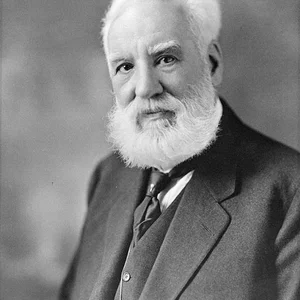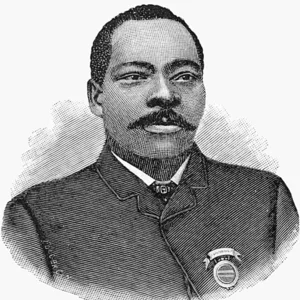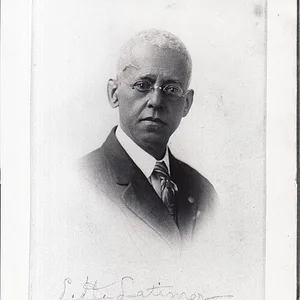

American inventor and engineer born in 1848, Lewis Latimer improved the carbon filament of the incandescent light bulb, making electric lighting accessible to the general public. A collaborator of Thomas Edison and Alexander Graham Bell, he was one of the few Black engineers recognized during his era.
Lewis Latimer
Lewis Howard Latimer
8 min read
Frequently asked questions
Key Facts
- 1848: born in Chelsea, Massachusetts, son of escaped slaves
- 1876: drafted the technical drawings for Alexander Graham Bell's telephone patent
- 1881: filed a patent for a long-lasting carbon filament, decisively improving Edison's light bulb
- 1884: joined Edison's team (Edison Electric Light Company) as the only Black engineer
- 1918: became a founding member of the “Edison Pioneers,” Edison's inner circle of collaborators
Works & Achievements
Latimer's first major patent, covering an improved incandescent electric lamp. It laid the groundwork for his research into the durability of carbon filaments.
Latimer's most important invention: a process for manufacturing stronger and less costly carbon filaments, which made the electric light bulb accessible to the general public.
Latimer personally supervised the installation of the first electric lighting networks in New York, Philadelphia, Montreal, and London, training local electrician crews and adapting installations to the specific constraints of each city.
A ventilation and air disinfection system, demonstrating Latimer's inventive versatility well beyond the field of electric lighting.
The first technical work on electric lighting written for a general audience. Authored by Latimer, it remains a primary historical source on the industrial implementation of the Edison system.
Anecdotes
Lewis Latimer was born in 1848 to parents who had formerly been enslaved and had fled to freedom. His father, George Latimer, had escaped from Virginia in 1842, but his enslaver tracked him down in Boston. The case became a national cause: abolitionists, including Frederick Douglass, campaigned to buy his freedom. Lewis grew up in the shadow of this struggle for human dignity, and it left a deep mark on his entire career.
At 15, Lewis enlisted in the Union Navy during the Civil War, lying about his age to be accepted. After the war, with no diploma or resources, he talked his way into a job as an office boy at a patent firm in Boston. By watching the draftsmen and secretly studying their manuals, he taught himself technical drawing and eventually rose to become their head draftsman — a completely self-taught achievement.
In 1876, Alexander Graham Bell was desperately searching for someone to draw the precise plans for his telephone before a competitor could file a similar patent. It was Latimer, then a young draftsman, who produced the official drawings that accompanied the patent application. Without those impeccably accurate schematics, the authorship of the telephone might have been challenged far sooner.
Latimer joined Hiram Maxim's company in 1880 and developed a process for manufacturing carbon filaments that were far more durable and cost-effective than Edison's. His 1882 patent made light bulbs cheap enough for ordinary households to afford. He then personally supervised the installation of the first electric lighting networks in New York, Philadelphia, Montreal, and London.
Latimer was the only Black engineer admitted to the "Edison Pioneers
the circle of inventors who had worked directly with Thomas Edison. A self-taught polyglot, he learned German and Japanese to communicate with foreign engineers. He was also a poet and musician, and taught English classes to immigrants in his neighborhood of Flushing, New York, where he lived until his death in 1928.
Primary Sources
Our invention relates to that class of electric lamps in which the light is produced by the incandescence of a carbon conductor; and it consists in a new and useful combination of parts forming an economical and efficient lamp.
Be it known that I, Lewis H. Latimer, have invented certain new and useful Improvements in the Process of Manufacturing Carbons for incandescent lamps, the object being to produce carbons of uniform resistance possessing sufficient mechanical strength to resist ordinary handling in manufacture and use.
The electric light requires for its production the concentration of a large amount of electrical energy upon a very small surface, the light being produced by the resistance offered by that surface to the passage of the current.
Key Places
Birthplace of Lewis Latimer, on September 4, 1848. A working-class city near Boston, it was where his family settled after his father escaped from Virginia.
The city where Latimer worked for the patent firm Crosby & Gould, the site of his self-directed education and his pivotal collaboration with Alexander Graham Bell on the telephone drawings.
Headquarters of Hiram Maxim's United States Electric Lighting Company, where Latimer developed his carbon filament manufacturing process between 1880 and 1882 and filed his most significant patents.
Headquarters of the Edison Electric Light Company, where Latimer worked from 1884 through the end of his active career as a patent expert, technical instructor, and engineering report writer.
The neighborhood where Latimer spent the final decades of his life with his wife Mary and their two daughters. His home, designated a historic landmark, is now the Lewis H. Latimer House Museum.
The city where Latimer oversaw the installation of one of Europe's earliest electric lighting networks in the early 1880s, demonstrating the industrial viability of his system on an international scale.
Typical Objects

Latimer's everyday tools throughout his career as a technical draughtsman. It was with these precision instruments that he drew the blueprints for Bell's telephone and the diagrams for his own patents on filaments.

The defining object of Latimer's work: thanks to his 1882 process, the carbon filament became more durable and less costly to produce, tipping electric lighting from a luxury into an everyday reality.

Latimer spent much of his career at Edison defending patents in court, mastering both the technical and legal sides of invention. Dozens of handwritten dossiers made up his daily working material.

The machine at the heart of the early electrical networks that Latimer helped install in New York, Philadelphia, Montreal, and London. He oversaw their installation and trained local electricians on the job.

Latimer taught himself through the manuals of his colleagues. These technical books — rare and expensive — represented the key to social advancement for those who had no access to the segregated universities of the time.

Outside his work as an engineer, Latimer played the flute and wrote poetry. These personal objects speak to a rich inner life in a man whom the society of his day so often reduced to his racial status alone.
School Curriculum
Vocabulary & Tags
Key Vocabulary
Tags
Daily Life
Morning
Latimer began his day early, like most workers in industrial-era America. After a family breakfast, he made his way to the office on foot or by streetcar — horse-drawn at first, then electric from the 1880s onward. The first hours of the day were devoted to correspondence and reviewing pending patent files.
Afternoon
Afternoons were dedicated to precision work: technical drawings at the drafting board, electrical resistance calculations, and writing reports for engineers or intellectual property lawyers. During his years at Maxim, he also supervised the carbon filament manufacturing workshops, checking the quality and consistency of production.
Evening
In the evenings, Latimer returned home to Flushing. He read, wrote poetry, played the flute, and sometimes taught English to immigrants in his neighborhood. A cultivated man, he also learned German and Japanese to facilitate exchanges with foreign engineers in an increasingly globalized world of invention.
Food
The diet of urban American middle classes in the late nineteenth century revolved around bread, meat (beef or pork), seasonal vegetables, and potatoes. The Latimer family, relatively well established for Black Americans of the time, had access to a varied diet, although de facto segregation still limited entry to certain shops and restaurants.
Clothing
In professional settings, Latimer wore the three-piece suit characteristic of the Victorian engineer and businessman: a double-breasted jacket, waistcoat, tie, and bowler hat. On electrical installation sites or in workshops, he switched to more practical attire — a work smock or overalls.
Housing
Latimer lived with his wife Mary Wilson Moore and their two daughters in a two-story wooden house in Flushing, Queens — a neighborhood then rapidly expanding on the outskirts of New York City. This modest but comfortable home stood as a testament to his remarkable social ascent as the son of fugitive slaves, in an America where racial barriers remained ever-present.
Historical Timeline
Period Vocabulary
Liens externes & ressources
Références
Œuvres
Brevet n° 247 097 — Electric Lamp (avec Joseph V. Nichols)
13 septembre 1881
Brevet n° 252 386 — Process of Manufacturing Carbons
17 janvier 1882
Installation des réseaux d'éclairage électrique urbains
1881–1883
Brevet n° 334 078 — Apparatus for Cooling and Disinfecting (avec John Tregoning)
12 janvier 1886
Incandescent Electric Lighting: A Practical Description of the Edison System
1890