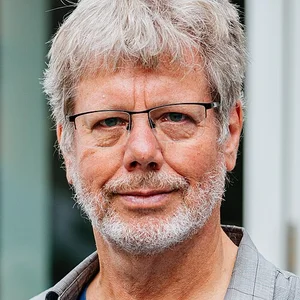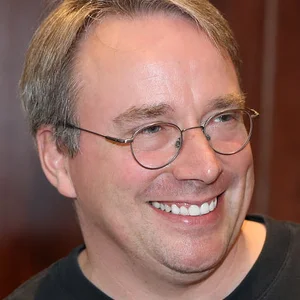

Finnish computer engineer born in 1969, Linus Torvalds is the creator of the Linux kernel in 1991, which became the most widely used open source operating system in the world. He also developed Git, a version control tool used by millions of developers.
Linus Torvalds(1969 — ?)
Linus Torvalds
États-Unis, Finlande
8 min read
Frequently asked questions
Famous Quotes
« Software is like sex: it's better when it's free.»
« Talk is cheap. Show me the code.»
Key Facts
- 1969: born in Helsinki, Finland
- 1991: creation and release of the Linux kernel (version 0.01) at age 21
- 1994: release of Linux 1.0 under the GPL license
- 2005: creation of Git, a distributed version control tool
- 2012: awarded the Millennium Technology Prize in Finland
Works & Achievements
First public release of the Linux kernel, published when Torvalds was only 21 years old. This code of a few thousand lines would go on to become the foundation of the most widely used operating system in servers, smartphones (Android), and supercomputers.
First stable, official release of the kernel, with 176,250 lines of code and support for multiple hardware architectures. This milestone marks the project's maturity and triggered widespread adoption by companies and universities.
Autobiography co-written with David Diamond in which Torvalds recounts his life, the creation of Linux, and his philosophy. He explains that human motivations follow a hierarchy — survival, social life, then entertainment — and that Linux was created above all for the fun of it.
Distributed version control system created by Torvalds in ten days. Git is now the essential collaboration tool for developers, used on platforms such as GitHub and GitLab by more than 100 million people worldwide.
Anecdotes
On August 25, 1991, Linus Torvalds posted a message on the Usenet forum comp.os.minix: “Hello everybody out there using minix — I'm doing a (free) operating system (just a hobby, won't be big and professional like gnu) for 386(486) AT clones.” He was then a 21-year-old student at the University of Helsinki. This modest message would mark the beginning of a worldwide technological revolution.
Originally, Torvalds wanted to call his operating system “Freax.” It was Ari Lemmke, the administrator of the university's FTP server where the code was uploaded, who decided to name the directory “Linux” — a blend of “Linus” and “Unix.” The name stuck, and Torvalds eventually adopted it without protest.
Linux's mascot, the penguin Tux, was chosen after Torvalds recounted being bitten by a penguin during a visit to a zoo in Australia. He jokingly claimed to have suffered from “penguin fever” ever since. Graphic designer Larry Ewing drew Tux in 1996, and the contented little penguin became one of the most recognizable icons in the computing world.
In 2005, Torvalds created Git in just ten days following a falling out with the company BitKeeper, whose version control tool he had been using. Frustrated by the lack of a fast, free distributed tool, he developed Git himself — and within a few years it became the global standard, used by more than 100 million developers through platforms like GitHub.
Known for his sometimes blunt frankness, Torvalds manages the Linux kernel community through public mailing lists where he does not hesitate to harshly criticize poor contributions. In 2018, under pressure from the community, he publicly apologized for his aggressive behavior and took a break to “understand emotions and communicate better with others.”
Primary Sources
Hello everybody out there using minix — I'm doing a (free) operating system (just a hobby, won't be big and professional like gnu) for 386(486) AT clones.
This is version 0.01 of Linux. It is not in any way a complete OS, and it has no kernel support for networking, etc. This is intended to replace Minix.
An operating system is the software that directly manages the hardware and acts as a bridge between the hardware and the programs that run on it. Linux is a good operating system. It's free. And you can change it.
'git' can mean anything, depending on your mood: random three-letter combination that is pronounceable; stupid, contemptible; 'global information tracker' when it actually works for you; 'goddamn idiotic truckload of sh*t' when it breaks.
I'm perfectly happy with all the people who are using Linux on Android, even if they don't ever really think about Linux. I think that's great. That's the goal: to be part of the background infrastructure that people don't need to worry about.
Key Places
Linus Torvalds's birthplace, where he grew up in a household of journalists and mathematicians. His maternal grandfather, a statistician at the university, introduced him to programming on a Commodore VIC-20 during his childhood.
It was here that Torvalds, a computer science student, developed the Linux kernel between 1990 and 1991. The university's server room hosted the first public versions of the code.
Torvalds moved to California in 1997 to work at Transmeta, a microprocessor company. This period allowed him to devote professional time to the development of the Linux kernel.
Since the 2010s, Torvalds has lived in the Portland area, where he continues to work on Linux kernel development for the Linux Foundation from a home office.
Typical Objects

The command-line interface has been Torvalds's everyday tool since the very beginning. It is through a terminal that he writes, compiles, and tests the Linux kernel.

It was on this model of personal computer, purchased in 1990, that Torvalds developed the earliest versions of Linux, pushing the Intel 386 processor to its limits.

Millions of lines of C and assembly code, the product of decades of contributions from around the world. Torvalds remains its principal integrator, reviewing every change before it is merged.

It was on this server that the Linux kernel was first made available online in September 1991, allowing anyone in the world to download and freely modify it.

The penguin Tux, drawn in 1996 by Larry Ewing, is the official symbol of Linux. Torvalds himself chose this logo after sharing a humorous anecdote about being nipped by a penguin in Australia.

Torvalds, like many developers of his generation, pays particular attention to his keyboard. He has expressed a preference for mechanical keyboards that allow him to code for long hours without fatigue.
School Curriculum
Vocabulary & Tags
Key Vocabulary
Tags
Daily Life
Morning
Torvalds starts his day early by going through his email and the Linux kernel mailing lists. He reviews contributions ("patches") submitted by developers from around the world, deciding which ones deserve to be merged into the main codebase.
Afternoon
The afternoon is devoted to reading and evaluating code. Torvalds examines proposed changes, tests new features on his local machine, and responds — sometimes with biting frankness — to contributing developers from all over the world.
Evening
Torvalds is the father of three daughters and places great importance on family life. In the evenings, he often disconnects from the computing world entirely. An avid scuba diver, he pursues the sport outside of work as a counterpoint to his long hours in front of a screen.
Food
Torvalds leads an ordinary daily life when it comes to food. Like many developers of his generation, coffee plays a central role in his working days, and he has mentioned in interviews from his early years in the United States a certain nostalgia for Finnish cuisine.
Clothing
Torvalds is known for his very casual style: jeans, plain T-shirts, or shirts bearing the Linux logo. He embodies the anti-formal aesthetic of hacker culture, far removed from the dress codes of traditional Silicon Valley business circles.
Housing
After a student apartment in Helsinki, Torvalds settled in the California suburbs when he moved to the United States in 1997. Since the 2010s he has lived in a house in the Portland, Oregon area, complete with a home office from which he oversees the global development of the Linux kernel.
Historical Timeline
Period Vocabulary
Liens externes & ressources
Références
Œuvres
Noyau Linux 0.01
Septembre 1991
Noyau Linux 1.0
14 mars 1994
Just for Fun: The Story of an Accidental Revolutionary
2001
Git
Avril 2005