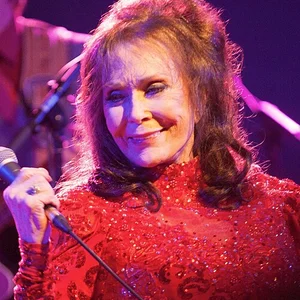

American singer-songwriter, Loretta Lynn is one of the founding figures of country music. Born into a poor family in the Appalachians, she authentically sang about the lives of rural American women, their joys and struggles.
Frequently asked questions
Famous Quotes
« I was a fool to ever leave your side.»
« Don't come home a-drinkin' with lovin' on your mind.»
Key Facts
- Born April 14, 1932 in Butcher Hollow, Kentucky, into a very modest Appalachian family
- Her album 'Coal Miner's Daughter' (1970) tells of her poor childhood and becomes a symbol of autobiographical country music
- First woman to be named Entertainer of the Year by the Country Music Association (1972)
- Songs like 'The Pill' (1975) address birth control, sparking censorship and public debate
- Died October 4, 2022, she remains one of the most influential country artists of the 20th century
Works & Achievements
Her first major success that launched her career. Recorded with $100 from her husband's salary, this song talks about women's lives in country bars.
Her autobiographical anthem celebrating her humble origins and the pride of working people. This song became Loretta's musical identity and a feminist statement.
A groundbreaking song that denounces alcoholism and domestic violence. It expresses a woman's refusal to tolerate her husband's violent behavior.
A radical song about contraception and women's reproductive freedom. Many radio stations refused to play it, but it became a feminist anthem.
Her autobiographical memoir recounting her life from Appalachian poverty to stardom. This book inspired the 1980 film of the same name.
The film based on her autobiography, starring Sissy Spacek as Loretta. This film cemented her legend and showed the world her extraordinary journey.
Anecdotes
Loretta Lynn wrote "The Pill" in 1972, a revolutionary song about contraception that shocked conservatives but liberated rural women. Many radio stations refused to play it, yet it became a feminist anthem despite the social taboos of the time.
Born in a cabin without electricity in the Appalachian Mountains of Kentucky in 1932, Loretta learned guitar at twelve by listening to her neighbors. She performed on local radio as early as 1946, then left the area to conquer Nashville with her husband at age 18.
In 1960, her first real song "I'm a Honky Tonk Girl" was recorded with her husband's money, $100. She distributed it herself by car to radio stations, which made her known and launched her toward a legendary career.
Loretta won the Grammy Award for Best Female Country Vocal Performance in 1973 for "Don't Come Home A'Drinkin' (With Lovin' on Your Mind)," an anthem against alcoholism and abuse in poor households.
She was one of the few country singers to publicly address feminist topics in her songs: contraception, divorce, abortion, and women's rights at work, which was revolutionary in rural America.
Primary Sources
"I came from a poor family, my father worked in the mine, and we had nothing. But I had a voice, and my voice was my only chance to escape."
"I sing for women like me, the ones nobody listens to. I sing their suffering, their dreams, their secrets."
"You wined me and dined me when I was your only wife / And chased all my bad dreams away when the Sandman came at night."
"We Appalachian women don't talk about those things. But I'm going to sing about them, whether they like it or not, because it's the truth."
Key Places
The hamlet where Loretta was born in 1932, a cabin without electricity in the heart of the Appalachians. This poor, rural place shaped her identity and her songs.
The capital of country music where Loretta moved at age 18 with her husband. She recorded her greatest hits there at the Decca Records studios.
The temple of country music where Loretta performed regularly from the 1960s onward. It was the ultimate dream of every country singer.
The historic theater where Loretta and the greatest country artists performed. Her concerts there were major cultural events.
Where the Lynn family emigrated in 1955 in search of work. Loretta continued her musical career there before conquering Nashville.
Typical Objects

Loretta learned to play on a cheap guitar at age 12, an instrument that became her lifelong companion. She used it to compose her songs about the suffering and joy of rural women.

“I'm a Honky Tonk Girl” and “Coal Miner's Daughter” were 45s that country families played on their phonographs. These small records carried Loretta’s voice across rural America.

Loretta conquered the big stages of the Ryman Auditorium (Grand Ole Opry) with a simple microphone, her powerful voice and raw emotions captivating thousands of spectators.

Loretta wore sparkling dresses on stage, a mix of urban glamour and country tradition, reflecting her transformation from a poor child to an international star.

Loretta wrote her own songs in notebooks, often late at night, inspired by the stories she heard from women in her community.

Appalachian women gathered around card games to talk in secret. Loretta mentioned them in her songs as a moment of freedom away from husbands.
School Curriculum
Vocabulary & Tags
Key Vocabulary
Tags
Daily Life
Morning
Loretta woke up early, before dawn, like the women of Appalachia. She would pour herself a strong, plain cup of coffee, then sit down with her guitar to write new songs, inspired by the stories of the women she knew.
Afternoon
During the day, she managed her household, looked after her children, and worked on her music. From the 1960s onward, she spent time in recording studios in Nashville, sharing meals with other country musicians.
Evening
In the evenings, Loretta got ready for performances at the Grand Ole Opry or in honky-tonks. She carefully applied her makeup, slipped into her sequined gowns, then took the stage to captivate her audience for two or three hours.
Food
Loretta ate the simple food of Appalachia: cornbread, beans, salt pork, canned vegetables, and sweet tea. Despite her comfortable adult life, she loved home-cooked meals and kept her roots at the table.
Clothing
She wore worn peasant dresses in her youth, then sequined, glamorous gowns on stage. In private, she preferred jeans, comfortable shirts, and boots, effortlessly blending rural style with country star flair.
Housing
Loretta grew up in a cabin with no electricity or running water, then settled in a modest house in Nashville. Later, she built an impressive estate in Tennessee, while keeping a home tied to her roots in Kentucky.
Historical Timeline
Period Vocabulary
Visual Style
Le style visuel de Loretta Lynn mêle l'authenticité rurale des Appalaches et le glamour de la scène country. Du denim usé de son enfance pauvre aux robes paillettées scintillantes des concerts, elle incarne la transformation d'une femme invisible en icône culturelle.
Sound Ambience
L'ambiance sonore de Loretta Lynn est celle de la musique country acoustique brute des Appalaches, mêlant fragilité et force. Sa voix rauque et puissante porte la fatigue des femmes rurales et l'espoir de celles qui refusent de se plier.