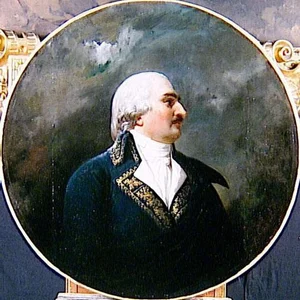
A French officer of the First Empire, Louis-Pierre-Pantaléon Resnier was a Napoleonic dignitary who served in the military and administrative structures of the Empire. He embodies the profile of the provincial notable elevated by Napoleonic reforms.
Louis-Pierre-Pantaléon Resnier(1752 — 1807)
Louis-Pierre-Pantaléon Resnier
France
7 min read
Frequently asked questions
Key Facts
- Active figure under the First Empire (1804–1814)
- Classified as a French political personality in biographical sources
- Representative of the corps of Napoleonic dignitaries and officers
Works & Achievements
Resnier's primary legacy was his steadfast service in the French armies throughout the Revolutionary and Napoleonic Wars. His career embodies the trajectory of officers who served under successive regimes while maintaining an unwavering loyalty to France.
Within the prefectural and military structures established by Napoleon, Resnier contributed to the administrative organization of imperial France, serving as the link between the central power in Paris and the realities of the provinces.
As an active officer of the First Empire, Resnier took part in the military operations that enabled Napoleon to dominate continental Europe, contributing to the collective effort of a generation of soldier-administrators.
Anecdotes
Born in 1752 during the reign of Louis XV, Resnier lived through one of the most turbulent periods in French history. Trained in arms under the Ancien Régime, he had to adapt both his skills and his loyalties through a succession of regimes — monarchy, Republic, Consulate, Empire — embodying the shared fate of provincial officers who chose to serve their country rather than emigrate.
Like thousands of military officers of his generation, Resnier swore several successive oaths: to the monarchy, then to the Republic during the levée en masse of 1793, then to Consul Bonaparte after 18 Brumaire. This loyalty to institutions rather than to rulers was precisely the profile Napoleon sought when filling his administration.
The Napoleonic reforms — notably the creation of the prefectures in 1800 and the establishment of the Légion d'honneur in 1802 — opened career prospects to men like Resnier that the Ancien Régime would have denied them. Merit, competence, and loyalty to the Emperor now mattered far more than noble lineage.
In 1807, the year of his death, Resnier could follow from his post Napoleon's glorious trajectory at its peak: the Battle of Eylau in February, the decisive victory at Friedland in June, and then the Treaties of Tilsit, which made France the dominant power on the European continent — a greatness to which he had contributed in his own way.
Primary Sources
Officer who served with steadfastness in the armies of the Republic and the Empire, proposed by his superior officers in recognition of his military and administrative services rendered to the homeland.
Resnier (Louis-Pierre-Pantaléon), officer, born 1752; having served in the infantry corps under the Republic and subsequently in military and administrative capacities under the First Empire.
It is ordered that the said Resnier shall continue to discharge his duties in accordance with the provisions established by the present ministry, ensuring good order and discipline within the scope of his jurisdiction.
Key Places
Born in 1752 in the France of the Ancien Régime, Resnier belonged to the generation of provincial notables educated under the monarchy who managed to adapt to the upheavals of the Revolution and then find their place within the Napoleonic administrative structures.
The administrative heart of the Napoleonic army, the Ministry of War was the hub through which appointments, promotions, and orders concerning all officers of the Empire — including Resnier — were processed.
Officers of the First Empire such as Resnier took part in the great Napoleonic campaigns in Italy, Germany, and Poland. These experiences shaped their careers and their understanding of the wider world.
The network of prefectures established in 1800 formed the institutional framework within which notables like Resnier carried out their civil and military responsibilities in the service of the Empire.
Typical Objects

Two-horned black felt hat characteristic of Napoleonic officers, worn perpendicular to the shoulders. An immediately recognizable symbol of Imperial military authority, it distinguished the officer from the common soldier wearing a shako.

Gold-hilted sword worn by officers and dignitaries of the Empire during ceremonies and reviews. It visually distinguished those of rank and symbolized their status as well as their right to command.

Blue uniform with colored facings according to the branch of service, adorned with gold epaulettes indicating rank and buttons stamped with the Imperial eagle. Strictly regulated by decree, it allowed one to recognize at a glance the rank and unit of its wearer.

Official document signed by the Minister of War attesting to the rank and duties conferred upon the officer. The commission was the fundamental title of legitimacy for any career soldier under the Empire.

Everyday working tools of every administrator and staff officer. The reports, orders of the day, and correspondence that kept the Napoleonic administrative machine running were written with a trimmed quill and black ink.

Blue, white, and red fabric badge worn on the hat since the Revolution of 1789. Retained under the Empire, the tricolor cockade symbolized belonging to the French nation and distinguished the republican and later Imperial soldier.

Tall black leather boots indispensable to every staff or cavalry officer. They protected the legs during rides and served as a distinctive mark of military rank, differentiating the mounted officer from the infantry soldier.
School Curriculum
Vocabulary & Tags
Key Vocabulary
Daily Life
Morning
The day of a Napoleonic officer-administrator began at dawn. Resnier rose early to don his regulation uniform, washed quickly, and ate a frugal meal — black coffee, bread, and cheese — before reporting to his post for the morning review or roll call.
Afternoon
The afternoon was devoted to administrative tasks: drafting reports with a quill pen, reading official correspondence, and holding meetings with subordinates and local dignitaries. Paperwork was the central tool of every Napoleonic official; a short ride on horseback sometimes offered a breath of fresh air between work sessions.
Evening
Evenings took two forms depending on the context: on campaign, they were austere, spent by candlelight studying maps and the next day's orders; in garrison, they gave way to dinners among officers where they discussed the bulletins of the Grande Armée and news from the various theatres of operations.
Food
The diet of a mid-ranking officer under the Empire was plain but nourishing: soup, boiled or roasted meat, seasonal vegetables, brown bread, and wine diluted with water. On campaign, soldiers made do with hardtack, salt pork, and whatever the local countryside could provide. Victories called for more festive meals.
Clothing
The blue uniform with coloured lapels, eagle-embossed gilt buttons, and gold epaulettes indicating rank was mandatory while on duty. Off duty, the civilian dress of the late eighteenth century — a dark frock coat, breeches, white stockings, and a knotted white cravat — remained the standard attire of a provincial notable of his generation.
Housing
In garrison, Resnier lodged in officers' quarters or a townhouse. A typical interior included a bedroom, a study for administrative work, and a reception room for receiving colleagues and constituents. Mahogany furniture with gilded bronze mounts in the Directoire and then Empire style adorned the interiors of notables of the era.
Historical Timeline
Period Vocabulary
Liens externes & ressources
Références
Œuvres
Service militaire sous la République et l'Empire (1792-1807)
1792-1807
Exercice de fonctions administratives napoléoniennes
1800-1807