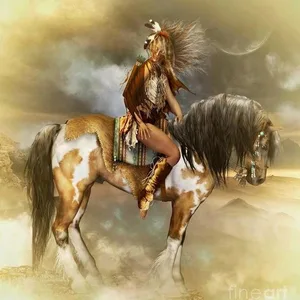

Chiricahua Apache warrior and shaman, sister of Chief Victorio. Renowned for her skill in combat and her spiritual power to locate the enemy, she fought the American and Mexican armies, then alongside Geronimo until the surrender of 1886.
Lozen(1840 — 1889)
Lozen
6 min read
Frequently asked questions
Key Facts
- Born around 1840 into the Chihenne band (Chiricahua Apaches), sister of Chief Victorio
- Took part in Victorio's campaigns against the American and Mexican armies in the 1870s and 1880s
- Survived Victorio's death at Tres Castillos (1880) because she was absent during the ambush
- Joined Geronimo and fought until the Apache surrender of 1886
- Taken prisoner and deported to Alabama, she died of tuberculosis around 1889 at Mount Vernon Barracks
Works & Achievements
A spiritual rite unique to Lozen, in which she “felt” through her palms the direction and distance of enemy troops, making her an irreplaceable scout.
The evacuation of women and children across a flooded river under enemy threat, a feat that sealed her reputation as a protector.
Her role as warrior, advisor, and rear guard in her brother's campaign against the American and Mexican armies.
Lozen accompanies the old chief Nana on a raid of more than a thousand kilometers across New Mexico, one of the most daring of the Apache Wars.
Combat and reconnaissance missions in the Sierra Madre up to the surrender of 1886; Lozen is said to have taken part in the negotiations with the army.
Beyond combat, Lozen assisted with births and tended to her people, blending spiritual knowledge with practical care at the camp.
Anecdotes
According to Chiricahua tradition, Lozen possessed a spiritual “power” to locate the enemy. During a ceremony, she would spread her arms toward the sky, palms open, then slowly turn in place: her hands would tingle and her skin would change color in the direction of the soldiers, the intensity revealing the distance. Her companions relied on it to guide the families' flight.
Her brother, Chief Victorio, is said to have called her “strong as a man, braver than most, and cunning in strategy,” adding that “Lozen is a shield to her people.” It is a rare account of a woman warrior respected as the equal of men in the Apache council.
During one retreat, Lozen is said to have led women and children across the flooded Rio Grande, riding her horse into the current to open the way before returning to fight in the rear guard. Her reputation rested as much on her courage as on her reliability in battle.
In October 1880, during the disaster at Tres Castillos where Victorio and most of his band were killed, Lozen was absent: she was escorting a young mother and her newborn to a reservation. Some Apache accounts suggest that her presence might have changed the outcome of the battle.
After Geronimo's surrender in 1886, Lozen was deported as a prisoner of war to the eastern United States. She died of tuberculosis around 1889 at Mount Vernon Barracks, in Alabama, far from the mountains of her childhood, never to see her homeland again.
Primary Sources
“Lozen is my right hand... strong as a man, braver than most, and cunning in strategy. Lozen is a shield to her people.” (words of Victorio reported by the Apache survivors)
“Upon this earth on which we live, Ussen holds the Power. This Power is mine, for locating the enemy.”
The accounts describe Lozen spreading her arms and turning in place to sense, through the tingling and color of her palms, the direction and distance of the enemy.
Key Places
Region of hot springs, homeland of the Chihenne band of Lozen and Victorio, which they defended against forced relocation.
Arid, unhealthy reservation where the army sought to gather all the Apaches; the refusal to live there drove Victorio and Lozen to take up arms again.
Site of the Mexican ambush of October 1880 in which Victorio and most of his band were killed; Lozen was absent.
Mountain range that served as a refuge for the last Apache holdouts, including Geronimo and Lozen, during the 1885-1886 campaign.
Site of Geronimo's final surrender on September 4, 1886; Lozen was part of the last group of holdouts.
Barracks where the Chiricahuas were held as prisoners of war; Lozen died there of tuberculosis around 1889.
Typical Objects

Repeating rifle often captured from the enemy or obtained in trade, an essential weapon of Apache warriors in their raids and ambushes.

A silent weapon that spares ammunition, made of wood and sinew, used for hunting as well as close combat.

A versatile blade worn on the belt, used for combat, skinning game, and the daily tasks of camp life.

A mount essential to Apache mobility, enabling swift raids, long flights across the desert, and crossings of flooded rivers.

A small leather pouch holding sacred pollen (hoddentin), herbs, and objects of power, tied to Lozen's spiritual gifts and her protection.

A supple garment of tanned leather and tall Apache boots (n'deh b'keh) with upturned toes, suited to long marches through the desert and mountains.

A belt lined with cartridges worn across the shoulder, a symbol of Apache warriors on campaign and a guarantee of self-sufficiency in combat.
School Curriculum
Vocabulary & Tags
Key Vocabulary
Tags
Daily Life
Morning
At camp, the day begins before dawn: the fire is rekindled, the horses are checked, and the surroundings are watched. Lozen, standing guard or preparing for a move, shared the warriors' tasks rather than those usually reserved for women.
Afternoon
Afternoons were spent maintaining weapons, scouting trails, and organizing raids or retreats. On campaign, Lozen led reconnaissance and used her “power” to locate the enemy before any movement.
Evening
In the evening, the band gathered around the fire to eat, tell stories, and plan what came next. Ceremonies, prayers to Ussen, and songs often accompanied these moments, which were essential to the cohesion of a people on the run.
Food
Their diet relied on game (deer, rabbit, wild turkey), the fruit of the mescal cooked in pits, mesquite seeds, berries, and corn obtained through trade or raids. In wartime, food was scarce and they often had to make do with little.
Clothing
Lozen wore garments of soft tanned leather and tall Apache moccasin-boots (*n'deh b'keh*) with upturned toes, protecting against cactus and rocks. A headband, cartridge belt, and weapon completed her warrior's outfit.
Housing
The Chiricahuas lived in wickiups, dome-shaped shelters made of a frame of branches covered with grass, hides, or canvas. Easy to put up and to abandon, they suited a nomadic life and constant flight.
Historical Timeline
Period Vocabulary
Liens externes & ressources
Références
Œuvres
Cérémonie de localisation de l'ennemi
années 1870-1880
Traversée du Rio Grande pour les familles
vers 1880
Participation à la guerre de Victorio
1879-1880
Raid de Nana (1881)
1881
Campagne finale aux côtés de Geronimo
1885-1886
Rôle de guérisseuse et de sage-femme
tout au long de sa vie