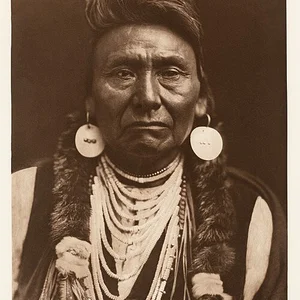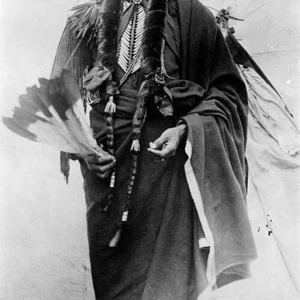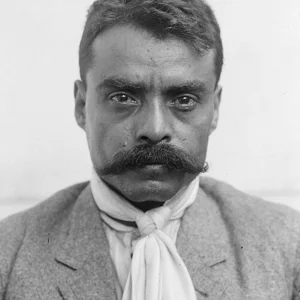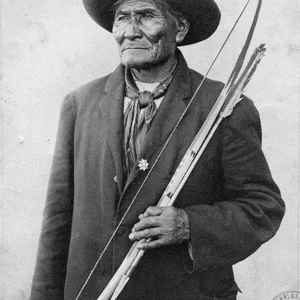

A Chiricahua Apache war leader and medicine man, Geronimo led the armed resistance against the expansion of the United States and Mexico in the American Southwest. His surrender in 1886 marked the end of the great Indian Wars.
Geronimo(1829 — 1909)
Geronimo
États-Unis, Mexique
6 min read
Frequently asked questions
Famous Quotes
« I was born on the prairies where the wind blew free and there was nothing to break the light of the sun.»
Key Facts
- Born around 1829 in the region of the upper Gila River (present-day New Mexico/Arizona)
- In 1858, his family was massacred by Mexican soldiers, triggering his armed struggle
- Led raids against Mexican and American forces for decades
- Surrendered for good to General Nelson Miles on September 4, 1886, the last great Apache surrender
- Died a prisoner of war at Fort Sill (Oklahoma) on February 17, 1909
Works & Achievements
After the massacre of his family, Geronimo led numerous raids against Mexican towns and the Mexican army, becoming a feared war leader.
He fought American expansion into the Southwest, taking part in the clashes that followed the Bascom Affair and the Battle of Apache Pass.
Refusing confinement, he fled repeatedly toward the Sierra Madre, holding off thousands of soldiers with a handful of warriors.
His surrender to General Miles at Skeleton Canyon brought the great Indian Wars to an end, a major event in the history of the American West.
An autobiographical account dictated to S. M. Barrett, a rare firsthand testimony of a Native American leader's perspective on the conquest of his lands.
His participation in Theodore Roosevelt's inauguration made him a national celebrity, an ambiguous symbol of a “pacified” West.
Anecdotes
Geronimo's real name was Goyahkla, "the one who yawns." The name "Geronimo" was given to him by Mexican soldiers: panic-stricken during his attacks, they would call upon Saint Jerome by shouting "Jeronimo!" The nickname stuck for the rest of his life.
In 1851, while returning from a village with other warriors, Geronimo learned that Mexican soldiers had attacked his camp at Janos. His mother, his wife Alope, and his three young children had been killed. This tragedy fueled his hatred and his resistance for decades.
Geronimo had a reputation for supernatural power among the Apaches: it was said that he could sense danger and that bullets could not touch him. By the end of his career, the American and Mexican armies had to mobilize thousands of soldiers to capture his small band of around thirty people.
In 1905, having become a famous prisoner, Geronimo rode on horseback in the inauguration parade of President Theodore Roosevelt in Washington. That same year, he dictated his memoirs and asked the president in vain for permission to return to his native Arizona to die.
Geronimo died a prisoner of war in 1909, at Fort Sill, without ever being able to return home. He had fallen from his horse one cold night and lay on the ground for hours before being found, contracting the pneumonia that took his life.
Primary Sources
I was born in No-doyohn Cañon, Arizona, in June 1829.
Mexican troops had attacked our camp, killed the warriors on guard, captured our horses, and killed many of our women and children.
Once I moved about like the wind. Now I surrender to you, and that is all.
There is no better country in the world than the White Mountains; I long to return there.
Key Places
Region at the headwaters of the Gila River where Geronimo was born and raised, in the heart of Chiricahua territory, between present-day Arizona and New Mexico.
Town near the site of the Kas-ki-yeh massacre in 1851, where Mexican soldiers killed Geronimo's family.
Arid and unhealthy reservation where the Apache were forcibly gathered; Geronimo escaped from it several times to take up the fight again.
Site of Geronimo's final surrender to General Nelson Miles on September 4, 1886, marking the end of the great Indian Wars.
Former Spanish fort turned into a place of detention where the captured Apache were sent, far from their native desert.
Geronimo's final place of captivity, where he lived out his last years and died in 1909, still a prisoner of war. He is buried there.
Typical Objects

A silent weapon made of mulberry wood, with stone- or metal-tipped arrows. Ideal for hunting and fighting without revealing one's position.

A long, sharp-tipped spear used in hand-to-hand combat and during raids. A symbol of warrior status.

A Winchester- or Springfield-type carbine, often taken from the enemy. It gave Apache warriors new firepower against the army.

A sacred cord adorned with beads and shells, worn across the body. It was believed to protect its wearer and to grant strength and clear-sightedness.

Tall, soft leather boots, folded down below the knee and fitted with an upturned toe to protect against desert cacti and rocks.

A versatile tool and weapon, used for hunting, skinning, crafting objects, and close combat.

A wide cloth band tied around the forehead, a distinctive mark of Apache warriors, which held back the hair and shielded against the sun.
School Curriculum
Vocabulary & Tags
Key Vocabulary
Tags
Daily Life
Morning
In free Apache life, the day began early: the men checked the horses and prepared weapons and equipment, while the community kept watch over the safety of the camp. In times of war, Geronimo scouted the trails and organized the band's movements.
Afternoon
The afternoon was devoted to hunting, raiding, or searching for food and water in the desert and the mountains. The Apaches covered considerable distances on foot or on horseback, renowned for their exceptional endurance.
Evening
In the evening, around the fire, they shared meals, told stories, and passed on knowledge and beliefs. As a medicine man, Geronimo also held a spiritual role there, leading prayers and ceremonies.
Food
Their diet relied on hunting (deer, rabbit), gathering desert plants, and the cooked heart of the agave (mescal), a staple food. They also ate seeds, wild fruits, and the spoils of raids or trade.
Clothing
They wore clothing of leather and cloth, a breechcloth or tunic, a headband tied around the forehead, and high moccasin-boots suited to the desert. Cords and amulets could be added for spiritual protection.
Housing
The Chiricahuas lived in wickiups, dome-shaped huts made of a frame of branches covered with grasses or hides. Light and quick to set up, they suited a semi-nomadic people who moved often.
Historical Timeline
Period Vocabulary
Liens externes & ressources
Références
Œuvres
Résistance contre le Mexique
à partir de 1851
Guerres apaches aux côtés de Cochise
1861-1872
Évasions de la réserve de San Carlos
1878-1886
Reddition finale de 1886
4 septembre 1886
Geronimo's Story of His Life (mémoires)
1906
Apparition au défilé présidentiel de 1905
1905