
An American outlaw of the Old West, Butch Cassidy was the leader of the Wild Bunch gang, which specialized in robbing banks and trains. Hunted by detective agencies, he fled to South America, where he is believed to have met his death in Bolivia.
Butch Cassidy(1866 — 1908)
Butch Cassidy
États-Unis
6 min read
Frequently asked questions
Key Facts
- Born in 1866 in Beaver, Utah, into a family of Mormon pioneers, under the name Robert LeRoy Parker
- Became the leader of the Wild Bunch in the 1890s, a gang that robbed banks and trains across the American West
- Hunted by the Pinkerton detective agency, he fled with the Sundance Kid to Argentina and then Bolivia around 1901
- Is believed to have died in a shootout with the Bolivian army at San Vicente in 1908 (the circumstances remain uncertain)
- His legend was popularized by the film “Butch Cassidy and the Sundance Kid” (1969)
Works & Achievements
The first major heist attributed to Cassidy, who escaped with around 21,000 dollars: the beginning of his career as an outlaw.
A robbery carried out shortly after his release from prison, marking the formation of the Wild Bunch.
Together with Elzy Lay, Cassidy stole the coal miners' payroll, a daring heist in broad daylight.
The gang blew open the mail car's safe with dynamite: one of its most famous train robberies.
Another attack on a Union Pacific train, which prompted the company to launch special trains filled with pursuers.
The gang's last major American heist before fleeing to South America.
An attempt at a settled life as a rancher in Patagonia, under a false identity, that lasted only a few years.
Anecdotes
Butch Cassidy was not really his name: he was born Robert LeRoy Parker, into a Mormon family in Utah, and was the eldest of thirteen children. He took the name “Cassidy” in tribute to Mike Cassidy, a cattle rustler who taught him the trade of guns, and the nickname “Butch” stuck after a job as a butcher in Rock Springs, Wyoming.
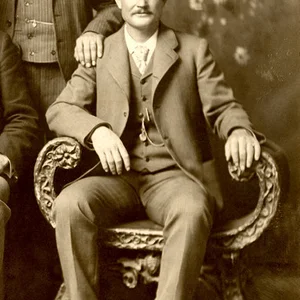
In 1900, in Fort Worth, Texas, Cassidy and four members of the Wild Bunch had the bad idea of proudly posing at a photographer's studio, dressed in suits and bowler hats. The photo, nicknamed the “Fort Worth Five,” was obtained by the Pinkerton agency, which used it to produce wanted posters: their own souvenir snapshot helped to track them down.
Tired of being hunted in the United States, Cassidy fled in 1901 to Argentina with the Sundance Kid and Etta Place. There, in Patagonia, near the village of Cholila, they bought a ranch and raised cattle for a few years, living as honest ranchers under false names.
The death of Butch Cassidy remains a mystery. The most widespread version tells that he perished in November 1908 during a shootout with soldiers in San Vicente, Bolivia, alongside the Sundance Kid. But no body was ever formally identified, and relatives claimed to have seen him alive in the United States years later.
Cassidy's gang was nicknamed the “Wild Bunch,” and its most famous hideout was the “Hole-in-the-Wall,” a Wyoming valley accessible by a single narrow passage, impossible for sheriffs to attack by surprise.
Primary Sources
I should indeed have written to you much sooner, but I kept putting it off… I love this country, and I am very happy here, even though it is so far from all my friends and everything I love.
Wanted — George Parker, alias “Butch” Cassidy, alias George Cassidy: bank and train robbery, criminal conspiracy.
George Cassidy, convicted of horse theft; admitted on July 15, 1894, declared occupation: cowboy.
The express train was stopped at night near Wilcox by masked men who blew open the safe with dynamite and made off with several thousand dollars.
Key Places
Town in Utah where Robert LeRoy Parker was born in 1866, into a family of Mormon pioneers.
Mining town where Cassidy carried out his first major heist in 1889, the robbery of the San Miguel Valley Bank.
Isolated Wyoming valley, reachable through a single narrow pass, that served as a hideout for the Wild Bunch and other outlaw gangs.
Prison where Cassidy served a sentence for horse theft between 1894 and 1896, his only known incarceration.
Patagonian village where Cassidy, the Sundance Kid, and Etta Place bought a ranch and lived as cattle ranchers after fleeing the United States.
Village in the Bolivian Andes where Cassidy is said to have met his death in 1908 during a shootout with soldiers.
Typical Objects

A .45 caliber revolver, the iconic weapon of the cowboys and outlaws of the West. Reliable and rugged, it was worn on the belt in a leather holster.

A repeating rifle able to fire several shots in quick succession thanks to its underlever. Nicknamed “the gun that won the West,” it was used both on horseback and on foot.

An explosive invented by Nobel, used by the Wild Bunch to blow open the safes of mail cars and banks. A poorly measured charge could destroy the entire loot along with the safe.

A wide-brimmed felt hat that protected against sun and rain during long rides. A true sartorial signature of the men of the West.

A poster printed by the police or detective agencies describing the outlaw and promising a reward for his capture. Those for Cassidy sometimes featured his own photograph.

A sturdy leather saddle, fitted with a horn to secure the lasso, essential for long flights across the plains. The horse was the only way to escape pursuers.
School Curriculum
Vocabulary & Tags
Key Vocabulary
Tags
Daily Life
Morning
During his years on the run, the morning began early, often on horseback, to scout escape routes or stake out a bank. On his Argentine ranch, he rose with the sun to tend the cattle like any other rancher.
Afternoon
Afternoons were devoted to the meticulous planning of his jobs: relays of fresh horses hidden along the route, scouting train stations and safes. In Patagonia, he plowed the fields, branded the cattle, and bargained with the neighbors.
Evening
In the evening, the gang would gather in a remote camp or a discreet saloon to split the loot and plan their next move. Cassidy, known to be affable and easygoing, loved playing cards and chatting around the fire.
Food
The diet of the men of the West was rough: beans, salt pork, flour cakes (“biscuits”), black coffee, and beef or game grilled over the campfire. On his ranch, Cassidy ate more mutton and fresh produce.
Clothing
Cassidy wore the classic cowboy outfit: cotton shirt, vest, sturdy canvas trousers, spurred boots, neckerchief, and wide-brimmed hat. For the famous Fort Worth photograph, the gang dressed up in dark suits and bowler hats.
Housing
On the run, he lived in rough hideouts like the Hole-in-the-Wall or Robbers Roost, sleeping under the stars or in a tent. In Argentina, he lived in a simple log cabin, then a ranch house in Patagonia.
Historical Timeline
Period Vocabulary
Liens externes & ressources
Références
Œuvres
Braquage de la banque San Miguel Valley (Telluride)
1889
Vol de la banque de Montpelier (Idaho)
1896
Vol de la paie de Castle Gate (Utah)
1897
Braquage du train de Wilcox (Union Pacific)
1899
Braquage du train de Tipton
1900
Vol de la First National Bank de Winnemucca (Nevada)
1900
Fondation du ranch de Cholila (Argentine)
1901