 flip
flipHerbed Yupqa
Herbed Yupqa
Why this dish? The term yupqa (thin layered dough) appears in the Dîwân. Al-Kashgari, while documenting the dialects of nomads around Lake Issyk-Kul and the Tian Shan, observed this technique of fat-layered flatbread that travelers carried rolled in a cloth. This compact, nourishing bread is suited to the encyclopedist's long journeys between his fieldwork sites.
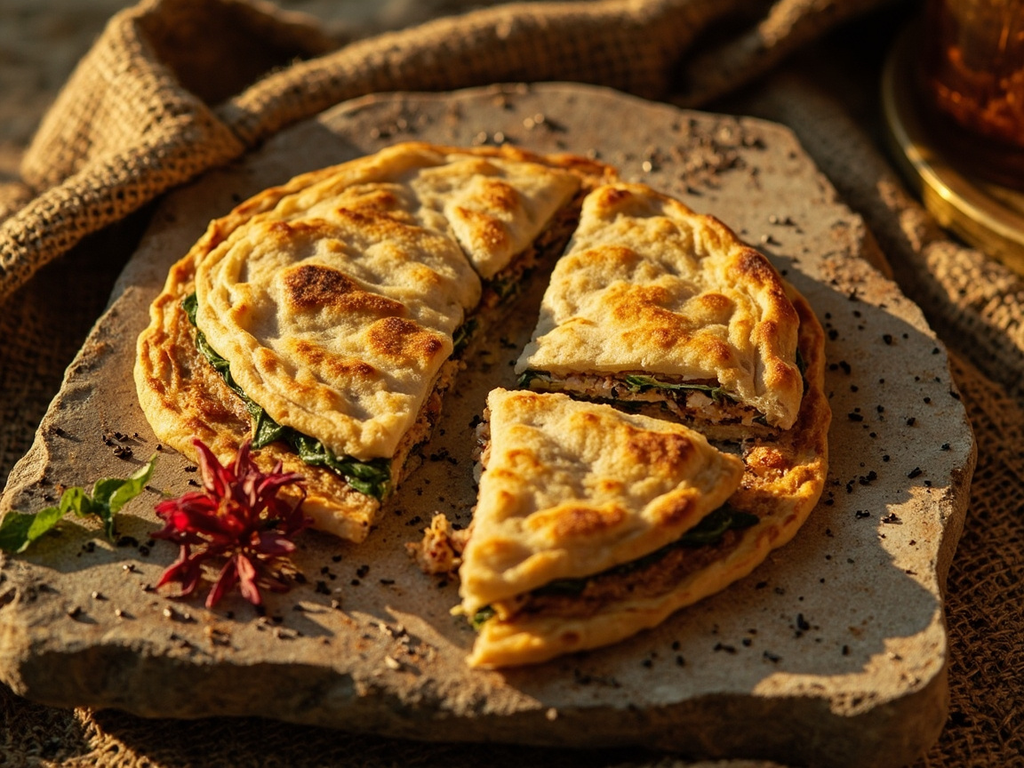
A flatbread laminated in thin layers, greased with fat-tailed sheep tail fat and perfumed with steppe herbs. Cooked on an iron plate or in a clay oven, it keeps for several days and is easily transported. Ancestor of qatlama and gözleme.
When I left one tribe to join another across the mountains, I had yupqa prepared — that thin-layered bread that women stretch and fold with fat between each layer. I recorded this word in my book because it is proper to the Turks and not found among the Arabs. Wild herbs that children gather on the slopes of the Tian Shan are mixed into it. Folded in a cloth, it keeps for several days without hardening, and one flatbread suffices a man for a day's march. It is the bread of the traveler and of the scholar who notes words along the way.
- •Wheat flour — enough for a soft dough (base)
- •Water — as needed (hydration)
- •Salt — a pinch (flavor)
- •Fat-tailed sheep tail fat — a few pieces, melted (laminating and preservation)
- •Wild herbs (chives, dill) — a chopped handful (flavoring)
- •Nigella seeds — a pinch (surface spice)
Herbed Yupqa
A flatbread laminated in thin layers, greased with fat-tailed sheep tail fat and perfumed with steppe herbs. Cooked on an iron plate or in a clay oven, it keeps for several days and is easily transported. Ancestor of qatlama and gözleme.
Why this dish? The term yupqa (thin layered dough) appears in the Dîwân. Al-Kashgari, while documenting the dialects of nomads around Lake Issyk-Kul and the Tian Shan, observed this technique of fat-layered flatbread that travelers carried rolled in a cloth. This compact, nourishing bread is suited to the encyclopedist's long journeys between his fieldwork sites.
When I left one tribe to join another across the mountains, I had yupqa prepared — that thin-layered bread that women stretch and fold with fat between each layer. I recorded this word in my book because it is proper to the Turks and not found among the Arabs. Wild herbs that children gather on the slopes of the Tian Shan are mixed into it. Folded in a cloth, it keeps for several days without hardening, and one flatbread suffices a man for a day's march. It is the bread of the traveler and of the scholar who notes words along the way.
Ingredients (period version)
- Wheat flour — enough for a soft dough (base)
- Water — as needed (hydration)
- Salt — a pinch (flavor)
- Fat-tailed sheep tail fat — a few pieces, melted (laminating and preservation)
- Wild herbs (chives, dill) — a chopped handful (flavoring)
- Nigella seeds — a pinch (surface spice)
Ingredients
- All-purpose flour — 400 g (base)
- Warm water — 200 ml (hydration)
- Salt — 1 tsp (flavor)
- Melted butter or lamb fat — 80 g (laminating)
- Fresh chives — 30 g, snipped (herb)
- Fresh dill — 20 g, snipped (herb)
- Nigella seeds — 1 tsp (surface spice)
Method
- Mix flour and salt. Gradually add warm water and knead 5 minutes to form a soft dough. Let rest 20 minutes under a cloth.
- Divide the dough into 4 equal balls.
- Roll each ball into a very thin disc (1-2 mm) on a floured surface.
- Brush generously with melted butter, sprinkle with snipped herbs and a pinch of salt.
- Roll the disc into a long log, then coil it into a spiral. Flatten the spiral with a rolling pin to a 20 cm disc, 5 mm thick.
- Heat a cast iron pan over medium heat without fat. Cook each flatbread for 3-4 minutes per side, until golden spots appear and layers separate.
- Sprinkle with nigella seeds at the end of cooking. Serve warm or at room temperature.
How it was made : The word yupqa is recorded in the Dîwân Lughât al-Turk. The technique of laminating dough by folding and greasing is attested among Turkish peoples and is considered by some historians (Charles Perry) as the origin of Middle Eastern laminated pastries. Cooking was done on an iron plate (saj) over embers or in a tandour (clay oven).
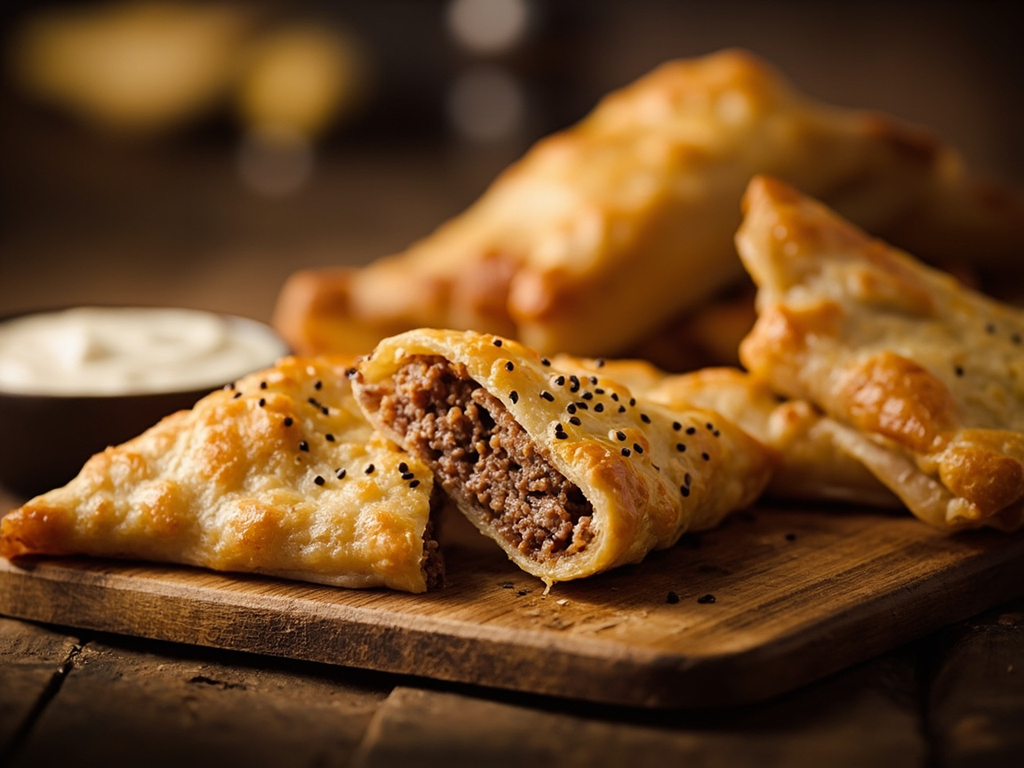
The contemporary twist : Cut into triangles and serve as a sharing bread with a bowl of herbed yogurt, like a Silk Road mezze.
Sources : Mahmoud al-Kashgari, Dîwân Lughât al-Turk (1072-1074), ed. Dankoff & Kelly · Charles Perry, "The Taste for Layered Bread among the Nomadic Turks and the Central Asian Origins of Baklava", in Turkish Cuisine, ed. S. Zubaida, 1994
Mahmoud al-Kashgari · Charactorium