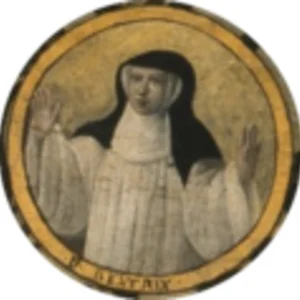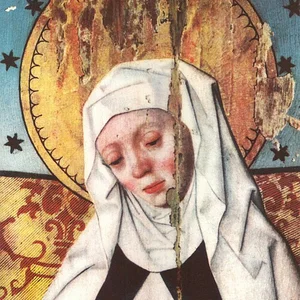

English Christian mystic of the late Middle Ages, mother of fourteen children who became a pilgrim and visionary. She dictated the account of her life and mystical experiences, regarded as the first autobiography in the English language.
Margery Kempe(1373 — 1438)
Margery Kempe
Royaume-Uni
6 min read
Frequently asked questions
Key Facts
- Born around 1373 in Bishop's Lynn (Norfolk, England).
- Mother of fourteen children before devoting herself to a life of devotion and chastity.
- Visited Julian of Norwich around 1413 to have her mystical experiences validated.
- Made pilgrimages to Jerusalem, Rome, and Santiago de Compostela.
- Dictated 'The Book of Margery Kempe', considered the first autobiography in English, around 1438; died after 1438.
Works & Achievements
Autobiographical account dictated by Margery, considered the first autobiography in the English language. It describes her conversion, her visions, and her pilgrimages in the third person (“this creature”).
A long spiritual journey to the Holy Land, passing through Venice. It was at Calvary that her famous fits of weeping first erupted.
A stay in the holy city on the way back from Jerusalem, marked by a life of voluntary poverty and intense devotion.
A journey to Galicia to venerate the tomb of the apostle James, one of the three great pilgrimages of medieval Christendom.
A journey undertaken late in life to accompany her daughter-in-law, reaching as far as Gdańsk in Prussia, a testament to her spiritual endurance.
A form of intense affective devotion (sobbing, crying out before images of the Passion) that she claimed as a divine gift and that left a lasting mark on the spirituality of her time.
Anecdotes
After the birth of her first child, Margery Kempe went through a severe crisis (around 1393) during which she saw demons and tried to harm herself. She recounted that a vision of Christ sitting at the edge of her bed brought her back to her senses: this was the beginning of her life as a mystic.
Margery would weep and sob loudly during religious services, sometimes screaming and rolling on the ground. These fits of tears so annoyed worshippers and priests that some drove her out of their churches, convinced she was possessed or faking holiness.
Mother of fourteen children, Margery negotiated a vow of chastity with her husband John: in 1413, in exchange for paying off his debts, he agreed that they would cease all conjugal life so that she could devote herself to God.
Margery undertook immense pilgrimages on foot and by boat: Jerusalem, Rome, Santiago de Compostela, and later Prussia and Norway, at a time when travelling alone was dangerous and rare for a woman.
Suspected of being a Lollard heretic, Margery was arrested and questioned on several occasions, notably at York and Leicester. She defended herself by reciting the articles of the faith and was released each time, for lack of any proof of heresy.
Primary Sources
When this creature was about twenty years of age, or somewhat more, she was married to a respectable man, and conceived within a reasonable time, as nature requires.
Our Lord Jesus Christ […] appeared to her in the likeness of a man, the most handsome, the most kind, and the most attractive that human eyes could ever behold, and said to her: “Daughter, why have you forsaken me, when I never once forsook you?”
She wept so loudly and so abundantly that many people were astonished and blamed her, not believing it was the work of God but that some evil disposition, or some sickness, possessed her.
Key Places
Port town in England where Margery was born, married, and lived. Her father, John Brunham, served as its mayor and was a prominent figure in the town.
Cathedral city where Margery visited the famous anchoress and mystic Julian of Norwich to have her visions validated.
The ultimate goal of her great pilgrimage of 1414; at Mount Calvary, before the sites of the Passion, Margery was seized by violent sobbing that never left her again.
A major stop on her pilgrimages, where she lived for a time in poverty and cared for the poor, multiplying prayers and devotional tears.
City where Margery was arrested and questioned in 1417 by the ecclesiastical authorities, suspected of Lollard heresy, before being released.
A great pilgrimage shrine in Spain, to which Margery traveled to venerate the relics of the Apostle James.
Typical Objects

On Christ's command in her visions, Margery wore entirely white clothing, a colour reserved for purity and normally forbidden to a married woman and mother. This choice made her conspicuous and suspect wherever she went.

A devotional object used to count the Ave Marias and Pater Nosters. Pilgrims like Margery would tell the beads as they recited their prayers along the roads.

A small lead or pewter badge bought at the holy sites (a scallop shell for Compostela, a palm for Jerusalem) and sewn onto the clothing. It proved that the pilgrimage had been completed.

A long walking stick used for support on the roads and for defence against animals. It was the emblematic attribute of medieval pilgrims travelling long distances on foot.

The account of her life, which Margery, being illiterate, dictated to a succession of scribes. This manuscript is regarded as the first autobiography in the English language.

A coarse garment worn next to the skin to mortify the body. Margery practised various forms of penance to atone for her sins and to imitate the suffering of Christ.
School Curriculum
Vocabulary & Tags
Key Vocabulary
Tags
Daily Life
Morning
Margery rose early to attend Mass and take communion, which she did with a fervour exceptional for the time. Her mornings were structured around prayer, frequent confession, and meditation on the Passion of Christ.
Afternoon
During her marriage, she ran a mill and a brewery in Lynn before these ventures failed. Later, her afternoons were devoted to visits from priests and confessors, to spiritual conversations, and to long pilgrimage walks.
Evening
In the evening, Margery prayed at length and wept over her sins and over the suffering of Christ. She held inner dialogues with Jesus and the Virgin in visions that she would later recount to her scribes.
Food
As penance, Margery imposed on herself for years the practice of abstaining from meat and fasting regularly. The ordinary medieval diet relied on bread, weak ale, fish on fast days, vegetables, and porridge.
Clothing
At the bidding of her visions, she wore entirely white clothing, unusual for a married woman, which drew suspicion. Earlier, in her pride, she had loved the showy and costly garments that she would renounce after her conversion.
Housing
In Lynn, Margery lived in the house of a well-to-do burgher, her father having been mayor of the town. During her pilgrimages, she lodged in inns, in pilgrim hospices, or relied on charity, at times sharing the destitution of the poorest.
Historical Timeline
Period Vocabulary
Liens externes & ressources
Références
Œuvres
The Book of Margery Kempe
vers 1436-1438
Pèlerinage à Jérusalem
1413-1415
Pèlerinage à Rome
1414-1415
Pèlerinage à Saint-Jacques-de-Compostelle
1417
Pèlerinage en Europe du Nord (Prusse et Norvège)
1433-1434
Témoignage mystique du « don des larmes »
1413-1438