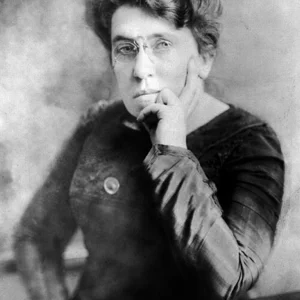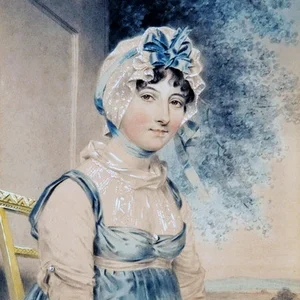

Anglo-Irish novelist and moralist (1768–1849), pioneer of the regional novel and the novel of education. Her works, praised by Walter Scott and Jane Austen, explore morality, the education of women, and Irish society.
Maria Edgeworth(1768 — 1849)
Maria Edgeworth
Royaume-Uni de Grande-Bretagne et d'Irlande
9 min read
Frequently asked questions
Famous Quotes
« We cannot judge either of the feelings or of the character of men with perfect accuracy from their actions or their appearance in public; it is from their careless conversations, their half-finished sentences, that we may hope with the greatest probability of success to discover their real character.»
Key Facts
- Born in 1768 in Black Bourton (England), raised in Ireland where she spent most of her life.
- Published *Practical Education* (1798) with her father Richard Lovell Edgeworth, an influential work on pedagogy.
- *Castle Rackrent* (1800) is considered one of the first regional novels in English-language literature.
- *Belinda* (1801) and *Helen* (1834) explore the condition of women and fashionable society.
- Admired and cited by Walter Scott and Jane Austen as a major influence on their own writing.
Works & Achievements
A pedagogical treatise co-written with her father Richard Lovell Edgeworth, grounded in direct observation of children. It advocates learning through experience and play, profoundly influencing teaching methods across nineteenth-century Europe.
The first regional novel in the English language, narrated by an elderly Irish servant. It paints a satirical portrait of an Irish landowning family across several generations, laying the foundations of the historical novel and inspiring Walter Scott's *Waverley*.
A social novel following a young woman navigating London high society. It examines the education of women, marriage as an institution, and the tension between appearances and virtue — and was read by Jane Austen herself.
A critical novel about Irish landlords who live in London while neglecting their estates and tenants. It makes a case for the social responsibility of elites and denounces British economic colonialism in Ireland.
A coming-of-age novel following a young Irish man searching for his identity between English and Irish society. Considered Edgeworth's artistic testament, it brings together her reflections on education, morality, and the Irish question.
A collection of moral stories aimed at young readers, among the earliest works of children's literature to pursue instruction through lively narrative rather than direct preaching. These texts were translated and read throughout Europe.
Anecdotes
Maria Edgeworth collaborated closely with her father Richard Lovell Edgeworth in writing “Practical Education” (1798), a groundbreaking educational treatise. Based on concrete observations of the children in the family, this book had a lasting influence on teaching methods in Britain and beyond.
When Walter Scott published his regionalist novel “Waverley” in 1814, he publicly paid tribute to Maria Edgeworth, acknowledging that “Castle Rackrent” had inspired him to portray the customs of his own Scotland as she had portrayed Ireland. He visited her at Edgeworthstown in 1825, a meeting that became a memorable literary event.
During the Great Irish Famine (1845–1849), Maria Edgeworth, then in her seventies, actively mobilized to organize relief for the starving peasants of the Edgeworthstown area. She wrote letters to American charitable organizations and personally supervised the distribution of food, demonstrating a humanitarian commitment that lasted until the end of her life.
Jane Austen herself admired Maria Edgeworth’s work: in a letter, she confessed to regretting that her own novels were not considered worthy of being read by so great a novelist. This mutual admiration between the two women illustrates the central place Edgeworth held in the English-language literature of her time.
For decades, Maria Edgeworth managed the family estate at Edgeworthstown in Ireland, negotiating directly with Irish tenant farmers and keeping meticulous accounts. This practical experience of rural Irish life deeply informed her novels, notably “The Absentee”, a sharp critique of absentee landlords who abandoned their Irish estates to live in London.
Primary Sources
The child who is never allowed to be idle, and who is never permitted to make any effort of his own to amuse himself, must lose that restlessness which is the incitement to activity, and which is the symptom of a healthy, vigorous mind.
Having out of friendship for the family, upon whose estate, praised be Heaven! I and mine have lived rent free time out of mind, voluntarily undertaken to publish the Memoirs of the Rackrent Family, I think it my duty to say a word or two concerning myself.
I am determined to write only what I know, and to describe only what I have seen. Ireland is my subject, my people, my inspiration; I can only write with truth about what I have lived.
It is the misfortune of women that they are bred up with the idea that beauty is their greatest, their only real accomplishment; that it is to beauty alone they are to owe their establishment in the world.
An absentee landlord is one who enjoys the income of an estate without residing upon it, without knowing his tenants, without improving his property, and without fulfilling any of the duties which property imposes.
Key Places
Birthplace of Maria Edgeworth on 1 January 1768. She spent her childhood here before the family settled permanently in Ireland.
The heart of Maria Edgeworth's life and work. She spent most of her existence here, managing the family estate, observing Irish society, and dying here in 1849. This place inspired the majority of her novels.
Maria Edgeworth made regular visits to London to meet her publishers (Johnson, then Blackwood) and move in literary and scientific circles. London is also the central setting of *The Absentee*, a symbol of the world of uprooted Irish landlords.
In 1802–1803, Maria Edgeworth accompanied her father to Paris during the Peace of Amiens. She met French scientists and intellectuals there, and came close to accepting a marriage proposal from a Swedish man she encountered in Parisian salons.
Maria Edgeworth visited Edinburgh and met Walter Scott there in 1823, strengthening the bond between the two greatest regionalist novelists writing in English at the time.
Typical Objects

Maria Edgeworth wrote her novels and voluminous correspondence with a goose quill pen, often seated at a desk in the family library at Edgeworthstown. It is said she would write for hours each morning before the household's daily obligations began.

As manager of the family lands, Edgeworth kept meticulous records of rents, expenses, and agricultural income. This bookkeeping practice deepened her precise understanding of the relationship between Irish landlords and tenant farmers, which she portrayed vividly in her novels.

Jean-Jacques Rousseau's *Émile* (1762) was an essential reference for Maria and her father Richard Lovell Edgeworth, who drew on it while also critiquing it in *Practical Education*. These works circulated widely in enlightened Anglo-Irish intellectual circles.

Linen cloth, a typical product of County Longford, was part of Edgeworth's everyday surroundings. She took a keen interest in local craftsmanship and in the living conditions of Irish spinners and weavers, whose work she describes in several of her stories.

Maria Edgeworth recorded her observations during her travels in France (1802–1803), Scotland, and London. These notebooks fed into her depictions of social customs and her portraits of characters drawn from very different walks of life.

In an era when artificial lighting was limited to tallow or wax candles, Maria Edgeworth would often read and write by candlelight in the evenings, in the manor's library, surrounded by her brothers and sisters.
School Curriculum
Vocabulary & Tags
Key Vocabulary
Tags
Daily Life
Morning
Maria Edgeworth rose early and devoted the first hours of the morning to writing, before the household came to life. In the library of Edgeworthstown Manor, she composed her novels, letters, and essays with a quill pen, often standing at a writing desk. Her father had instilled this intellectual discipline in her from childhood.
Afternoon
Afternoons were given over to managing the agricultural estate: meeting with tenant farmers, overseeing works, keeping the accounts. Maria Edgeworth readily immersed herself in Irish rural life, collecting the local expressions, stories, and customs that fed her novels. She also received visitors — neighbours, intellectuals, and travellers passing through.
Evening
In the evenings, the Edgeworth family gathered to read aloud by the fireside — a common practice in prosperous households of the time. Maria would read her manuscripts to her brothers and sisters to gauge their reactions, refining her dialogue and plots accordingly. Correspondence with her many friends — scientists, writers, and educators — also filled her evenings.
Food
The table at Edgeworthstown reflected the Anglo-Irish cuisine of the nineteenth century: roasted mutton or beef, potatoes — the staple of rural Ireland — garden vegetables, rye bread, and porridge in the morning. Tea was served several times a day, and more formal dinners included sweet courses, jams, and cheeses imported from England.
Clothing
Maria Edgeworth wore the characteristic dress of women of the Irish gentry of her era: high-waisted gowns in muslin or linen (Regency style), wool shawls, lace caps indoors, and wide-brimmed bonnets for outings. She attached no great importance to fashion, as her writing often attests — she frequently satirises the shallowness of women obsessed with their appearance.
Housing
Edgeworthstown Manor was a comfortable Georgian residence, enlarged and improved by Richard Lovell Edgeworth. Its library, holding several thousand volumes, was the intellectual heart of the house. The property included farms, kitchen gardens, stables, and outbuildings typical of a medium-sized Irish estate. Maria lived there almost without interruption from 1782 until her death in 1849.
Historical Timeline
Period Vocabulary
Liens externes & ressources
Références
Œuvres
Practical Education
1798
Castle Rackrent
1800
The Absentee
1812
Moral Tales for Young People
1801