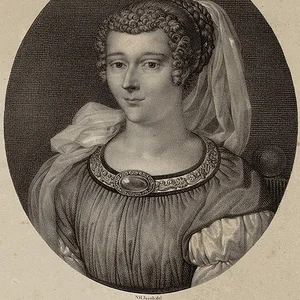

Marie de Gournay (1565-1645) was a French woman of letters, the first editor of Montaigne's Essays, whose “fille d'alliance” (adopted daughter) she became. An author and polemicist, she championed intellectual equality between the sexes.
Marie de Gournay(1565 — 1645)
Marie de Gournay
France
6 min read
Frequently asked questions
Famous Quotes
« Most of those who take up the cause of women, against the arrogant preference that men claim for themselves, pay them back in full.»
Key Facts
- Born in 1565 in Paris into a noble family
- Met Montaigne in 1588 and became his “fille d'alliance” (adopted daughter)
- Published in 1595 the first complete posthumous edition of Montaigne's Essays
- Published in 1622 “On the Equality of Men and Women,” a plea for the intellectual equality of the sexes
- Died in 1645 in Paris
Works & Achievements
A short sentimental novel, Marie's first published work, dedicated to the memory of Montaigne.
Her major posthumous edition of the *Essais*, accompanied by a famous preface; she would produce several revised versions of it up until 1635.
A major treatise defending the intellectual equality of the sexes, grounded in education rather than nature.
A pamphlet denouncing the exclusion of women from knowledge and from the honors reserved for men.
Her first collection bringing together her varied writings: treatises, poems, and reflections on language.
An expanded edition of her complete works, the sum of her thinking on letters, language, and the condition of women.
Anecdotes
At just eighteen or nineteen years old, Marie de Gournay was utterly captivated by Montaigne's *Essays*. She was, it is said, so overwhelmed by reading them that those around her feared for her health and had to give her hellebore, a plant then believed to calm troubled minds. This encounter with a book shaped the whole course of her intellectual life.
When she finally met Montaigne in Paris in 1588, the aging philosopher was so moved by this young admirer that he symbolically adopted her as his “covenant daughter.” It was a rare relationship for the time: neither blood kinship nor marriage, but a chosen kinship built around thought and writing.
After Montaigne's death in 1592, his widow entrusted Marie with the manuscript of the *Essays*. Marie devoted decades to editing and re-editing the work, adding a long, impassioned preface. It is largely thanks to her relentless labor that the *Essays* have come down through the centuries in the form we know today.
A learned woman living alone and writing under her own name, she was often mocked by the witty minds of her day, who jeered at her poverty, her cats, and her “old-fashioned” language. Far from staying silent, she struck back with biting writings defending women's right to knowledge.
In her treatise *The Equality of Men and Women* (1622), she argues that if women appear inferior, it is not by nature but because they are denied an education. It was a strikingly modern argument, made more than three centuries before the great contemporary debates on equality.
Primary Sources
Most of those who take up the cause of women, against the arrogant preference that men assign to themselves, [...] I content myself with making them equal to men.
O my Father, can it be that, with so much glory to your memory, I should also bear the dishonour of outliving you?
Happy are you, Reader, if you are not of that sex which is forbidden all good things, deprived of its liberty.
A collection gathering her works: treatises, poems, reflections on language, education, and the condition of women.
Key Places
Birthplace and place of death of Marie de Gournay, where she kept a modest lodging and took part in the literary life of the capital.
Montaigne's residence in Périgord, where Marie stayed after their meeting and formed a lasting bond with his family.
The seigneurial estate from which her family took its name; Marie spent part of her youth there after her father's death.
A city near the Château de Montaigne and a major intellectual center, linked to the dissemination of the *Essays* that she edited.
Typical Objects

The annotated copy entrusted to Marie after Montaigne's death, which she edited and re-edited for decades. The central object of her life as his “adopted daughter.”

The everyday writing instruments of a seventeenth-century woman of letters, cut and dipped to compose treatises, prefaces, and poems.

The large printed editions of the Essays that she supervised, the fruit of the labor of Parisian printing workshops. At the time, a book was a costly and prestigious object.

To support herself, Marie tried her hand at alchemy for a time; the alembic was used to distill matter and attempt to transform it, a vain hope of riches.

The dress of a noblewoman of the late sixteenth century, with its wide starched ruff around the neck, a fashion considered outdated by the end of Marie's life.

A modest pension granted by the kings and great lords of the realm, which allowed her to live independently of any husband, a rare thing for a woman of her time.
School Curriculum
Vocabulary & Tags
Key Vocabulary
Daily Life
Morning
Marie would rise in her modest Parisian lodgings, often surrounded by the cats she was so fond of. The morning was devoted to reading and to correcting her manuscripts, pen in hand at her writing desk.
Afternoon
In the afternoon, she worked on her editions of the *Essays* or composed her treatises, sometimes interrupted by visits from scholars, admirers, or mockers who came to discuss literature and the French language.
Evening
In the evening, by the light of a candle, she continued her reading or her correspondence with the learned figures of her time. Living alone and frugally, she devoted her evenings to the life of the mind rather than to social affairs.
Food
Her diet was simple and frugal, in keeping with her meager resources: bread, soups, vegetables, and a little meat on good days. She depended on pensions and on the generosity of her patrons.
Clothing
She wore the fine gowns of a lady, inherited from a fashion already long out of date, with a starched ruff and farthingale, which made the young courtiers smile and find her old-fashioned.
Housing
She occupied a small Parisian apartment often described as poor and cluttered with books and papers. This cramped space was at once her refuge, her library, and her writing studio.
Historical Timeline
Period Vocabulary
Liens externes & ressources
Références
Œuvres
Le Proumenoir de Monsieur de Montaigne
1594
Édition des Essais de Montaigne (préface de 1595)
1595
Égalité des hommes et des femmes
1622
Grief des dames
1626
L'Ombre de la Damoiselle de Gournay
1626
Les Advis, ou les Présens de la Demoiselle de Gournay
1634-1641