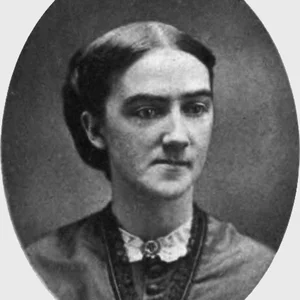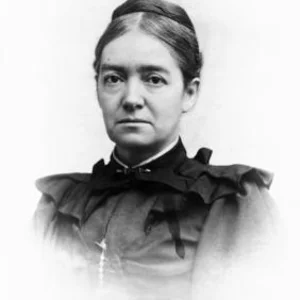

American physician, a pioneer for the place of women in medicine in the 19th century. A rigorous researcher and suffragist activist, she scientifically refuted the medical prejudices that deemed women unfit for intellectual and physical effort.
Mary Putnam Jacobi(1842 — 1906)
Mary Corinna Putnam
États-Unis
6 min read
Frequently asked questions
Key Facts
- Born in 1842 in London and died in 1906 in New York.
- First woman admitted to the New York College of Pharmacy (1863) and then to the School of Medicine in Paris (1868).
- Won the Harvard Boylston Prize in 1876 with an essay refuting the idea that women needed to rest during menstruation.
- Founded the Association for the Advancement of the Medical Education of Women in 1872.
- Author of more than 100 scientific articles in physiology, neurology, and pediatrics.
Works & Achievements
Research work in physiology rewarded with the jury's commendations, crowning her scientific training at the highest European level.
Essay that won Harvard's Boylston Prize, using statistics to refute the idea that women were unfit for intellectual effort.
Organization aimed at raising the standard of women's medical training and opening hospitals and laboratories to them.
Campaigning work in favor of women's right to vote, blending political arguments with scientific reasoning.
Publications in pathology, neurology, and physiology that made her one of the most respected researchers of her time.
Detailed medical account of the symptoms of her illness, written as a scientist to the very end and published after her death.
Anecdotes
In 1876, Mary Putnam Jacobi won the prestigious Boylston Prize from Harvard University. Her essay, submitted anonymously as the competition required, demolished with hard data the fashionable theory that studying damaged the health of young women. When the envelope was opened, the all-male jury was astonished to discover that a woman had won.
To build this demonstration, she sent a detailed questionnaire to a thousand women and used a sphygmograph, a device that traced the rhythm of the pulse onto paper. She wanted to prove with figures in hand that no “mandatory rest” was physiologically necessary — a statistical survey ahead of its time.
In 1868, she became the first woman admitted to the prestigious School of Medicine in Paris. The authorization was won only after a hard-fought battle, and it is said that at first she had to sit apart from the male students. She graduated in 1871 with honors and a medal for her thesis.
The daughter of George Palmer Putnam, founder of the great New York publishing house Putnam, she had published a short story in a magazine as a teenager. Her family hoped for a literary career; she chose medicine, a field then almost entirely closed to women.
A scientist to the very end, she methodically observed and recorded the symptoms of the brain tumor that would claim her life in 1906. This clinical account of her own illness was published after her death, a striking example of rigor in the face of one's own demise.
Primary Sources
“There is nothing in the nature of menstruation to imply the necessity, or even the desirability, of rest for women whose nutrition is really normal.”
In it she argues that women's right to vote follows from the founding principles of democracy, and refutes the idea that they are sufficiently “represented” by the men of their family.
A collection of her letters in which she describes her years of study in Paris, her determination to be recognized as a physician and researcher in her own right, and her reflections on the place of women in science.
Key Places
Mary Putnam's birthplace, where her father was then running the London branch of his publishing house.
The world's first medical college for women, where she earned her American degree in 1864.
A prestigious faculty of which she was the first female student, graduating with honors in 1871.
The school founded by Elizabeth Blackwell where Mary Putnam Jacobi taught and trained generations of women doctors.
The city where she practiced, campaigned for suffrage, and died in 1906.
Typical Objects

Device that traces variations in the pulse onto paper. She used it to objectively measure women's physiological state and dismantle medical prejudices.

A central instrument of 19th-century medical research. She used it for her laboratory work and her teaching of physiology.

The auscultation tool of the practicing physician. A symbol of the profession she practiced and championed for women.

A form sent to a thousand women to gather data on their health. A pioneering statistical survey approach in social medicine.

A long, reasoned text submitted anonymously to the Harvard competition. It earned its author a prestigious prize and became a landmark in the scientific defense of women.

A satchel holding the visiting physician's instruments. She carried it to treat her patients, notably in the dispensaries for poor women.
School Curriculum
Vocabulary & Tags
Key Vocabulary
Tags
Daily Life
Morning
Rising early, Mary Putnam Jacobi divides her morning between visits to her patients and her work in the laboratory or at the dispensary. A respected physician, she examines, listens, and records her observations with the rigor of a researcher.
Afternoon
The afternoon is often devoted to teaching at the women's medical college, where she trains future practitioners, or to writing her many scientific articles.
Evening
In the evening, in her New York home shared with her husband, the pediatrician Abraham Jacobi, family life mingles with scholarly reading and discussions about medicine, science, and women's rights.
Food
An educated middle-class woman of the late 19th century, she eats varied meals typical of a well-off New York family: meats, vegetables, bread, tea, and coffee. As a physician, she places great importance on “good nutrition,” a central notion in her work.
Clothing
She wears the long, structured dresses of the Victorian middle class — understated outfits suited to a professional woman who wants to be taken seriously in a man's world.
Housing
She lives in a comfortable townhouse in New York, home to both the family's daily life and the intellectual workspace of the physician couple.
Historical Timeline
Period Vocabulary
Liens externes & ressources
Références
Œuvres
Thèse de médecine de l'École de Paris
1871
The Question of Rest for Women during Menstruation
1877
Co-fondation de l'Association for the Advancement of the Medical Education of Women
1872
Common Sense Applied to Woman Suffrage
1894
Plus d'une centaine d'articles médicaux et scientifiques
1870-1906
Description clinique de sa propre tumeur cérébrale
1906