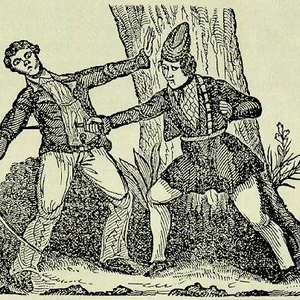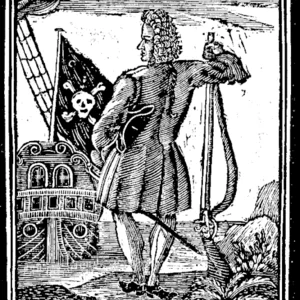

Stede Bonnet (c. 1688–1718), nicknamed “the gentleman pirate,” was a wealthy Barbadian planter who abandoned his plantation to become a pirate in the Caribbean. Allied for a time with Blackbeard, he was captured and hanged in Charleston in 1718.
Stede Bonnet(1688 — 1718)
Stede Bonnet
royaume de Grande-Bretagne, royaume d'Angleterre
6 min read
Frequently asked questions
Key Facts
- Born around 1688 in Barbados to a wealthy English planter family
- Abandoned his plantation to buy and arm a ship, the Revenge, in 1717 — a rare feat, as pirates usually stole their vessels
- Allied with the pirate Blackbeard (Edward Teach) before becoming his rival
- Captured during the Battle of Cape Fear River in September 1718
- Tried and hanged in Charleston (South Carolina) on December 10, 1718
Works & Achievements
An unprecedented act in the history of piracy: Bonnet financed his own warship instead of capturing one, thereby launching his career as a pirate.
Off the coasts of Virginia, the Carolinas, and in the Caribbean, Bonnet attacked and plundered several merchant ships, sometimes burning them.
His partnership with the most famous pirate of the era made Bonnet a legend, even though it cost him command of his own ship.
Alongside Blackbeard, Bonnet took part in the blockade of the port of Charleston, where hostages were taken to demand a ransom paid in medicine.
After his pardon, he went back to piracy under a false identity with his ship renamed the Royal James, until his capture.
His trial, published under the title The Tryals of Major Stede Bonnet, is one of the best-documented pirate trials of the Golden Age of Piracy.
Anecdotes
Unlike nearly every other pirate, who stole their ships, Stede Bonnet BOUGHT his: a ten-gun sloop that he christened the Revenge. More surprising still, he paid his crew a wage instead of sharing out the plunder. This wealthy sugar planter from Barbados, who had no experience of the sea, thus earned his nickname of the “gentleman pirate.”
When Bonnet teamed up with Blackbeard, the latter quickly realized that the gentleman was a poor sailor and took effective command. According to A General History of the Pyrates, Bonnet then remained aboard like a guest, free to pace the deck in his dressing gown and read the books from his library — an extremely rare thing on a pirate ship.
After taking advantage of the royal pardon offered to pirates, Bonnet plunged back into piracy almost immediately. To cover his tracks, he took the false name of “Captain Thomas” and renamed his ship the Royal James.
Captured and then imprisoned in Charleston, Bonnet managed to escape from his jail with an accomplice. His freedom was short-lived: he was recaptured a few days later on a nearby island and brought back for his trial.
Before his execution, a terrified Bonnet wrote a heartbreaking letter to Governor Robert Johnson begging for mercy, going so far as to offer to have his own limbs cut off as a guarantee that he would never turn pirate again. His plea went unheeded: he was hanged on December 10, 1718.
Primary Sources
Judge Nicholas Trott's address to the condemned man: “You being a gentleman that have had the advantage of a liberal education, and being generally esteemed a man of letters, it will be needless for me to explain to you the nature of repentance and faith.”
“This humour of going a-pirating proceeded from a disorder in the mind, which had been but too visible in him some time before, and which is said to have been occasioned by some discomforts he found in the married state.”
Major Stede Bonnet is charged with having, as a pirate, attacked and taken off the coast of Virginia the sloop Francis (commanded by Peter Manwaring) and the sloop Fortune (commanded by Thomas Read).
Key Places
Caribbean island where Bonnet was born and owned a wealthy sugar plantation before abandoning it all for piracy.
The main lair of Atlantic pirates in the early 18th century, a hub where Bonnet crossed paths with Blackbeard.
Small port where Bonnet obtained a royal pardon from Governor Charles Eden, hoping to become a privateer against Spain.
Estuary where Colonel William Rhett gave battle to Bonnet and captured him in September 1718.
Town where Bonnet was imprisoned, tried, and then hanged at White Point on December 10, 1718.
Typical Objects

A fast little ten-gun sloop that Bonnet bought — unique among pirates — instead of stealing it. It was later renamed the Royal James.

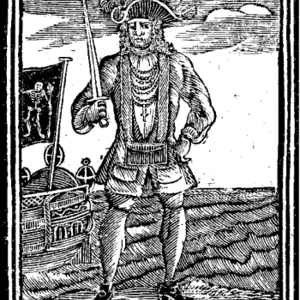
A black flag raised to terrify prey; the one attributed to Bonnet bore a skull above a single bone, flanked by a heart and a dagger.

A short, sturdy blade, easy to wield in the cramped space of a ship's deck during hand-to-hand combat.

A pirate's personal firearm, often carried several at a time so they could fire multiple shots without reloading.

A piece of artillery mounted on board; the Revenge's ten cannons were used to force merchant ships to surrender.

The collection of books Bonnet carried aboard his ship, a sign of his gentleman's education and an unusual thing for a pirate.

Compass, quadrant, and sea charts essential for finding one's way on the open sea — a skill Bonnet had little command of.
School Curriculum
Vocabulary & Tags
Key Vocabulary
Tags
Daily Life
Morning
On land, Bonnet the planter would rise to oversee the work on his sugarcane plantation. At sea, having turned pirate but being a poor sailor, he is said to have spent his mornings reading in his cabin while the crew handled the ship.
Afternoon
The afternoon aboard was spent scanning the horizon for a sail and preparing for a possible attack. When a target was spotted, the black flag was raised and the crew made ready to board.
Evening
In the evening, the crew ate their meal and shared out the rum, often amid a noisy atmosphere. Watch shifts were organized, for a pirate ship feared the royal navy's patrols as much as it feared storms.
Food
The sailors' everyday fare consisted of ship's biscuit (a very hard flatbread), salted meat and fish, and rum, since fresh water spoiled quickly. Pirates improved on this diet with provisions plundered from captured ships.
Clothing
Coming from high society, Bonnet kept the clothes of a gentleman — a fine coat, waistcoat, and shirt — where his companions wore worn-out sailors' garments. Such elegance stood out on a pirate's deck.
Housing
In Barbados, Bonnet lived in a planter's house surrounded by his lands. Once he became a pirate, he lodged in the captain's cramped cabin at the stern of his sloop, his only private space aboard.
Historical Timeline
Period Vocabulary
Liens externes & ressources
Références
Œuvres
Achat et armement du sloop Revenge
1717
Campagne de piraterie sur la côte américaine
1717-1718
Alliance avec Barbe-Noire
1717-1718
Blocus de Charleston
1718
Reprise de la piraterie sous l'alias « capitaine Thomas »
1718
Procès de Charleston
1718