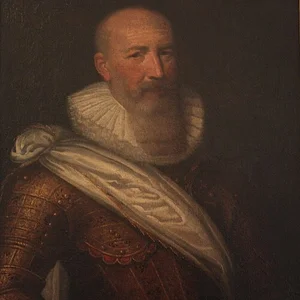

Maximilien II (1527–1576) was Holy Roman Emperor from 1564 to 1576. The son of Ferdinand I, he pursued a policy of relative religious tolerance amid tensions between Catholics and Protestants, seeking to preserve the unity of the Empire during the height of the Reformation.
Maximilien II
Maximilien II
9 min read
Frequently asked questions
Key Facts
- Born in 1527 in Vienna, son of Emperor Ferdinand I
- Crowned King of Bohemia (1562) and Hungary (1563) before succeeding his father in 1564
- Policy of concessions toward German Protestant princes (inherited from the Peace of Augsburg, 1555)
- Refused to publicly convert to Protestantism despite personal sympathies
- Died in 1576 in Regensburg without having resolved the religious question within the Empire
Works & Achievements
A document granting Lutheran nobles of Lower Austria the right to freely practice their faith. It stands as the most significant act of Maximilian II's policy of religious tolerance, unprecedented in the Habsburg hereditary lands.
An extension of the religious rights granted to Austrian Protestants, now broadened to include the nobles of Upper Austria. With this act, Maximilian II reaffirmed his commitment to maintaining a lasting religious peace across his hereditary territories.
Maximilian II presided over this crucial Diet at a time when the Empire was under Ottoman threat. He secured military subsidies from the princes while skillfully navigating between the Catholic and Protestant religious factions.
Maximilian II expanded and organized the Vienna cabinet of curiosities, assembling artworks, natural specimens, automata, and scientific instruments. This collection foreshadowed the great museums of later centuries and embodied the humanist ideals of his reign.
Following the Ottoman campaign of 1566, Maximilian II negotiated a truce with Selim II, Suleiman's successor. This peace allowed the Empire to turn its attention to its internal religious tensions rather than the threat from without.
Anecdotes
Throughout his life, Maximilien II maintained an ambiguous relationship with religion. Raised in part by a Lutheran tutor, he secretly sympathized with the Reformation but could never openly convert, on pain of losing his throne. On his deathbed in Regensburg in 1576, he reportedly refused, according to several accounts, to receive the last Catholic sacraments, leaving all of Europe puzzled as to his true faith.
Maximilien II had a passionate interest in science and the arts. In Vienna, he assembled an impressive Kunstkammer (cabinet of curiosities) containing mechanical automatons, astronomical instruments, exotic stuffed animals, and curiosities from around the world. This collection embodied the humanist ideal of his era: to understand and catalogue the entire visible world.
Faced with religious tensions in his territories, Maximilien II made a bold decision in 1568: he granted the Protestant nobles of Lower Austria the right to practice their faith freely, in a document known as the 'Assekuration'. This was an unprecedented gesture at a time when the principle of cuius regio, eius religio required every ruler to impose his religion on his subjects.
Maximilien II was subjected to constant pressure from his cousin Philip II of Spain, a champion of Catholicism who pressed him to suppress Protestant heresy in the Empire. The two men maintained a deeply strained relationship: Philip did not hesitate to write directly to the pope to complain about the Emperor's overly tolerant policies, while Maximilien held firm, convinced that moderation was preferable to civil war.
During the Ottoman campaign of 1566, Suleiman the Magnificent threatened the heart of Christian Europe. Maximilien II assembled a large imperial army but hesitated to engage in battle. While some criticized his lack of military boldness, the unexpected death of Suleiman before the fortress of Szigetvár changed the course of events and most likely spared the Empire from catastrophe.
Primary Sources
Maximilian II grants the Lutheran nobles of Lower Austria the right to freely practice the evangelical faith on their estates and residences, thereby de facto acknowledging the existence of Protestantism within his hereditary territories.
The Emperor sets out to the Holy Father the necessity of reforming the Church from within, advocating for communion under both kinds for German laypeople as a means of bringing Protestants back into the Catholic fold.
The nuncio informs Rome that the King of Bohemia (the future Maximilian II) regularly attends Lutheran sermons and that his conversion to the Reformation is considered likely in Protestant circles in Vienna.
Maximilian defends his policy of moderation against the reproaches of his Spanish cousin, arguing that coercion would only inflame consciences and drive German Protestants into open rebellion, threatening the unity of the Empire.
The deliberations of the 1566 Diet show Maximilian II skillfully navigating between the demands of Catholic princes supporting the Counter-Reformation and those of Protestant princes pressing for an extension of the Peace of Augsburg.
Key Places
Capital of the Habsburg hereditary lands and the main residence of Maximilian II. It was here that he held his court, developed his Kunstkammer, and pursued his policy of relative religious tolerance.
Imperial city where the Diets of the Holy Roman Empire (Reichstag) regularly convened. It was in Regensburg that Maximilian II died in October 1576, in the midst of a Reichstag session, leaving the religious question without a lasting resolution.
Capital of the Kingdom of Bohemia, of which Maximilian II was crowned king in 1562. Prague was an important intellectual and artistic center of the Empire, which his son Rudolf II would go on to transform into a great cultural metropolis.
Capital of the part of the Kingdom of Hungary not conquered by the Ottomans. Maximilian II was crowned King of Hungary here in 1563, inheriting a realm partially occupied by the Ottoman Empire that he had to defend throughout his reign.
Maximilian II spent several years at the Spanish court of his uncle Charles V, where he was exposed to the rigid Catholicism of the Iberian court before returning to the German lands with a different outlook on religion.
Typical Objects

An octagonal crown adorned with precious stones and enamel, the supreme symbol of imperial authority. Maximilian II wore it during coronation ceremonies and the great Diets of the Empire.

A complete suit of armor, finely engraved and gilded, worn at tournaments and major military ceremonies. During the Renaissance, armor was as much a work of art and a mark of prestige as it was a piece of combat equipment.

Torn between Catholicism and Lutheranism, Maximilian II read the Bible in both versions. Owning Luther's translation was at once an act of intellectual curiosity and a political risk for an Emperor.

A passionate science enthusiast, Maximilian II collected terrestrial globes, astrolabes, and armillary spheres in his Viennese *Kunstkammer*. These objects reflect the humanist spirit and encyclopedic curiosity of the Renaissance.

An engraved metal die used to authenticate the Emperor's official documents — decrees, treaties, letters patent. The seal bore the Habsburg double-headed eagle and was kept by an imperial dignitary.

Falconry was the favorite pastime of the great Renaissance rulers. Maximilian II regularly practiced this royal hunt, regarded as military training and a display of noble standing.
School Curriculum
Vocabulary & Tags
Key Vocabulary
Daily Life
Morning
Maximilian II began his day with an early morning Mass in the palace chapel — a Catholic ritual he observed publicly despite his Lutheran sympathies. He would then receive reports from his advisors and diplomatic dispatches from across Europe, to which he often replied personally in several languages (German, Latin, Spanish, and Czech).
Afternoon
Afternoons were devoted to official audiences, sessions of the Imperial Council, and diplomatic negotiations. Maximilian II also found time to visit his *Kunstkammer*, to converse with scholars and artists invited to his court, or to hunt in the forests around Vienna — an indispensable aristocratic pastime for a Renaissance sovereign.
Evening
Evenings were often taken up by formal banquets where court etiquette demanded lavish ceremony. Music played a central role: Maximilian II loved polyphony and maintained a renowned court chapel. Before retiring, he would readily read works of history and theology, feeding his reflections on the religious crisis tearing the Empire apart.
Food
The imperial table reflected the opulence of the Habsburg court: game hunted in the imperial forests, fish from the rivers of Bohemia, wines from the Rhine and Moselle, and spices from the East brought by Venetian merchants. Official feasts comprised dozens of dishes served in multiple courses, bearing witness to the wealth and prestige of imperial power.
Clothing
In official dress, Maximilian II wore the imperial ceremonial robes: an embroidered velvet doublet, a fur-lined cloak, and the collar of the Order of the Golden Fleece (the highest distinction of the Habsburgs). For war or hunting, he donned finely engraved armour or a leather doublet. In the Renaissance, a prince's attire was a political instrument signalling power, legitimacy, and refinement.
Housing
The Emperor resided primarily at the Hofburg, the imperial palace in Vienna, whose expansion he continued. During his travels across the Empire (Imperial Diets, military campaigns), he lodged in the castles of allied princes or in the town halls of major imperial cities. His private apartments housed his prized library and carefully selected pieces from his *Kunstkammer*.
Historical Timeline
Period Vocabulary
Liens externes & ressources
Références
Œuvres
Assekuration pour la noblesse protestante d'Autriche-Inférieure
1568
Assekuration pour la noblesse protestante d'Autriche-Supérieure
1571
Gestion de la Diète impériale d'Augsbourg
1566
Constitution de la Kunstkammer impériale de Vienne
1564-1576
Traité de paix avec l'Empire ottoman
1568