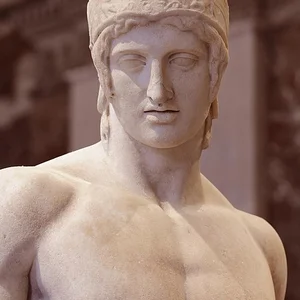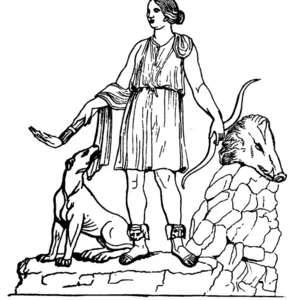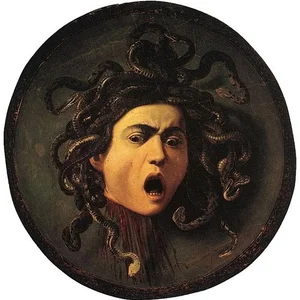

In Greek mythology, Medusa is one of the three Gorgons — fearsome female monsters with snakes for hair whose gaze turns anyone who looks at them to stone. She is slain by the hero Perseus, who uses his shield as a mirror to face her without being petrified.
Medusa
Medusa
8 min read
Frequently asked questions
Key Facts
- Medusa is one of the three Gorgons in Greek mythology (alongside Stheno and Euryale)
- Her gaze has the power to petrify (turn to stone) anyone who looks at her directly
- She is beheaded by the hero Perseus, who uses his own reflection in his polished shield to face her without meeting her eyes
- After her death, Perseus uses Medusa's severed head as a weapon, and her image is later borne on his shield (the aegis)
- In some versions of the myth, Medusa was once a beautiful woman transformed into a monster by Athena as punishment
Works & Achievements
Medusa became a protective symbol in Greek culture, her image being used on shields and amulets to ward off evil. Her apotropaic effigy embodies defensive power and protection against malevolent forces.
According to some versions of the myth, Medusa was transformed into a monster by Athena as punishment for her sacrilege. This story illustrates themes of transgression, divine punishment, and transformation in Greek mythology.
The battle between Medusa and the hero Perseus is one of the greatest adventures in Greek mythology. Perseus cleverly uses his shield as a mirror to defeat the monster, demonstrating the importance of cunning over brute strength.
Medusa's gaze, capable of turning to stone any creature that looks upon her, represents the ultimate manifestation of the power of seduction and destruction. This extraordinary gift makes Medusa one of the most iconic figures in Greek mythology.
Medusa inspired countless artistic representations in ancient Greece, appearing on pottery, sculptures, and mosaics. Her enduring image attests to her cultural importance and lasting fascination in the Greek imagination.
Anecdotes
According to some versions of the myth, most notably Ovid's, Medusa was originally a beautiful young woman. Transformed into a monster with a hideous face and snakes in place of hair, she was confined to an underground cave. This transformation represented a punishment in the various Greek versions of the myth, making her a tragic figure despite her terrifying appearance.
The hero Perseus used a clever strategy to defeat Medusa without being turned to stone by her deadly gaze. He used the Gorgon's reflection in his polished bronze shield, which allowed him to fight without directly meeting her dangerous eyes. This trick appears in ancient accounts such as Homer's Odyssey and has become emblematic of wisdom in the face of danger.
After her death, Medusa retained her power of petrification according to ancient myth. Perseus used her severed head as a weapon by attaching it to his shield or giving it to Athena for her own protection. This detail appears repeatedly in ancient Greek texts, showing how the myth explored the idea that a monster remained dangerous even after death.
Medusa is depicted in ancient Greek art on vases, coins, and sculptures, which attests to the importance of this myth in Greek culture. Her image — with its grimacing face and serpents — was used as a protective symbol on warriors' shields, transforming the monster into a figure of dread meant to ward off enemies.
Primary Sources
Medusa alone was mortal among the three Gorgons; the other two, Stheno and Euryale, were immortal and untouched by old age. It was with the golden-footed god that she lay in tender love, in a meadow covered with spring flowers.
Perseus, borne aloft on Mercury's wings, caught sight of Medusa asleep. He avoided looking at her directly, but saw her reflection in his bronze shield as in a mirror, and with one stroke of his adamantine sword, he severed the Gorgon's head.
Medusa had once been beautiful, and was especially renowned for her hair. Athena, jealous of her beauty or angered by her desecration of her temple, transformed her lovely hair into venomous serpents.
It is said that Perseus placed Medusa's head upon Athena's aegis, and that through its power it retained the ability to turn to stone all who looked upon it, even after the Gorgon's death.
Key Places
According to Greek mythology, Medusa was said to have lived in Libya, in the desert lands of North Africa. It was there that the hero Perseus finally tracked her down and defeated her.
After beheading Medusa, Perseus is said to have flown over these islands in the Ionian Sea using his winged sandals. Medusa's blood is said to have dripped into the Mediterranean basin.
This Greek island is the place where Perseus brought back Medusa's head and used it to confront King Polydectes. The severed head retained its petrifying powers.
According to some versions of the myth, Medusa was once a beautiful mortal woman who fell victim to Athena's wrath in Attica. The goddess transformed her hair into serpents as punishment for a sacrilege committed in her temple.
After her death, Medusa's head was said to have retained its powers even when severed, symbolizing her enduring place in the Greek imagination of the afterlife and the underworld.
Typical Objects
The snakes that make up Medusa's hair are her most famous distinguishing feature in Greek mythology. They represent her monstrous nature and serve as her primary weapon, capable of killing through venom and terror.

The shield belonging to the hero Perseus, gifted by Athena, which bears the engraved image of Medusa after her death. It is by using the reflection in this shield that Perseus is able to confront Medusa without being turned to stone by her gaze.

The indestructible sword or sickle used by Perseus to sever Medusa's head. This divine weapon represents the tool required to defeat even the most fearsome creatures.

The magical winged sandals given to Perseus by Hermes for his quest. They symbolize the speed and mobility a hero needs to battle superhuman forces.

The severed head of Medusa, which retains its petrifying power even in death. It becomes a powerful artifact used as both a shield and a symbol of victory over the monster.

A ceramic vessel typical of ancient Greece, often decorated with mythological scenes featuring Medusa and Perseus. This everyday object reflects the cultural importance of the myth in ancient Greek society.

The reflective surface Perseus used as a strategy to face Medusa without meeting her deadly gaze. The mirror symbolizes cunning and intelligence triumphing over the monster's brute force.

The magical bag in which Perseus places Medusa's head to carry it after his victory. This object represents the ability to contain and control monstrous power.
School Curriculum
Vocabulary & Tags
Key Vocabulary
Daily Life
Morning
Medusa wakes in her isolated cave on the edges of the known world, far from Greek civilization. She begins her day feeding on the remains of her prey, for she is a solitary monster feared by all. She tends to her hair of serpents, which make up her monstrous nature.
Afternoon
Medusa spends her afternoons withdrawn in her underground lair, avoiding all human contact. She watches the entrance to her cave, aware of the danger posed by intruders and monster hunters. She waits passively, as though imprisoned by her divine curse.
Evening
At nightfall, Medusa rests in the darkness of her cave, the hour when her monstrous appearance no longer poses a threat. She remains isolated and alone, contemplating her fate as a creature cursed by the gods. She sleeps little, haunted by her tragic existence.
Food
Medusa feeds on the animals and warriors she captures or who venture near her dwelling. As a monstrous creature, her diet goes far beyond ordinary human fare. She consumes her prey raw — her divine and monstrous nature requiring no culinary preparation.
Clothing
Medusa's appearance is profoundly altered: her hair has been replaced by living serpents that writhe constantly. Her body bears the marks of her divine curse, making her hideous and terrifying to behold. She wears no ordinary clothing, her monstrous nature transcending all human convention.
Housing
Medusa lives in an isolated cave, an underground refuge far from inhabited lands and human eyes. This dwelling is a dark and desolate place, reflecting her isolation and her curse. It is less a home than a prison, where she remains confined far from Greek civilization.
Historical Timeline
Period Vocabulary
Visual Style
Un style fusionnant l'esthétique des vases grecs antiques (poterie à figures noires) avec une approche dramatique inspirée de la sculpture grecque. L'ambiance évoque un univers souterrain, sombre et tragique, où la lumière rasante crée des contrastes forts pour magnifier l'aspect monstrueux et légendaire de Méduse.
Sound Ambience
Une ambiance sonore sombre et oppressante évoquant l'antre de Méduse, combinant les sifflements sinistres des serpents, les échos caverneux de la pierre et des éléments surnaturels inquiétants qui reflètent la menace mortelle du personnage.
Liens externes & ressources
Références
Œuvres
La Gorgoneion (représentation apotropaïque)
inconnue
Le mythe de la transformation en monstre
inconnue
L'affrontement avec Persée
inconnue
Le pouvoir pétrifiant du regard
inconnue
L'héritage symbolique dans l'art antique
inconnue