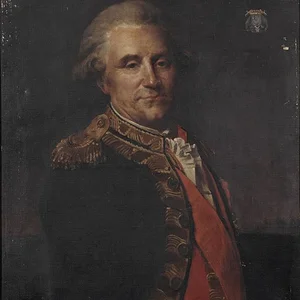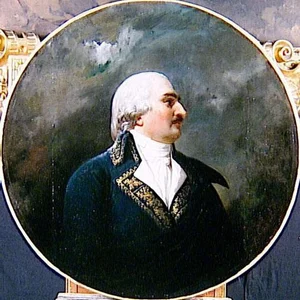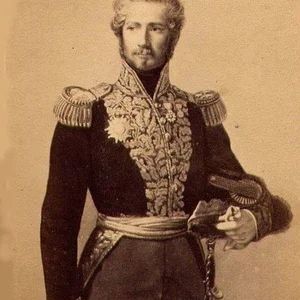

French cavalry general (1755–1811), Michel Ordener distinguished himself in the Revolutionary and Napoleonic Wars. He commanded the Horse Grenadiers of the Imperial Guard and was created a Count of the Empire.
Michel Ordener(1787 — 1862)
Michel Ordener
France
8 min read
Frequently asked questions
Key Facts
- Born on 2 May 1755 in Drusenheim (Bas-Rhin)
- Commanded the Horse Grenadiers of the Imperial Guard from 1801
- Took part in major Napoleonic battles including Austerlitz (1805)
- Created Count of the Empire by Napoleon I
- Died on 30 July 1811 in Paris
Works & Achievements
Ordener forged and led the most prestigious elite cavalry unit of the Empire. His Horse Grenadiers took part in the major battles of the Napoleonic decade and represented the pinnacle of the military art of the era.
A secret mission entrusted by Napoleon: cross the Rhine, enter foreign territory, and capture the Bourbon prince. This major political act helped eliminate royalist opposition and consolidate the authority of the Consular regime.
The Horse Grenadiers under Ordener played a role in Napoleon's most celebrated victory, protecting the Emperor and taking part in the decisive charges against the Austro-Russian allies.
Ordener led his elite cavalry during Napoleon's lightning successes against Prussia at Jena, and then during the pursuit into Poland, contributing to the expansion of the Empire toward Eastern Europe.
Anecdotes
In March 1804, Napoleon entrusted Ordener with a secret and delicate mission: to cross the Rhine frontier, enter the territory of the Duchy of Baden, and arrest the Duke of Enghien, a Bourbon prince suspected of plotting against the Consul. Ordener crossed the Rhine under cover of night at the head of two hundred dragoons, captured the duke at Ettenheim without resistance, and brought him back to France. This abduction on foreign soil provoked outrage across all of Europe, and the duke's execution at Vincennes scandalized the royal courts.
The Horse Grenadiers of the Imperial Guard commanded by Ordener were nicknamed by the enemy the 'Gods on Horseback': tall men mounted on carefully selected black horses, they wore the bearskin cap and the full dress uniform of blue and red. At the Battle of Austerlitz in December 1805, these elite cavalrymen played a decisive role in protecting the Emperor and pursuing the routed enemy.
The son of a simple Alsatian craftsman from Rosheim, Michel Ordener enlisted at a very young age in the royal army. The Revolution opened unprecedented opportunities for talented soldiers of common origin: Ordener rose through every rank on merit and bravery, from simple grenadier to the rank of general, embodying the revolutionary meritocracy that transformed the French army.
Ordener served without interruption from the first revolutionary armies of 1792 through the great Napoleonic victories. Present during the campaigns in Germany and Prussia, he earned a reputation as a reliable and courageous soldier, which Napoleon rewarded by naming him Count of the Empire in 1810, granting him a new nobility born of military merit rather than birth.
Primary Sources
In accordance with the orders I had received, I crossed the Rhine during the night of 14 to 15 Ventôse with the detachment of dragoons under my command, and proceeded to Ettenheim where I arrested the former Duke of Enghien.
Citizen Ordener, colonel of the mounted grenadiers, will proceed with all speed to Strasbourg and from there cross the Rhine at Rheinau to make for Ettenheim and seize the Duke of Enghien, Dumouriez, and others.
The mounted grenadiers of the Guard, under the orders of General Ordener, charged with remarkable impetuosity and contributed to breaking the center of the enemy army, routing the Russian battalions that were still holding out.
Napoleon, Emperor of the French, King of Italy, hereby grant to Michel Ordener, divisional general, commander of our mounted grenadiers of the Imperial Guard, the title of Count of the Empire with the rights and prerogatives attached thereto.
Key Places
A small Alsatian town where Michel Ordener was born in 1755 into a family of craftsmen. His origins in this border region between France and the Germanic world shaped his career as a soldier defending the Rhine frontier.
A small town in the Duchy of Baden, on foreign soil, where the Duke of Enghien resided. It was here that Ordener carried out his most famous and most controversial mission in March 1804: the arrest of a Bourbon prince on German territory.
A former royal residence converted into a state prison under the Empire. The Duke of Enghien, arrested by Ordener, was held there, tried before a military tribunal, and shot in the moat on 21 March 1804.
The headquarters where Ordener commanded his elite regiment, oversaw the training of cavalrymen, and ensured the horses were kept in readiness between campaigns. The Guard was garrisoned in the outlying districts of the capital.
The major Alsatian city and strategic stronghold that served as the staging point for the Ettenheim mission. Ordener died there on 10 January 1811, in a city he had known intimately since his Alsatian childhood.
Typical Objects

The regulation weapon of the Horse Grenadiers of the Guard, with a slightly curved blade and brass guard. Ordener carried it constantly on campaign — a symbol of authority and a combat tool during charges.

The iconic bearskin headdress worn by the Grenadiers of the Guard, a defining mark of the Napoleonic elite. Its imposing height made a powerful visual impression and was designed to intimidate enemies on the battlefield.

A regulation flintlock pistol carried in pairs in saddle holsters, used as a close-range shock weapon during charges or as a last resort. Cavalrymen fired it at point-blank range in the thick of the melee.

A dark blue wool coat adorned with gold embroidery, fringed epaulettes, white leather breeches, and Souvarov boots. The general's uniform proclaimed the rank and distinction of its wearer.

A copper-engraved map showing the course of the Rhine, the German duchies, and the fortified positions of the region. Essential for the Ettenheim mission, it allowed Ordener to plan the crossing of the river into foreign territory.

A white enamel five-pointed cross suspended from a red ribbon, instituted by Napoleon in 1802 to reward exceptional civil and military service. It embodies the meritocratic ideals of the new imperial regime.
School Curriculum
Vocabulary & Tags
Key Vocabulary
Daily Life
Morning
On campaign, General Ordener was roused before dawn by his aide-de-camp. He performed a quick wash, dressed in his general's uniform with the help of his orderly, and inspected the condition of his personal horse and his officers. He reviewed the night's reports and issued orders for the disposition of his squadrons.
Afternoon
His days were dominated by rides on horseback, terrain reconnaissance, and meetings with the imperial staff. Ordener oversaw the training of his grenadiers, ensured the horses were properly equipped and shod, and drafted reports for his superiors. Forced marches sometimes covered dozens of kilometres on horseback, in all weather conditions.
Evening
In the evening bivouac, senior officers gathered under a tent or in a requisitioned house to study maps and plan the next day's operations. The meal — often frugal on campaign — was shared with the staff. Before retiring, Ordener dictated or wrote his official correspondence by candlelight.
Food
On campaign, food was simple and depended on local requisitions: soup, army bread, boiled meat, and wine or brandy. In peacetime garrisons, general officers enjoyed a more generous table, with several courses and quality wines befitting their social rank and a general's income.
Clothing
Ordener wore the dark navy uniform of the Guard's generals on a daily basis, with gold embroidery on the collar and cuffs, fringed epaulettes, and white buckskin breeches. A bicorne hat topped with a tricolour cockade completed his service dress. In bitter cold, he added the grey greatcoat or the fur-lined *pelisse* worn by cavalry officers.
Housing
When garrisoned in Paris, Ordener lodged in a private mansion befitting his rank as a general and future Count of the Empire, with domestic staff and stables for his service horses. On campaign, he made do in the best available dwelling or under a staff tent equipped with a camp bed, a folding desk, and a chest for documents and maps.
Historical Timeline
Period Vocabulary
Liens externes & ressources
Références
Œuvres
Commandement des Grenadiers à cheval de la Garde consulaire puis impériale
1800-1811
Mission d'arrestation du duc d'Enghien à Ettenheim
Mars 1804
Participation à la campagne et bataille d'Austerlitz
Décembre 1805
Campagnes de Prusse et de Pologne
1806-1807