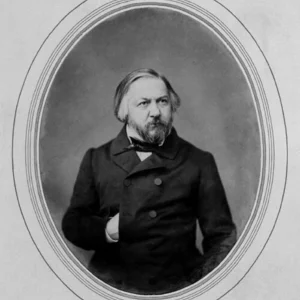

Russian composer regarded as the father of Russian classical music. His operas inspired an entire generation of Russian nationalist composers and founded a distinctly Russian school of music.
Mikhail Glinka(1804 — 1857)
Mikhail Glinka
Empire russe
6 min read
Frequently asked questions
Key Facts
- Born in 1804 in Novospasskoye, Russia, into a family of the nobility
- Created in 1836 the opera “A Life for the Tsar” (Ivan Susanin), the first Russian national opera
- Composed in 1842 the opera “Ruslan and Lyudmila,” inspired by a poem by Pushkin
- Major influence on “The Five” and on Tchaikovsky
- Died in 1857 in Berlin
Works & Achievements
The first great Russian national opera, built on a patriotic subject and melodies inspired by folklore; it marks the birth of Russian opera.
A fairy-tale opera after Pushkin, introducing original and orientalist harmonies that foreshadow modern Russian music.
An orchestral fantasy on two Russian folk themes; Tchaikovsky said that all Russian symphonic music came out of it, “like the oak from the acorn.”
A brilliant orchestral piece inspired by Spanish melodies gathered during his travels.
A second orchestral fantasy on Spanish themes, reflecting his taste for national colors.
A song for voice and piano that became famous, showcasing his gift for the Russian art song; it was transcribed for piano by Balakirev.
Anecdotes
Glinka spent part of his childhood with his grandmother, who doted on him so much that she kept him in an overheated room and prevented him from going outside. It was by listening to the church bells and the songs of the peasants in his village of Novospasskoye that he developed his love of music very early on.
At the premiere of his opera *A Life for the Tsar* in 1836, the aristocratic audience of Saint Petersburg was bewildered by the melodies inspired by peasant folklore. One nobleman is even said to have called this music “coachman's music,” but Tsar Nicholas I enjoyed the work so much that he gave Glinka a precious ring.
Glinka traveled abroad extensively to perfect his art: in Italy he met the great opera composers Bellini and Donizetti, then he studied music theory in Berlin. But far from his homeland, he was gripped by an intense nostalgia that drove him to want to write authentically Russian music.
For his second opera, *Ruslan and Lyudmila*, Glinka drew inspiration from a fantasy poem by Alexander Pushkin. His plan to write the libretto with the poet himself ended tragically: Pushkin was killed in a duel in 1837, before the collaboration could begin.
Glinka died in Berlin in 1857 from a chill. His remains were brought back to Russia, and his influence became so great that a group of five composers, nicknamed “The Five,” claimed his legacy to build a true Russian national school of music.
Primary Sources
The desire to compose Russian national music, and in particular a national opera, came to me during my stay abroad, where homesickness for my homeland gradually led me to the idea of writing in the Russian manner.
Everything I experienced in Italy, all that beauty of Italian song, made me feel all the more keenly that I had to write in my own way, as a Russian.
Mr. Glinka's opera opens a new era in the art of music: it is the birth of a truly Russian national opera.
Key Places
Village in the Smolensk Governorate where Glinka was born and spent his childhood, lulled by peasant songs and church bells.
Imperial capital where Glinka studied and where his two great operas premiered. The center of Russian musical life.
City in Italy where Glinka stayed to study opera and where he met Bellini and Donizetti.
Prussian capital where Glinka studied music theory under Siegfried Dehn and where he died in 1857.
Regions of Spain where Glinka traveled and collected folk melodies that inspired his Spanish overtures.