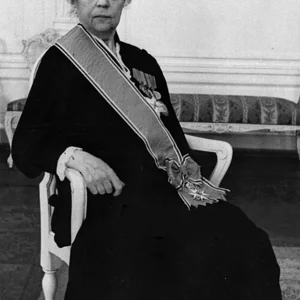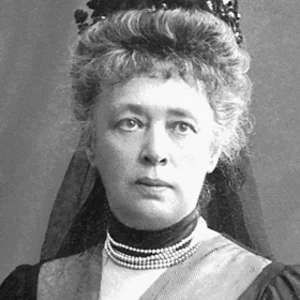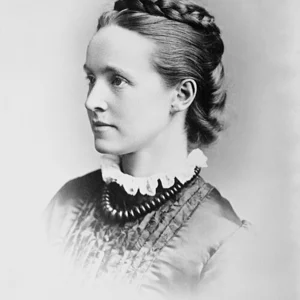

British feminist activist and leading figure of constitutional suffragism. As president of the NUWSS, she championed winning women's voting rights through lawful and peaceful means, in contrast to the militant methods of the suffragettes.
Millicent Fawcett(1847 — 1929)
Millicent Fawcett
Royaume-Uni de Grande-Bretagne et d'Irlande
6 min read
Frequently asked questions
Famous Quotes
« Courage calls to courage everywhere, and its voice cannot be denied.»
Key Facts
- Born on 11 June 1847 in Aldeburgh, Suffolk
- In 1897, became president of the National Union of Women's Suffrage Societies (NUWSS), uniting the moderate suffragist societies
- Championed a constitutional and peaceful strategy, distinct from the militancy of the WSPU suffragettes led by Emmeline Pankhurst
- In 1918, the Representation of the People Act granted the vote to British people over 30 who met certain conditions
- Died on 5 August 1929 in London, shortly after full electoral equality was achieved in 1928
Works & Achievements
A clear and accessible textbook on political economy, reprinted for many years. It reveals Fawcett as a talented populariser and a respected intellectual.
At the head of the largest constitutional suffragist organisation, she unites hundreds of local societies around lawful and peaceful methods.
She leads the government commission investigating detention conditions in South Africa, gaining national stature.
She works to give women access to higher education at one of the pioneering women's colleges of the University of Cambridge.
An account of the long suffragist struggle written after the 1918 victory. A first-hand testimony to decades of activism.
An autobiography retracing her life, her convictions and the movement for women's suffrage. A valuable source for historians.
An honorific distinction recognising her decisive role in securing the right to vote for women.
Anecdotes
Millicent Garrett was only 19 when she heard a speech by John Stuart Mill on women's right to vote; deeply moved, she decided to devote her life to it. At 21, in 1868, she was already delivering her first public speeches in favour of women's suffrage — something scandalous at a time when it was considered improper for a woman to speak before a crowd.
Her elder sister, Elizabeth Garrett Anderson, became the first officially recognised woman doctor in Britain. The two sisters had divided up their battles: one would open up medicine to women, the other would win the right to vote. Millicent said she had chosen suffrage because it would make all other progress possible.
Unlike the suffragettes who smashed shop windows and went on hunger strike, Millicent Fawcett believed in patient, lawful persuasion. She compared her movement to a glacier: slow but unstoppable, advancing step by step towards its goal without ever retreating.
During the First World War, she encouraged the women of the NUWSS to support the war effort through their work, showing that they were full citizens. Many attribute the 1918 vote in part to this demonstration of civic responsibility.
In 2018, for the centenary of the right to vote, a statue of Millicent Fawcett was erected in Parliament Square in London: it is the very first statue of a woman to stand there, among eleven men. She holds a banner bearing her own words: “Courage calls to courage everywhere.”
Primary Sources
“I have had the great joy and privilege of seeing the political enfranchisement of women practically completed.”
“The women's suffrage movement gathered behind it a great volume of public opinion, and it advanced like a glacier, slowly but irresistibly.”
“I cannot say I became a suffragist; I always was one, from the time I was old enough to think at all about the principles of representative government.”
“Courage calls to courage everywhere, and its voice cannot be denied.”
Key Places
Small coastal town where Millicent Garrett was born in 1847 into a large and progressive family. It was there that her independent spirit took shape.
Heart of British political power, where Fawcett led the parliamentary fight and where a statue was dedicated to her in 2018. It is also near here that she died in 1929.
Seat of Parliament where suffrage laws were debated and voted on. Fawcett followed the legislative work there alongside her husband, who was a Member of Parliament.
University town where Henry Fawcett taught political economy and where the couple lived. Millicent also campaigned there for women's access to higher education, helping to found Newnham College.
In 1901, the British government tasked Fawcett with investigating the concentration camps where Boer families were interned. Her mission marked her recognition as a trusted public figure.
Typical Objects

An embroidered fabric standard, often green, white and red, carried during the peaceful parades of the National Union of Women's Suffrage Societies. It identified the local societies during the great London marches.

A long scroll of signatures demanding the right to vote, submitted to Parliament. It was the constitutional weapon favoured by Fawcett to demonstrate the weight of public opinion.

A small badge worn on the lapel to display one's allegiance to the suffrage movement. The colours made it possible to tell constitutionalists from militants.

A wooden platform from which Fawcett addressed crowds in public halls and open-air gatherings. For a Victorian woman, speaking in public was a bold act.

A printed booklet arguing in favour of votes for women, handed out at meetings and door to door. The NUWSS relied on education and reason rather than on violent action.

Writing instruments with which Fawcett composed books, letters and speeches. A prolific author, she defended her cause as much with the pen as with the spoken word.
School Curriculum
Vocabulary & Tags
Key Vocabulary
Tags
Daily Life
Morning
An early riser and disciplined, Millicent often devoted her mornings to reading the newspapers and to correspondence. She replied to the countless letters from the suffragist societies and prepared articles and speeches.
Afternoon
Her afternoons were divided between committee meetings, encounters with Members of Parliament and the preparation of petition campaigns. She also received activists and allies to coordinate the work of the NUWSS.
Evening
In the evening, she frequently delivered speeches in public halls or attended debates. Back home, she read, wrote her books and maintained her networks through letters.
Food
Her diet was that of the well-to-do Victorian middle class: regular meals featuring meats, vegetables, bread and tea, a central element of British sociability. The table also served as a setting for political discussions.
Clothing
She wore the sober, respectable attire of Victorian ladies: long dresses fitted at the waist, high collars and hats. Her measured elegance reinforced her image as a serious and trustworthy reformer.
Housing
She lived in the comfortable homes of the cultivated middle class, in Cambridge and then in London. Her house was a place of intellectual work, full of books and open to activist gatherings.
Historical Timeline
Period Vocabulary
Liens externes & ressources
Références
Œuvres
Political Economy for Beginners
1870
Fondation et présidence de la NUWSS
1897-1919
Mission d'enquête sur les camps de la guerre des Boers
1901
Contribution à la fondation de Newnham College (Cambridge)
années 1870-1880
The Women's Victory — and After
1920
What I Remember
1924
Titre de Dame Commander (DBE)
1925