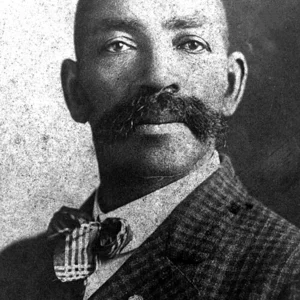

Bass Reeves (1838-1910) was the first African American deputy U.S. marshal west of the Mississippi. Born into slavery, he became one of the most famous lawmen of the Wild West, credited with more than 3,000 arrests over a thirty-two-year career.
Bass Reeves(1838 — 1910)
Bass Reeves
États-Unis
6 min read
Frequently asked questions
Key Facts
- Born into slavery in 1838 in Arkansas, he escaped during the Civil War and lived among the Native American nations of the Indian Territory
- Appointed deputy U.S. marshal in 1875 by Judge Isaac Parker, he became the first Black man to hold that position west of the Mississippi
- Over the course of his career (1875-1907), he made more than 3,000 arrests of outlaws
- Fluent in several Native American languages and a master of disguise, he operated in the dangerous Indian Territory
- He died in 1910 in Muskogee, Oklahoma, shortly after the end of his career as a municipal police officer
Works & Achievements
Recruited by the marshal of the Western District of Arkansas, Reeves paved the way for Black lawmen in the West, at a time of intense discrimination.
An exceptional record that made him one of the most effective and most feared marshals of the Old West.
Reeves tracked this elusive bandit of the Indian Territory for years before arresting him, illustrating his legendary tenacity.
Reeves personally took on the warrant for his son, who was wanted for murder, demonstrating his absolute sense of duty.
Grown too old for long manhunts, the veteran continued to enforce the law as a simple town officer.
A statue in Fort Smith, a bridge named after him in Muskogee: Reeves is today celebrated as a major figure in African-American history and in the lore of the Old West.
Anecdotes
Bass Reeves was born into slavery in 1838 in Arkansas. During the Civil War, according to the most widespread tradition, he is said to have fled after a violent quarrel with the man who held him in slavery, and took refuge in the Indian Territory among the Cherokee, the Creek and the Seminole. There he learned several Native American languages, knowledge that would later make him a feared marshal.
Reeves could neither read nor write. Before each mission, he had the arrest warrants read aloud to him and memorized the names and descriptions of the wanted men. It is said that he never erred in presenting the right paper to the right prisoner, despite carrying dozens of warrants in his pocket.
A master of disguise, Reeves sometimes dressed up as a tramp, a farmer or an outlaw to approach his targets without arousing suspicion. Once he had gained their trust, he would draw his weapon and clap on the handcuffs. He is credited with more than 3,000 arrests over thirty-two years of service.
Duty came before family: Reeves once had to arrest his own son, who was wanted for murder. He insisted on handling the warrant himself rather than entrusting it to a colleague, and brought him before the court in Fort Smith.
Reputed to be an excellent shot and a man of great physical strength, Reeves came through hundreds of gunfights without ever being killed. At the end of his life, after Oklahoma became a state in 1907, the old marshal became an ordinary police officer in Muskogee, continuing to serve the law until his final months.
Primary Sources
In the history of the early days of eastern Oklahoma, the name of Bass Reeves holds a place in the front rank among those who rid the old Indian Territory of outlaws and bandits.
A deputy U.S. marshal, Bass Reeves served for many long years in the Indian Territory and was credited with a considerable number of arrests of men wanted by the federal courts.
The newspaper regularly reported on the expeditions of the deputies who set out into the Indian Territory and on the prisoners brought back to Fort Smith to be tried before the federal court.
Key Places
Rural region of Arkansas where Bass Reeves was born into slavery in 1838.
Seat of Judge Isaac Parker's federal court, from which deputy marshals set out for Indian Territory and where prisoners were tried.
Town near which Reeves settled as a farmer after the abolition of slavery, before taking up the career of marshal.
Vast territory home to the Native American nations and many outlaws, Reeves's main field of operations for thirty-two years.
Town where Reeves ended his career as a police officer after 1907 and where he died in 1910.
Seat of a federal court with jurisdiction over part of Indian Territory, to which Reeves also had to bring prisoners.
Typical Objects

The famous six-shot “Peacemaker,” the iconic sidearm of the lawmen and outlaws of the Wild West. Reeves, a crack shot, usually carried two of them.

A lever-action repeating rifle, deadly at a distance and essential during the long mounted manhunts across Indian Territory.

A star-shaped metal badge symbolizing federal authority. It made Reeves the first African American deputy marshal west of the Mississippi.

Judicial documents issued by the Fort Smith court authorizing the arrest of wanted men. Illiterate, Reeves had them read aloud to him and memorized their contents.

A felt hat typical of Western riders, shielding them from sun and rain during long rides.

A heavy canvas-covered wagon used to transport prisoners across Indian Territory to the Fort Smith court, during rounds that sometimes lasted weeks.

Metal restraints used to immobilize captured suspects during the long journey back to the federal court.
School Curriculum
Vocabulary & Tags
Key Vocabulary
Tags
Daily Life
Morning
During patrols across Indian Territory, Reeves would rise before dawn beside the campfire, saddle his horse, and check his weapons. He would go back over the warrants he had memorized in his head and plan the day's leg of the journey across prairies and forests.
Afternoon
Afternoons were spent on horseback, tracking fugitives over dozens of miles or questioning locals and scouts. Sometimes he would disguise himself to approach an outlaw camp without being noticed.
Evening
In the evening, he set up his bivouac, kept watch over the prisoners chained in the wagon, and stood guard. A full expedition back to Fort Smith could last several weeks away from home.
Food
On the trail, meals were rough and simple: corn cakes, salt pork, black coffee, game hunted along the way, and canned goods carried in the wagon. At the farm, the family ate produce from the vegetable garden and the henhouse.
Clothing
Reeves wore the sturdy clothes of a horseman: a shirt, vest, heavy trousers, boots, and a wide-brimmed hat. For his missions, he might put on worn-out clothes to pass for a drifter or a farmer.
Housing
Between missions, he lived with his family in a wooden house in Arkansas and later in Oklahoma. In the field, his home was the open-air camp, under the wagon's canvas cover or beneath the open sky.
Historical Timeline
Period Vocabulary
Liens externes & ressources
Références
Œuvres
Premier adjoint afro-américain au marshal des États-Unis à l'ouest du Mississippi
1875
Plus de 3000 arrestations en trente-deux ans
1875-1907
Capture du hors-la-loi Bob Dozier
années 1870-1880
Arrestation de son propre fils
vers 1902
Service dans la police de Muskogee
1907-1909
Postérité et mémoire
XXe-XXIe siècles