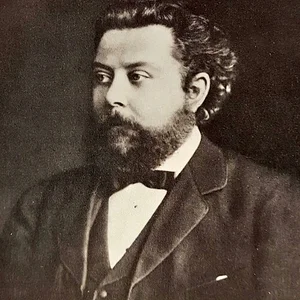

Modest Mussorgsky was a 19th-century Russian composer and member of “The Five,” a group that sought to create a distinctly Russian national music. He is famous for his opera Boris Godunov and his piano suite Pictures at an Exhibition.
Modest Mussorgsky(1839 — 1881)
Modest Mussorgsky
Empire russe
6 min read
Frequently asked questions
Key Facts
- Born in 1839 in Karevo, Russia, into a family of the minor nobility
- Member of “The Five” (alongside Balakirev, Borodin, Rimsky-Korsakov, and Cui), champions of a Russian national music
- Composed his major opera Boris Godunov, premiered in 1874 at the Mariinsky Theatre in Saint Petersburg
- Composed Pictures at an Exhibition (1874), a piano suite later orchestrated by Maurice Ravel (1922)
- Died in 1881 in Saint Petersburg, at the age of 42, his health ruined by alcoholism
Works & Achievements
A major opera about a tsar consumed by remorse; it places the Russian people at the heart of the drama and profoundly renews the art of opera.
A piano suite inspired by the drawings of Viktor Hartmann, famous worldwide, especially in Ravel's orchestration (1922).
A symphonic poem evoking a witches' sabbath, based on Russian folklore.
An unfinished historical opera about the turmoil of 17th-century Russia, completed after his death.
An unfinished comic opera after Gogol, depicting Ukrainian village life.
A song cycle in which Death appears under several guises, the pinnacle of his vocal art.
A song cycle on the world of childhood, of great tenderness and a fresh realism.
Anecdotes
The famous final scene of the opera *Boris Godunov* shows a holy fool, the *Yurodivy*, who weeps over the fate of Russia. Mussorgsky was determined to give a voice to the common people and the humble, which was very rare in opera in his day.
*Pictures at an Exhibition* was composed in 1874 in tribute to his friend, the painter **Viktor Hartmann**, who died very young. In his imagination, Mussorgsky strolled through an exhibition of his friend's drawings, translating each image into music, linked together by a *Promenade* that recurs like a connecting thread.
Mussorgsky and four other composers (**Borodin**, **Rimsky-Korsakov**, **Balakirev** and **Cui**) formed *The Mighty Handful*. Most of them were amateurs in the noble sense: Borodin was a chemist, Rimsky-Korsakov a naval officer, and Mussorgsky himself a civil servant.
At the end of his life, Mussorgsky sank into alcoholism and poverty. The painter **Ilya Repin** painted his famous portrait just a few days before his death, in **1881**, in a military hospital in Saint Petersburg: it shows a man with a feverish gaze, wearing a dressing gown.
Many of his works remained unfinished or were judged “too crude” by his contemporaries. It was his friend Rimsky-Korsakov who revised and orchestrated several of his scores after his death, helping to make them known throughout the world.
Primary Sources
My Hartmann is seething just as Boris seethed. Sounds and ideas float in the air, I swallow them up to the point of indigestion, and I barely have time to throw them down on paper.
Art is a means of conversing with people, not an end in itself.
Life, wherever it shows itself; truth, however bitter; speaking boldly and frankly to people: that is my leaven, that is what I want.
Key Places
Village in the Pskov region where Mussorgsky was born into a family of landowners, in close contact with the countryside and peasant songs.
Imperial capital where he studied, pursued his career as a civil servant and composer, and where his operas were premiered.
Great opera house in Saint Petersburg where Boris Godunov was premiered in 1874.
Establishment in Saint Petersburg where Mussorgsky, ill and destitute, died in March 1881.
Necropolis of artists in Saint Petersburg where he was buried, near other great Russian musicians.
Typical Objects

Mussorgsky's favourite instrument, on which he composed and improvised. *Pictures at an Exhibition* was first written for solo piano.

Sheets of ruled paper on which he jotted his musical ideas in ink. Many of his manuscripts remained unfinished or full of crossings-out.

The military dress he wore as a young man at the Cadet School and then in the Preobrazhensky Regiment, before devoting himself to music.

Administrative documents he filled out at the ministry to earn a living, his job leaving him little time to compose.

The sound of church bells permeates his music, notably the coronation scene of *Boris Godunov*, which imitates their deep, resonant tone.

Watercolours and sketches by the painter, a friend of Mussorgsky, exhibited after his death, which inspired each movement of *Pictures at an Exhibition*.
School Curriculum
Vocabulary & Tags
Key Vocabulary
Daily Life
Morning
For years, Mussorgsky went each morning to his civil servant's office in a ministry in Saint Petersburg. This day job to make ends meet kept him busy for long hours and often cut him off from composing.
Afternoon
In the afternoon, whenever he could, he would meet up with his friends from “The Mighty Five” to discuss music and art. He liked to play at the piano the pages he had just written in order to gather their opinions.
Evening
Evenings brought the artists together in salons where music was made. Mussorgsky, an excellent pianist and accompanist, would improvise there and sing his own songs.
Food
Like many Russians of his time, he ate black bread, soups such as cabbage shchi and borscht, kasha (a porridge of grains) and tea from the samovar. Toward the end of his life, alcohol, especially brandy, ruined his health.
Clothing
An elegant and refined young man, he took care over his appearance in the salons. Impoverished at the end of his life, he was portrayed by Repin in a simple dressing gown, his hair in disarray.
Housing
Lacking the means, he often lived in rented rooms, sometimes sharing lodgings with friends such as Rimsky-Korsakov. His Saint Petersburg apartments were modest.