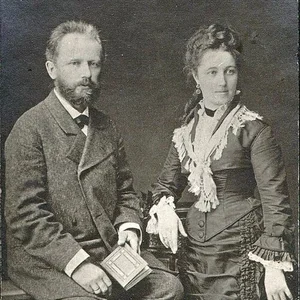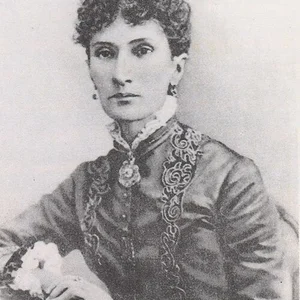

A wealthy Russian widow and businesswoman, patron of Pyotr Ilyich Tchaikovsky, whom she supported financially for thirteen years. Their relationship, kept strictly to letters by mutual agreement, produced more than 1,200 letters.
Nadezhda von Meck(1831 — 1894)
Nadezhda von Meck
Empire russe
6 min read
Frequently asked questions
Key Facts
- Born in 1831 into a family of the minor Russian nobility
- Widowed in 1876 on the death of Karl von Meck, a railway magnate, she inherited an immense fortune
- From 1877 onward, she paid Tchaikovsky an annual allowance of 6,000 rubles that allowed him to devote himself to composition
- Carried on a correspondence of more than 1,200 letters with the composer without ever meeting him in private
- Abruptly broke off her support and their correspondence in 1890, three years before her death in 1894
Works & Achievements
An annual stipend of 6,000 rubles that freed the composer from teaching and allowed him to devote himself to creative work.
More than 1,200 letters, an exceptional record of the composer's creative process and of Russian society at the time.
A work conceived during the early years of their friendship and dedicated to “my best friend,” an emblem of their collaboration.
Maintaining a household orchestra and hiring young musicians, including Claude Debussy, who was employed as the family's pianist.
Shrewd administration of the vast fortune inherited from her husband, making her one of the wealthiest women in Russia.
Raising a family of eleven children in a refined musical environment, several of whom became accomplished musicians or music lovers.
Anecdotes
Nadezhda von Meck and Pyotr Tchaikovsky exchanged more than 1,200 letters over thirteen years, but imposed a strange rule on themselves: never to meet in person. When they crossed paths by chance during a walk in 1879, they merely exchanged a brief, awkward greeting before moving on without a word.
The widow of a railway magnate, Nadezhda von Meck raised eleven children while managing an immense fortune. To entertain her large family, she maintained a private orchestra: a young French pianist named Claude Debussy was hired in 1880 to give lessons and play in a quartet.
The annual pension of 6,000 rubles that she paid Tchaikovsky allowed him to leave his post at the Moscow Conservatory and devote himself entirely to composition. It was during this period that he completed his Fourth Symphony, which he dedicated to her with the inscription “to my best friend.”
In 1890, von Meck abruptly ended both the pension and the correspondence, citing financial difficulties. The composer was deeply hurt, convinced that he had been abandoned; historians today believe that illness and family pressures were the main reasons for this break.
Tchaikovsky died in November 1893; Nadezhda von Meck passed away less than two months later, in January 1894, taken by tuberculosis. Their fates remained intertwined to the very end, as if the epistolary friendship that had united them could only be undone in death.
Primary Sources
How could it not be yours, since it is our symphony, yours and mine? To my best friend.
The more closely the matter touches me, the less I wish to make your personal acquaintance. It seems to me that I would then no longer be able to speak to you as I do today.
My affairs are in a deplorable state... Do not forget me, and think of me sometimes.
A collection of more than 1,200 letters exchanged between 1876 and 1890, a unique testimony to a friendship conducted entirely through letters between a patron and a composer.
Key Places
Center of Russian musical life where Tchaikovsky taught and where von Meck owned a residence. The pivotal city of their relationship.
Von Meck's property, which she made available to Tchaikovsky so he could compose there, always arranging never to be present at the same time as him.
Imperial capital and great musical hub, the stage of the era's cultural life and the place where Tchaikovsky died.
Von Meck stayed here and invited Tchaikovsky in 1878, lodging him in a villa next to her own — still without any direct contact.
Spa town where Nadezhda von Meck died of tuberculosis in January 1894, shortly after Tchaikovsky.
Typical Objects

The more than 1,200 letters exchanged with Tchaikovsky, the exclusive vehicle of their friendship. They blended intimate confidences, reflections on music and everyday concerns.

Writing instruments essential to such an abundant correspondence. Von Meck often wrote several pages in a single sitting.

The work Tchaikovsky dedicated to her and called “our symphony.” It symbolizes the musical fruit of her patronage.

At the heart of her household's musical life, where her hired musicians played, including the young Debussy. The piano accompanied evening gatherings and family lessons.

Securities and stakes in the railway companies on which her husband had built his fortune. They were the foundation of her wealth and her independence as a businesswoman.

Von Meck sent photographs to Tchaikovsky, their only way to “see” each other without ever meeting. These images sustained their bond across the distance.
School Curriculum
Vocabulary & Tags
Key Vocabulary
Daily Life
Morning
Rising in her vast residence, Nadejda von Meck devoted her mornings to correspondence and to managing her railway affairs. She read and answered numerous letters, including the eagerly awaited ones from Tchaikovsky.
Afternoon
In the afternoon, she oversaw the education of her many children and received estate managers and businessmen. Suffering increasingly from fragile health, she limited her outings and shunned society life.
Evening
Evenings were musical: her private orchestra and the musicians she employed played for the family. One could hear Tchaikovsky's music there, and the young Debussy practiced piano and string quartet.
Food
Like the great Russian aristocracy, her table blended refined French cuisine with Russian dishes: soups, game, and fish, accompanied by imported wines. The meals, hearty and abundant, followed the customs of grand wealthy households.
Clothing
She wore the dark, sober dresses of a wealthy nineteenth-century widow, made of fine silks and quality fabrics, without ostentation. Her prolonged mourning after her husband's death left a lasting mark on her wardrobe.
Housing
She lived in vast residences and estates, both in Moscow and in the countryside (Brailov), and stayed in villas in Italy and France. Her homes, richly furnished, housed libraries and music rooms.