 flip
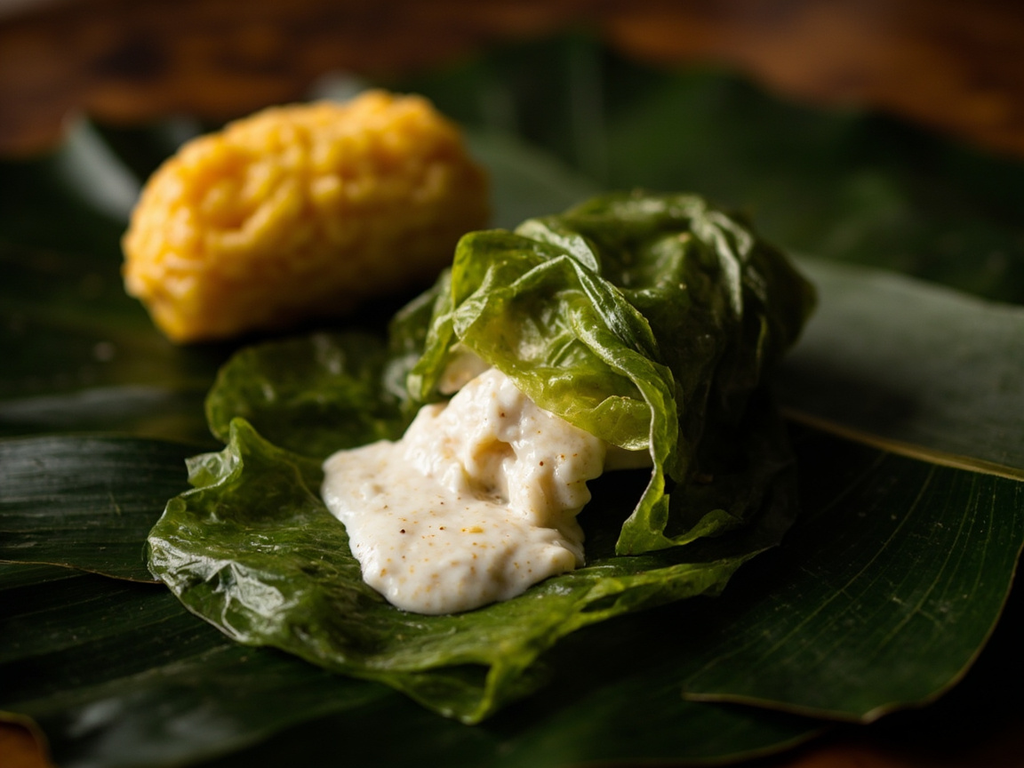
Palusami — taro leaf bundles with coconut cream
Palusami — taro leaf bundles with coconut cream
Why this dish? Taro (talo) is the staple food of daily Samoan life mentioned in Nafanua's profile. Palusami, its young leaves soaked in coconut cream, accompanies every ordinary meal: it is the everyday food of the people she leads, that which keeps warriors strong between battles.
Young taro leaves wrapped in a bundle around a generous salted coconut cream, cooked until melting and creamy, halfway between spinach and a velouté.
You think we live only on glory and plunder? Before the battle, there are simple days, and simple days have their treasure. I took the young leaves of the talo, still tender, and filled them with the white cream pressed from the nuts. A tight bundle, placed on the stones, and patience: that's all. When the leaf becomes soft as a child's earlobe, it's ready. It's humble, but it's that strength my warriors carried in their bellies.
- •Young taro leaves (lau talo) — a good handful per bundle (wrap and vegetable)
- •Pressed coconut cream (pe'epe'e) — generous (rich, creamy binder)
- •Seawater or sea salt — a pinch (seasoning)
- •Banana leaf — 1 per bundle (cooking wrap)
Palusami — taro leaf bundles with coconut cream
Young taro leaves wrapped in a bundle around a generous salted coconut cream, cooked until melting and creamy, halfway between spinach and a velouté.
Why this dish? Taro (talo) is the staple food of daily Samoan life mentioned in Nafanua's profile. Palusami, its young leaves soaked in coconut cream, accompanies every ordinary meal: it is the everyday food of the people she leads, that which keeps warriors strong between battles.
You think we live only on glory and plunder? Before the battle, there are simple days, and simple days have their treasure. I took the young leaves of the talo, still tender, and filled them with the white cream pressed from the nuts. A tight bundle, placed on the stones, and patience: that's all. When the leaf becomes soft as a child's earlobe, it's ready. It's humble, but it's that strength my warriors carried in their bellies.
Ingredients (period version)
- Young taro leaves (lau talo) — a good handful per bundle (wrap and vegetable)
- Pressed coconut cream (pe'epe'e) — generous (rich, creamy binder)
- Seawater or sea salt — a pinch (seasoning)
- Banana leaf — 1 per bundle (cooking wrap)
Ingredients
- Young taro leaves (Asian/Caribbean grocery) — or spinach/young Swiss chard — 300 g (main vegetable)
- Thick coconut cream (unsweetened) — 200 ml (creamy binder)
- Sea salt — 1/2 tsp (seasoning)
- Spring onion, sliced (optional, modern touch) — 1 (freshness)
- Banana leaves OR parchment paper + foil — 4 squares (papillotes)
Method
- Wash the leaves thoroughly. IMPORTANT: raw taro leaves contain calcium oxalate — they must be well cooked (never raw).
- Stack 4-5 leaves into a cup shape, pour 3-4 tbsp salted coconut cream (and onion) in the center.
- Fold into a bundle and wrap in a banana leaf softened over a flame (or in a papillote).
- Steam or bake at 160°C for 1 hour, until the leaves are completely melting.
- Open carefully: the cream should have thickened and coated the leaves.
How it was made : Palusami is a living classic throughout Western Polynesia. Traditionally, the leaf bundles cooked in the umu, nestled between the taros and the pig, benefiting from the heat of the stones. Long cooking is essential to neutralize the oxalate crystals in taro leaves.
The contemporary twist : Serve the bundle closed in the plate and let each guest open it: the burst of coconut steam is a small spectacle.
Nafanua · Charactorium