 flip
flipPua'a i le umu — whole pig in the stone oven
Pua'a i le umu — whole pig in the stone oven
Why this dish? Oral traditions make Nafanua a war chief who leads the armies of Savai'i to victory and unifies Samoa. After a won battle, the pig umu is the banquet that celebrates the warriors and thanks the aitu: it is the victory dish naturally associated with her.
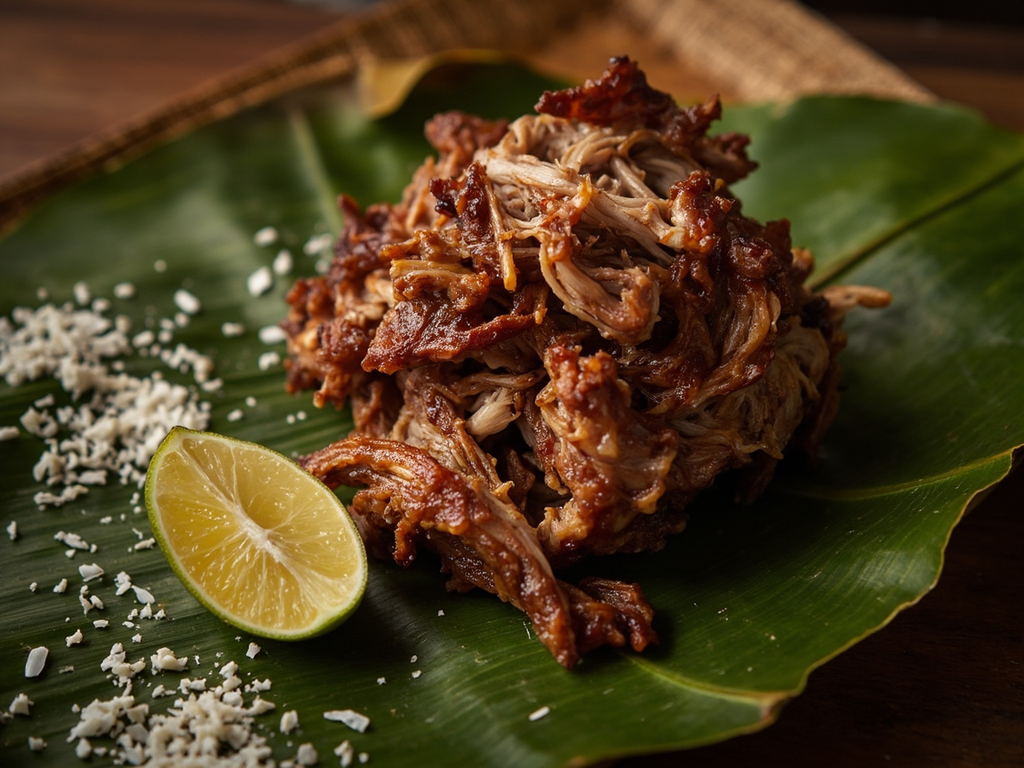
A whole pig basted, stuffed with herbs and leaves, slowly cooked on hot volcanic stones covered with banana leaves. The meat confits in its own fat, smoky and tender.
Listen well, you who share my fire. When my warriors returned from the islands with victory in hand, we opened the earth like one opens an offered hand. The stones of Savai'i, I heated them until they glowed red like the heart of a brave man, then we laid the pua'a wrapped in fa'i leaves. The smoke rose to the aitu before the meat touched our lips — for we feed the spirits first, then the men. And he who had held the rank received the fattest portion: it was my honor to hand it to him.
- •Pig (pua'a) — one whole young animal (centerpiece of the banquet)
- •Volcanic stones (ma'a) — a bed of stones (heat source for the earth oven)
- •Banana leaves (lau fa'i) — in large quantity (cover, steam, and perfume)
- •Seawater or sea salt — to taste (seasoning)
- •Grated coconut flesh — a few nuts (fat and perfume in the cavity)
Pua'a i le umu — whole pig in the stone oven
A whole pig basted, stuffed with herbs and leaves, slowly cooked on hot volcanic stones covered with banana leaves. The meat confits in its own fat, smoky and tender.
Why this dish? Oral traditions make Nafanua a war chief who leads the armies of Savai'i to victory and unifies Samoa. After a won battle, the pig umu is the banquet that celebrates the warriors and thanks the aitu: it is the victory dish naturally associated with her.
Listen well, you who share my fire. When my warriors returned from the islands with victory in hand, we opened the earth like one opens an offered hand. The stones of Savai'i, I heated them until they glowed red like the heart of a brave man, then we laid the pua'a wrapped in fa'i leaves. The smoke rose to the aitu before the meat touched our lips — for we feed the spirits first, then the men. And he who had held the rank received the fattest portion: it was my honor to hand it to him.
Ingredients (period version)
- Pig (pua'a) — one whole young animal (centerpiece of the banquet)
- Volcanic stones (ma'a) — a bed of stones (heat source for the earth oven)
- Banana leaves (lau fa'i) — in large quantity (cover, steam, and perfume)
- Seawater or sea salt — to taste (seasoning)
- Grated coconut flesh — a few nuts (fat and perfume in the cavity)
Ingredients
- Pork shoulder or blade with skin — 2 kg (replaces the whole pig)
- Freshly grated coconut (or unsweetened coconut) — 150 g (fat and perfume)
- Coarse sea salt — 2 tbsp (seasoning)
- Banana leaves (Asian frozen section) — 4 large leaves (flavored papillote)
- Water — 1 cup (cooking steam)
Method
- Rub the pork with coarse salt on all sides and score the skin in a crosshatch pattern.
- Insert the grated coconut against the flesh, then wrap the piece in banana leaves passed over a flame for 10 seconds to soften.
- Place the packet in a dish, add a cup of water at the bottom, cover tightly.
- Bake at 150°C for 3 to 3.5 hours, until the meat falls off the fork.
- Open the leaves, increase to 220°C for 15 minutes to crisp the skin, then shred and drizzle with cooking juices.
How it was made : The authentic umu has no oven: you dig a pit, build a fire on volcanic stones until they are incandescent, remove the embers, place the food wrapped in leaves, cover with leaves then earth, and let it steam for several hours. It is a festive cooking method, assembled by men, that can feed an entire village.
The contemporary twist : Serve the shredded meat on a large banana leaf at the center of the table, without individual plates: everyone serves themselves by hand, as at a fono.
Nafanua · Charactorium