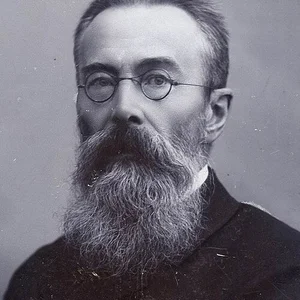

Russian composer of the 19th century and member of The Five. An undisputed master of orchestration, he is famous for his symphonic suite Scheherazade and his many operas inspired by Russian folklore.
Nikolai Rimsky-Korsakov(1844 — 1908)
Nikolai Rimsky-Korsakov
Empire russe
5 min read
Frequently asked questions
Key Facts
- Born in 1844 in Tikhvin, died in 1908 near Luga (Russia)
- Member of The Five, a circle of Russian composers championing a national music
- Composed the symphonic suite Scheherazade in 1888, inspired by One Thousand and One Nights
- A professor at the Saint Petersburg Conservatory, he taught notably Igor Stravinsky
- Author of famous operas such as The Golden Cockerel and The Legend of the Invisible City of Kitezh, and of Flight of the Bumblebee
Works & Achievements
Symphonic suite inspired by the *One Thousand and One Nights*, the pinnacle of his orchestration mastery and one of the most frequently performed Russian works.
A dazzling orchestral piece celebrating the colors of Spanish music, a showcase of his instrumental virtuosity.
An overture evoking the Orthodox liturgy and Russian religious chants.
His final opera, a biting satire of absolute power after Pushkin, censored by the tsarist authorities.
A mystical opera blending Russian legend with spirituality, sometimes nicknamed the “Russian Parsifal.”
A brief orchestral interlude that became world-famous for its whirlwind of rapid notes.
A didactic treatise published after his death, a major reference for the teaching of orchestration.
Anecdotes
Before becoming a composer, Rimsky-Korsakov was an officer in the Imperial Russian Navy. In 1862, he boarded the clipper Almaz for a round-the-world voyage lasting nearly three years, composing his first symphony during the long crossings at sea.
When he accepted a post as professor of composition at the Saint Petersburg Conservatory in 1871, Rimsky-Korsakov barely mastered the rules of harmony and counterpoint himself. He studied in secret, sometimes only one lesson ahead of his own students, to fill the gaps in his knowledge.
He completed or reorchestrated many works by his friends from The Five after their deaths, notably Borodin's unfinished opera Prince Igor and Mussorgsky's Boris Godunov. Without him, several Russian masterpieces might have remained silent.
In 1905, he publicly defended the students who had revolted and was dismissed from the Conservatory. In a show of solidarity, many professors resigned, and his works were for a time banned from performance by the tsarist censors.
Rimsky-Korsakov perceived musical keys as colors, a phenomenon close to synesthesia: he associated, for example, the key of E major with blue and E-flat with darkness. This perception fueled his genius for orchestration.
Primary Sources
The talent for orchestration, like any other, can and must be developed. The composer must feel his orchestra, love its colours and its timbres.
To orchestrate is to create; and that cannot be taught. One can only show how the great masters went about it and point out the resources of the instruments.
I had become a professor of composition while remaining ignorant of a great many things myself; I learned by teaching, often staying just one lesson ahead of my pupils.
Key Places
Small town in the Novgorod region where Rimsky-Korsakov was born in 1844. The house of his birth is now a museum.
Imperial capital where he studied at the Naval Academy, taught at the Conservatory, and composed the bulk of his work.
Institution where he was a professor of composition from 1871 to 1905, training students such as Stravinsky and Prokofiev.
Country estate near Saint Petersburg where he died in 1908.
Typical Objects

Document where all the instrumental parts are written out simultaneously. Rimsky-Korsakov made an art of it, balancing timbres and sonic colours.

A slender stick used to direct a musical ensemble. Rimsky-Korsakov conducted his own works and those of his friends in The Mighty Five.

A keyboard instrument used to compose and try out harmonies. The composer's everyday working tool at his desk.

The braided dress uniform worn by Rimsky-Korsakov during his naval career. A symbol of his double life as both sailor and musician.

A small metal instrument that gives a reference note for tuning. Essential for precise work on timbres.

A collection of folk melodies that Rimsky-Korsakov compiled and harmonised. A source of inspiration for his national operas.
School Curriculum
Vocabulary & Tags
Key Vocabulary
Daily Life
Morning
Methodical and disciplined by his military training, Rimsky-Korsakov often devoted his mornings to composition and to writing out scores at his desk. He liked quiet in order to refine his orchestrations.
Afternoon
In the afternoon, he taught at the Saint Petersburg Conservatory, correcting his students' exercises and giving his courses in composition and orchestration. He also carried out his official duties connected to the music of the navy.
Evening
Evenings were devoted to rehearsals, concerts, and meetings of The Five, where the composers played and discussed their works in progress. The capital's musical life was intense.
Food
He shared the diet of the cultivated Russian bourgeoisie of the nineteenth century: soups such as borscht and shchi, rye bread, fish, and tea served from the samovar accompanied long conversations.
Clothing
During his naval career, he wore the braided uniform of an officer of the Imperial Navy. Once he became a professor and civilian composer, he adopted the dark suit and frock coat of Saint Petersburg's polite society.
Housing
He lived in a middle-class apartment in Saint Petersburg, surrounded by his large family, and spent the summer in country houses (*dachas*) well suited to composition, such as at Lyubensk.