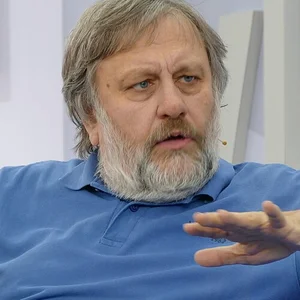

Slovenian philosopher and essayist born in 1949, a major figure of contemporary critical thought. He blends Lacanian psychoanalysis, German idealism (Hegel) and Marxism to analyze ideology, popular culture and globalized capitalism.
Slavoj Žižek(1949 — ?)
Slavoj Žižek
Slovénie
6 min read
Frequently asked questions
Key Facts
- Born on March 21, 1949 in Ljubljana, Slovenia (then Yugoslavia)
- In 1989 published 'The Sublime Object of Ideology', the work that brought him worldwide recognition
- Develops a reading of ideology connecting Hegel, Marx and the psychoanalysis of Jacques Lacan
- Researcher at the Institute of Sociology of the University of Ljubljana and visiting professor at numerous universities
- Becomes a media figure of contemporary philosophy, nicknamed the “most dangerous thinker in the West”
Works & Achievements
Žižek's first major book in English, the one that made his name; in it he explains how ideology shapes our everyday gestures without our being aware of it.
A documentary film in which Žižek analyses great movies to explain desire and the unconscious; it made him famous with the general public.
An essay on the September 11, 2001 attacks, questioning the fragility of the sheltered Western world.
An analysis of the crises — economic, ecological, social — that in his view threaten globalised capitalism.
A monumental work of more than a thousand pages devoted to Hegel, regarded as his major philosophical achievement.
A follow-up documentary in which Žižek dissects ideology through cinema and popular culture.
A collection of essays in which Žižek blends psychoanalysis, politics and philosophy to think through the contemporary subject.
Anecdotes
Slavoj Žižek is nicknamed “the most dangerous philosopher in the West” by some newspapers, but he loves to poke fun at himself: he gesticulates nonstop, sniffles, and tugs at his t-shirt while talking, to the point that his tics have become his trademark in hundreds of videos across the Internet.
In his youth in communist Yugoslavia, Žižek was passed over for a post at the University of Ljubljana because the regime judged his thesis to be too insufficiently Marxist-Leninist. He then worked for several years as a researcher without a real teaching position, and even went through a spell of unemployment.
Žižek loves analyzing Hollywood movies and popular culture to explain difficult philosophical ideas. He comments on Hitchcock just as readily as on “Star Wars” or Coca-Cola, convinced that a cartoon or an advertisement says as much about our society as a hefty philosophy book.
In 1990, during Slovenia's first free elections, Žižek ran as a candidate for the country's collective presidency. The philosopher genuinely campaigned, without being elected, proving that his reflections on politics did not stay confined to books alone.
In 2019, Žižek debated in public in Canada against the psychologist Jordan Peterson before a packed hall and tens of thousands of online viewers. The topic — “happiness, capitalism, and Marxism” — was followed like a real match, a sign of the Slovenian philosopher's worldwide fame.
Primary Sources
“They do not know it, but they are doing it”: this, according to Žižek, is the very definition of ideology, which operates in our everyday gestures without our being aware of it.
Here Žižek analyzes the September 11, 2001 attacks as a moment when the West brutally discovers the fragility of its sheltered world.
“Cinema is the ultimate pervert art: it does not give you what you desire, it tells you how to desire,” Žižek explains directly to the camera, blending philosophy with film clips.
Here Žižek argues that globalized capitalism is approaching several limits — ecological, social, economic — that it nonetheless refuses to face.
Key Places
Žižek's birthplace and the capital of Slovenia, where he studied and worked. He remains a researcher at the University of Ljubljana.
Žižek pursues his philosophy studies here and then becomes a researcher at the Institute of Sociology. The communist regime long denied him a genuine teaching position.
Žižek comes to train in Paris under the heirs of Jacques Lacan and defends a thesis in psychoanalysis there. France profoundly shapes his thought.
Žižek teaches at this British university and directs an institute devoted to the humanities there. London is one of his academic anchor points.
Žižek gives numerous lectures here and, in 2011, supports the Occupy Wall Street movement. The city symbolizes his fame in the English-speaking world.
In 2019, Žižek confronts psychologist Jordan Peterson here in a globally followed public debate on capitalism and Marxism.
Typical Objects

Žižek almost always appears in a simple t-shirt, refusing the formal attire expected of a professor. He nervously tugs at it while speaking, a gesture that has become his signature.

Žižek is the author of dozens of works, some of them over a thousand pages long. The book remains his main tool for spreading his ideas.

Much of Žižek's fame comes from his appearances filmed and broadcast on the Internet. Video has become an extension of his books.

Žižek uses popular films as the raw material of his philosophy. The movie poster symbolizes his way of analyzing mass culture.

Žižek often uses the famous drink as an example to explain capitalism and the desire to consume. An ordinary object becomes a tool for reflection.

Žižek is a tireless speaker, giving lectures all over the world. The microphone accompanies his fiery, humor-filled appearances.
School Curriculum
Vocabulary & Tags
Key Vocabulary
Daily Life
Morning
Žižek gets up and often starts by reading and writing, surrounded by piles of books. He calls himself a morning person and likes to work very early, before being swept up by demands and travel.
Afternoon
His afternoons are devoted to preparing lectures, giving interviews, and flying from one country to another. His life runs to the rhythm of a very busy international schedule.
Evening
In the evening, Žižek frequently watches films, which feed directly into his philosophical thinking. He often keeps reading or debating late into the night.
Food
Žižek leads a rather unsociable life and admits to hating formal dinners and table chitchat. He prefers simple, no-fuss food, so as not to waste time away from his work.
Clothing
He almost always dresses casually, in a T-shirt and ordinary trousers, far from the academic suit. This deliberately plain attire is part of his public persona.
Housing
Žižek lives in Ljubljana, his hometown, in an apartment cluttered with books. He divides his time between Slovenia and long stays abroad to teach.
Historical Timeline
Period Vocabulary
Liens externes & ressources
Références
Œuvres
Le Sublime Objet de l'idéologie
1989
Bienvenue dans le désert du réel
2002
Vivre la fin des temps
2010
Less Than Nothing
2012
La Subjectivité à venir
2004