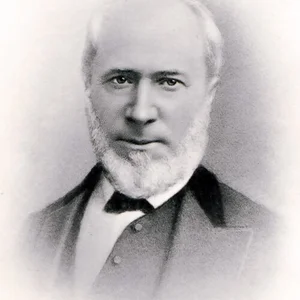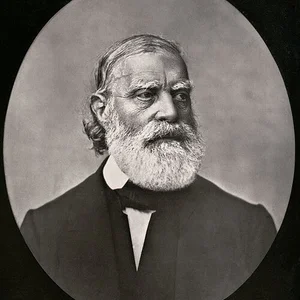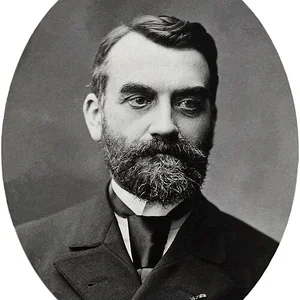

Paul Vidal de La Blache (1845-1918) was a French geographer regarded as the founder of the French school of geography. He developed the concept of the “genre de vie” (way of life) and the notion of possibilism, establishing a human geography attentive to the relationships between societies and their environment.
Paul Vidal de La Blache(1845 — 1918)
Paul Vidal de La Blache
France
6 min read
Frequently asked questions
Key Facts
- Born on 22 January 1845 in Pézenas
- Holder of the agrégation in history and geography, former student of the École normale supérieure (1863)
- Founded the Annales de géographie in 1891
- Published the “Tableau de la géographie de la France” in 1903, an introduction to Lavisse's Histoire de France
- Died on 25 April 1918; his major work “Principles of Human Geography” appeared posthumously in 1922
Works & Achievements
Creation of the leading scientific journal of geography in France, still published today. It shaped the entire French school of geography.
The standard school atlas used throughout French education. It trained generations of pupils to read maps.
A literary and scientific description of the regions of France, opening Lavisse's Histoire de France. A founding work of regional geography.
A notion designating the organized set of techniques and customs through which a society adapts to its environment. A cornerstone of Vidalian human geography.
The doctrine that the environment offers possibilities from which humans choose, as opposed to determinism. It renewed geographical thinking worldwide.
A geographical and historical study of Alsace-Lorraine during the First World War. It reflects the geographer's civic commitment.
A posthumous synthesis of his thought, edited by his disciple Emmanuel de Martonne. It durably established the foundations of French human geography.
Anecdotes
Before becoming a geographer, Paul Vidal de La Blache was first a normalien and a historian: admitted to the École normale supérieure in 1863, he stayed at the French School of Athens, where he studied archaeology and epigraphy. It was only later that he turned to geography, a discipline he would transform into a science in its own right.
In 1894, Vidal de La Blache published a *General Atlas of History and Geography* that became a reference tool in French schools for decades. Generations of pupils learned geography from his maps, and teachers nicknamed the work “the Vidal-Lablache.”
Vidal de La Blache coined the idea of “possibilism” to counter the geographical determinism then in vogue: in his view, the natural environment does not impose a destiny on societies but offers them possibilities from which people choose. Summed up in the formula “nature proposes, man disposes,” this idea left a lasting mark on geography.
In 1891, he founded the journal *Annales de Géographie*, which still exists today and remains one of the most important French scientific publications in the field. It served as a platform for the entire “French school of geography” that he led.
His major work, the *Tableau de la géographie de la France* (1903), served as an introduction to the monumental *Histoire de France* directed by the historian Ernest Lavisse. In it, Vidal described the “pays” and regions of France with a precision and a sensitivity to landscape that still make it a model of geographical prose.
Primary Sources
A region is defined less by the nature of its soil than by the relationships that humans have managed to establish between themselves and the environment in which they live.
Geography is the science of places and not of people; it takes an interest in the events of history insofar as they bring into play and into light the properties of regions.
A way of life is an organized set of customs through which humans assert their hold over nature and adapt to the conditions of their environment.
Alsace and Lorraine form a whole in which nature and history have woven bonds that an imposed border cannot undo.
Key Places
Town in the Hérault where Paul Vidal de La Blache was born in 1845. This small Languedoc city shaped his southern French origins.
Institution where he was admitted in 1863 and to which he returned to teach from 1877 onward. There he trained a generation of French geographers.
Site of his first university posts in the 1870s. The nearby eastern border shaped his interest in Alsace-Lorraine.
University where he held the chair of geography from 1898. There he established geography's autonomy as an academic discipline.
Institution where the young Vidal de La Blache stayed to study archaeology and epigraphy. This experience shaped his taste for direct observation.
Locality in the Var where Paul Vidal de La Blache died in 1918. He had retired there in his final years.
Liens externes & ressources
Références
Œuvres
Fondation des Annales de Géographie
1891
Atlas général d'histoire et de géographie (Atlas Vidal-Lablache)
1894
Tableau de la géographie de la France
1903
Concept de « genre de vie »
vers 1900-1911
Le possibilisme géographique
vers 1900-1913
La France de l'Est
1917
Principes de géographie humaine
1922