 flip
flipThe Poilu's Rata
The Poilu's Rata
Why this dish? At Verdun in 1916, General Pétain organized supply via the Sacred Way to feed an entire army. The 'rata' — this meat and potato stew simmered in field kitchens — was the daily fare of the soldier he commanded, the meal that went up to the trenches at night in bouteillons (insulated containers).
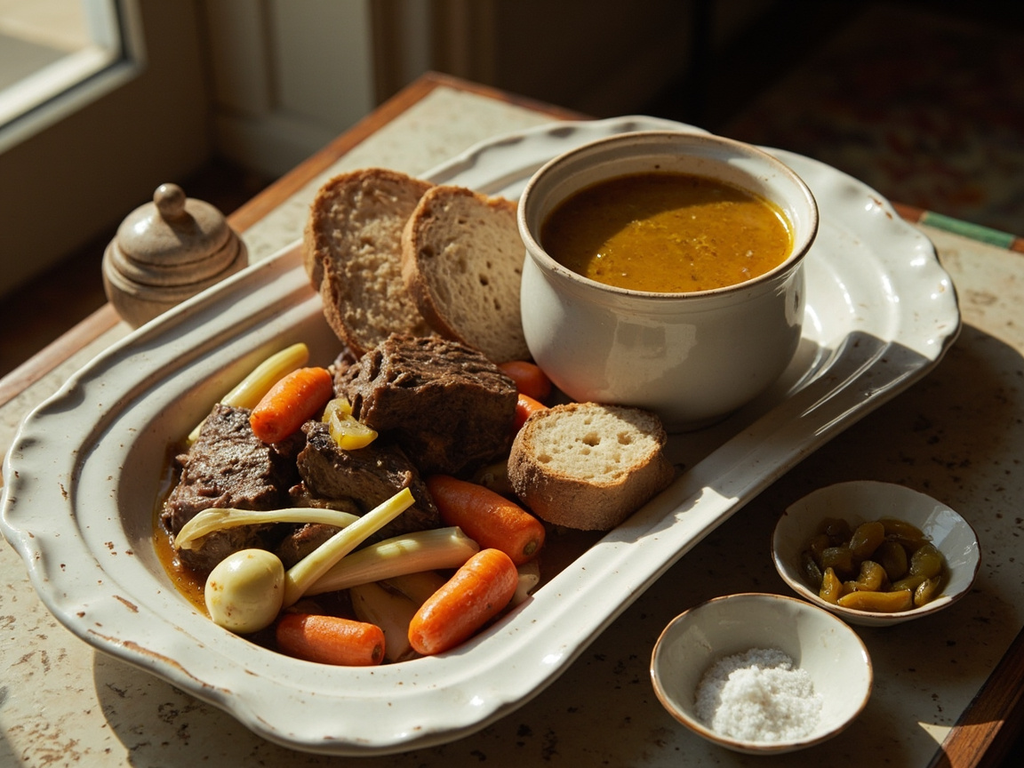
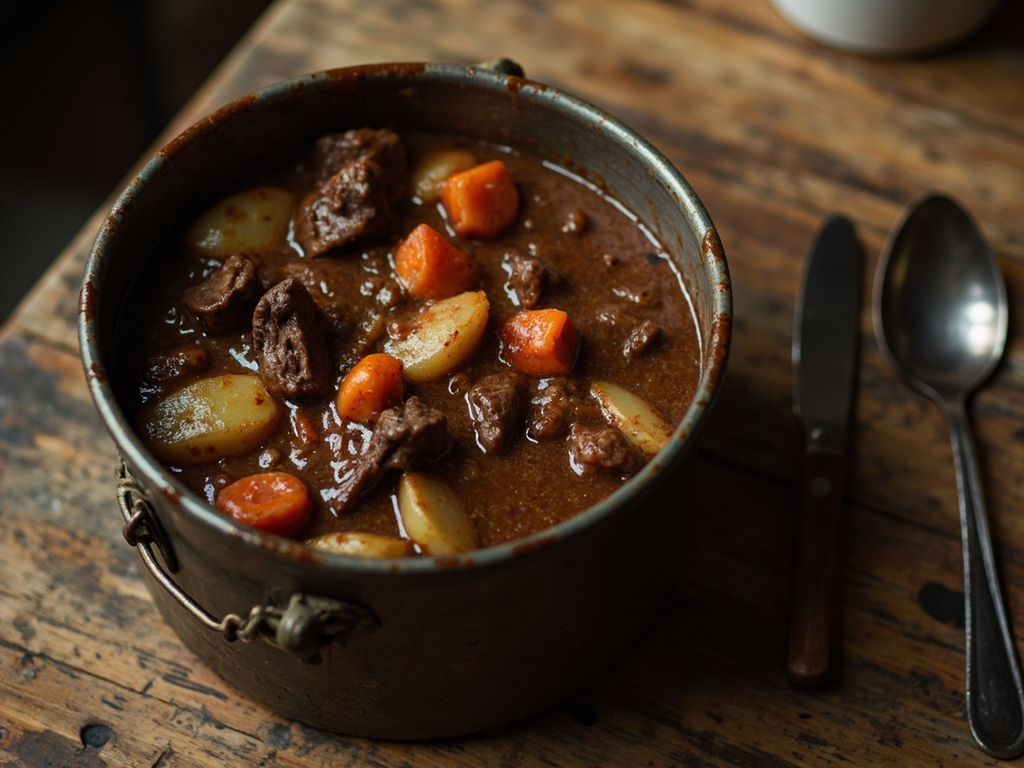
A rustic stew of beef and root vegetables, simmered long until the meat shreds and the sauce coats the potatoes. The staple dish of the troops: nourishing, simple, economical.
See this dish, it's the soldier's everyday fare, and I never despised it. At Verdun, I had enough sent up via the Sacred Way to fill every bouteillon, for a troop that eats is a troop that holds. They threw into the pot what the earth gave — meat, onion, potato, carrot — and let it simmer for hours without fuss. Beware of superfluity: a good hot rata is worth more than all the sauces of the great houses. Sobriety, young man, is already a discipline.
- •Beef from the commissariat (chuck, shin) — a good piece (protein base)
- •Potatoes — as much as needed (filling starch)
- •Carrots and turnips — a handful (root vegetables)
- •Onions — a few (aromatic base)
- •Lard or suet — a spoonful (cooking fat)
- •Salt, pepper, thyme, bay leaf — to taste (seasoning)
The Poilu's Rata
A rustic stew of beef and root vegetables, simmered long until the meat shreds and the sauce coats the potatoes. The staple dish of the troops: nourishing, simple, economical.
Why this dish? At Verdun in 1916, General Pétain organized supply via the Sacred Way to feed an entire army. The 'rata' — this meat and potato stew simmered in field kitchens — was the daily fare of the soldier he commanded, the meal that went up to the trenches at night in bouteillons (insulated containers).
See this dish, it's the soldier's everyday fare, and I never despised it. At Verdun, I had enough sent up via the Sacred Way to fill every bouteillon, for a troop that eats is a troop that holds. They threw into the pot what the earth gave — meat, onion, potato, carrot — and let it simmer for hours without fuss. Beware of superfluity: a good hot rata is worth more than all the sauces of the great houses. Sobriety, young man, is already a discipline.
Ingredients (period version)
- Beef from the commissariat (chuck, shin) — a good piece (protein base)
- Potatoes — as much as needed (filling starch)
- Carrots and turnips — a handful (root vegetables)
- Onions — a few (aromatic base)
- Lard or suet — a spoonful (cooking fat)
- Salt, pepper, thyme, bay leaf — to taste (seasoning)
Ingredients
- Beef chuck — 800 g (stewing meat)
- Firm-fleshed potatoes — 1 kg (starch)
- Carrots — 4 (root vegetable)
- Turnips — 2 (root vegetable)
- Onions — 2 (aromatic)
- Lard (or oil) — 2 tbsp (cooking)
- Bouquet garni (thyme, bay leaf) — 1 (flavor)
- Water or broth — 1 liter (liquid)
Method
- Cut the beef into large cubes. Melt the lard in a casserole and brown the meat on all sides.
- Add the sliced onions, let them turn golden, then add the water or broth. Add the bouquet garni, salt, and pepper.
- Cover and simmer gently for 1.5 to 2 hours, until the meat is tender.
- Add the carrots and turnips in pieces, then the potatoes 30 minutes before the end.
- Uncover and reduce for the last few minutes so the sauce coats. Serve piping hot, ladled out.
How it was made : In the trenches, the rata was prepared in the rear by field cooks, then carried at night to the soldiers in bouteillons (rudimentary insulated containers); it often arrived cold and congealed. The word 'rata' comes from 'ratatouille', in the old sense of a simmered mixture.
The contemporary twist : A spoonful of Dijon mustard whisked into the sauce at the end of cooking wakes up the dish without betraying it.
Sources : Silvano Serventi, À table dans les tranchées, 2014
Philippe Pétain · Charactorium