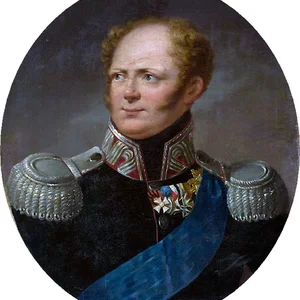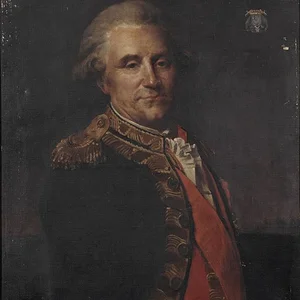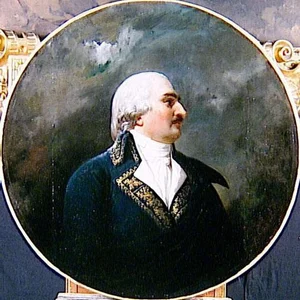

A French general of the First Empire, Pierre Garnier de Laboissière built his career under the Revolution and Napoleon Bonaparte. He also served as a senator, embodying the fusion of military and political elites characteristic of the Napoleonic era.
Pierre Garnier de Laboissière(1755 — 1809)
Pierre Garnier de Laboissière
France
8 min read
Frequently asked questions
Key Facts
- French general who served under the Revolution and the First Empire
- Appointed senator under the Napoleonic regime
- Embodies the figure of the officer-notable of the Imperial era
- Typical career path of military officers promoted by Napoleon Bonaparte
Works & Achievements
Garnier de Laboissière rose through the military ranks during the Revolutionary Wars, commanding units engaged in defending France's borders against the European coalitions, forging the reputation that would earn him his appointment to the Senate.
Appointed senator under the Consulate, he took part in the work of the upper assembly tasked with upholding the constitution and voting on the senatus-consulta that progressively reshaped France into a hereditary Empire.
Continuing to carry out military duties alongside his senatorial mandate, Garnier de Laboissière exemplified the Napoleonic practice of combining civil and military offices as a way of rewarding loyal generals.
Anecdotes
An officer trained under the Ancien Régime, Pierre Garnier de Laboissière chose, unlike many nobles, to serve the Revolution rather than emigrate. This courageous and pragmatic decision allowed him to retain his commission and continue his military career at a time when hundreds of his peers were taking the road to exile or mounting the scaffold.
Under the Consulate, Garnier de Laboissière was appointed to the Conservative Senate, an institution created by the Constitution of Year VIII to safeguard respect for the fundamental laws. His dual role as general and senator perfectly illustrated Napoleon's strategy: securing the loyalty of his best officers by offering them honorary civil positions and comfortable salaries.
Like many dignitaries of the Empire, Garnier de Laboissière benefited from generous imperial endowments: income from land, a private mansion, and a substantial senatorial stipend. These rewards were not without ulterior motives: Napoleon bound his military and political elites to his regime through powerful material interests, making any act of betrayal financially ruinous.
Garnier de Laboissière's career spanned three entirely different regimes — the royal Ancien Régime, the republican Revolution, and the Napoleonic Empire — which was remarkable and spoke to a rare capacity for political adaptation in an era when a single wrong choice could cost a man his head.
Primary Sources
Citizen Garnier de Laboissière, brigadier general, is listed among the members of the Conservative Senate appointed in accordance with the provisions of the Constitution of Year VIII, with the rank and emoluments attached to that dignity.
By decree of the Government, General Garnier de Laboissière is confirmed in his rank and duties within the armies of the Republic, in recognition of his services rendered during the frontier campaigns.
Session of the Conservative Senate. Present: […] Senator Garnier de Laboissière […]. The assembly deliberates on the draft senatus-consultum concerning the organization of the departments annexed to the Empire.
Garnier de Laboissière (Pierre), general, senator. Entered service in… Successive ranks obtained under the Revolution and the Consulate. Decorations: Légion d'honneur.
Key Places
Seat of the Conservative Senate during the Consulate and the Empire. Garnier de Laboissière served there as a senator, taking part in the deliberations of this upper assembly entrusted with upholding the constitutionality of imperial laws.
The political, administrative, and social heart of imperial France, where general-senators resided in private mansions, attended military reviews, and mingled in the salons of the Empire's dignitaries.
The main theatre of the Revolutionary Wars of the 1790s, where French armies fought the European coalitions. Generals of this generation forged their military reputations in the heat of these defensive campaigns.
The stage of the Italian campaigns (1796–1797 and 1800) led by Bonaparte, where many republican and later imperial generals won glory and promotion in battles against Austria.
Typical Objects

The regulation side arm of French generals under the Empire, with a curved blade for cavalry or a straight blade for infantry. A symbol of military authority, it was often richly adorned with engravings and gilding for senior officers.

A two-cornered hat worn sideways by Napoleonic generals, which became an iconic symbol of the era. Its shape and orientation allowed one to identify an officer's rank and function from a distance, even in the midst of battle.

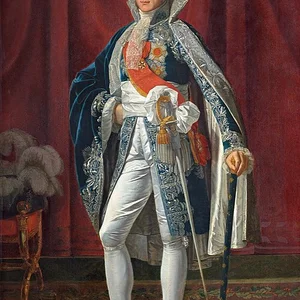
A blue coat with lapels and gold embroidery, gold-fringed epaulettes, and decorations attesting to the wearer's campaigns. The uniform immediately distinguished ranks within the Napoleonic hierarchy and expressed its owner's military glory.

A decoration created by Napoleon in 1802 and awarded to military personnel and civilians who had distinguished themselves in the service of France. Worn with pride, it conferred a social status recognised throughout Napoleonic Europe.

A detailed topographic map used by officers to plan campaigns and direct troop movements. Essential to Napoleonic command, it represented a decisive technical advance in the modern conduct of war.

An engraved metal instrument used by senators to authenticate official documents of the upper assembly. In the Conservative Senate, it symbolised the supreme constitutional authority of the Napoleonic Empire.
School Curriculum
Vocabulary & Tags
Key Vocabulary
Daily Life
Morning
The general-senator rose early, a habit forged by years on campaign where dawn signaled the resumption of marches or fighting. His mornings began with the reading of military reports and bulletins, followed by official correspondence with the ministries. During senatorial sessions, he traveled to the Palais du Luxembourg by horse-drawn carriage, in uniform or in senatorial dress depending on the occasion.
Afternoon
Afternoons were often devoted to sessions of the Conservative Senate, where senators deliberated on draft senatus-consultes presented by commissioners of the imperial government. Outside of sessions, general-senators received officers and petitioners at their private mansions, granted audiences, or took part in the grand military reviews organized at the Tuileries by the Emperor himself.
Evening
The evenings of Napoleonic dignitaries were often brilliant and sociable: dinners with fellow senators or marshals, receptions in the salons of Parisian high society, or performances at the Opéra and the Comédie-Française. Napoleon encouraged this intense social life, seeing in it a cement for the cohesion and loyalty of his elites.
Food
The table of a general-senator was abundant and refined: roasted meats, game birds and ground game, freshwater fish, garden vegetables, and wines from Burgundy or Bordeaux. This sophisticated fare stood in stark contrast to the spartan rations of military campaigns — coarse bread, bean soup, and brandy — that the same man had known in his youth as a soldier.
Clothing
On military duty or during ceremonies, Garnier de Laboissière wore the general's uniform: a midnight-blue coat with scarlet lapels embroidered in gold, epaulettes with large golden fringes, a bicorne hat with a plume, and riding boots. During Senate sessions, he donned the red-and-gold dress of the Conservative Senate, a solemn attire prescribed by Napoleonic imperial protocol.
Housing
Senators of the Empire were often granted private mansions in Paris or endowments in land revenues from national properties. These well-appointed residences, frequently located in the Faubourg Saint-Germain or around the grands boulevards, were testament to the prosperity that came with high imperial office. Some also retained provincial estates inherited from their families under the *Ancien Régime*.
Historical Timeline
Period Vocabulary
Liens externes & ressources
Références
Œuvres
Carrière militaire sous la Révolution française
1789-1799
Mandat de sénateur au Sénat conservateur
1800-1809
Commandement militaire sous le Consulat et l'Empire
1800-1809