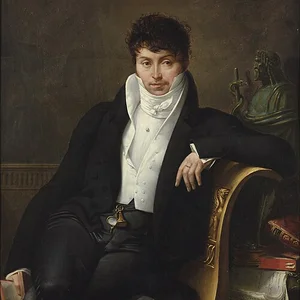

French physician, physiologist, and philosopher (1757–1808), a leading figure among the Idéologues. He sought to establish a science of man by linking the physical functions of the body to moral phenomena.
Pierre Jean Georges Cabanis(1757 — 1808)
Pierre Jean Georges Cabanis
France
8 min read
Frequently asked questions
Famous Quotes
« The brain digests impressions and secretes thought.»
Key Facts
- 1757: born in Cosnac (Corrèze)
- 1802: publication of ‘Rapports du physique et du moral de l’homme’
- Member of the Council of Five Hundred, he supported the coup of 18 Brumaire (1799)
- Senator under the Consulate
- 1808: died in Rueil
Works & Achievements
Cabanis's masterpiece, this two-volume work establishes a science of man by demonstrating that moral states (emotions, thoughts) depend directly on the physical condition of the body and nervous system. It is considered a foundational text of scientific materialism and the future field of neuropsychology.
An epistemological essay in which Cabanis examines the foundations of medical knowledge, arguing for a rigorous medicine grounded in observation and comparison — midway between empiricism and rationalism.
A clinical yet intimate account of his friend Mirabeau's final days, blending precise medical observation with personal emotion. A valuable document on medical practices during the Revolutionary era.
A historical and programmatic work in which Cabanis traces the evolution of medicine from Antiquity and calls for an overhaul of its teaching and methods, in close dialogue with the natural sciences.
A philosophical text published after his death, in which Cabanis tempered his materialist positions to incorporate a form of universal vital principle. This letter long fuelled debate about his true conception of the soul and matter.
Anecdotes
Cabanis was the intimate friend of Mirabeau, the celebrated revolutionary orator. When Mirabeau fell gravely ill in April 1791, Cabanis kept vigil at his bedside during his final nights. After his death, he published his clinical observations on his friend's agony, blending medical science with sincere personal emotion.
In his 'Rapports du physique et du moral de l'homme', Cabanis dared to write that the brain 'digests' impressions and 'secretes' thought, just as the stomach digests food. This provocative formulation caused a scandal: his opponents accused him of denying the existence of the soul, while his supporters saw it as the foundation of a rigorous science of the human mind.
In November 1799, Cabanis actively supported the coup of 18 Brumaire that brought Napoleon to power. Convinced that a strong and enlightened government would serve the ideals of the Enlightenment better than revolutionary chaos, he voted in favor of the new constitution as a member of the Council of Five Hundred. He later became a senator, but eventually distanced himself from the imperial regime.
Cabanis was a regular at Madame Helvétius's salon in Auteuil, nicknamed the 'little academy of Cupid.' This circle brought together the leading figures of the Ideologues — Destutt de Tracy, Volney, Condorcet — along with celebrated foreign visitors such as Benjamin Franklin and Thomas Jefferson. It was in this vibrant setting that his ideas on the relationship between body and mind took their definitive form.
Primary Sources
The brain digests, so to speak, impressions; it organically secretes thought. Thus, by the same analogy, after having considered impressions and ideas in themselves, we must consider them in relation to the functions that produce them.
Medicine can only be a conjectural science, and it is precisely for this reason that it requires all the more numerous observations, careful comparisons, and rigorous reasoning.
Mirabeau experienced a sharp and continuous pain in the upper part of the epigastrium. His intellect remained fully intact until his final moments; he was still dictating political instructions just a few hours before his death.
It is in the body of the natural sciences and in their relationship to the arts that medicine must find its true foundations. It can be neither purely empirical nor purely rational: it must be both at once.
Key Places
Village in the Limousin region where Cabanis was born in 1757. His father worked there as a notary; it was in this rural setting that young Pierre Jean Georges received his first lessons before leaving for Paris.
A major intellectual gathering place for the Idéologues, hosted by Madame Helvétius following the death of her philosopher husband. Cabanis lived and worked there for many years, shaping his ideas through contact with the greatest minds in Europe.
A symbolic site of the French Revolution where Cabanis witnessed decisive political events, particularly during his tenure as administrator of Paris's public hospitals (1791–1795).
Founded in 1795, it brought together the leading intellectual figures of France. Cabanis presented his memoirs there on the relationship between the physical and the moral, writings that established his reputation as a philosopher.
A commune near Paris where Cabanis had withdrawn in his final years, far from the bustle of imperial life. He died there on 5 May 1808.
Typical Objects

A surgical instrument with a thin steel blade, indispensable to anatomists and physicians of the 18th century. Cabanis used it in his work on the nervous system to understand the connections between body and mind.

The universal writing tool of 18th-century scholars. Cabanis composed his memoirs, his correspondence with the Idéologues, and his philosophical treatises using a trimmed quill dipped into a glass or ceramic inkwell.

An instrument for measuring body temperature, still uncommon but used by forward-thinking physicians of the 18th century. It symbolizes Cabanis's drive to make medicine more rigorous and quantitative.

Full-calf leather-bound volumes with gilt edges, forming Cabanis's working library. He owned the works of Locke, Condillac, Hippocrates, and Buffon, all heavily annotated in the margins.

The distinctive hairstyle of European elites in the second half of the 18th century, worn at receptions and salon gatherings. Cabanis wore one until the Revolution, which brought more natural fashions into vogue.

A padded seat in carved wood and silk fabric, the centerpiece of 18th-century literary salons. It was in chairs like these, at Madame Helvétius's home in Auteuil, that Cabanis debated philosophy with Condorcet, Volney, and Jefferson.
School Curriculum
Vocabulary & Tags
Key Vocabulary
Daily Life
Morning
Cabanis rose early to receive his patients, often members of the Parisian elite and political figures. After his medical consultations, he devoted himself to reading scientific and philosophical works that fed his thinking, annotating his copies extensively.
Afternoon
Afternoons were reserved for drafting his memoirs and treatises, which he composed methodically in his study. He also attended sessions of the Institut national, where he presented his work and debated with his fellow Idéologues.
Evening
Cabanis spent his evenings frequently in the salons, particularly at Madame Helvétius's home in Auteuil, where he resided for many years. These social and intellectual gatherings blended philosophical conversation, political news, and fine dining; it was there that Cabanis met Benjamin Franklin, Thomas Jefferson, and the great minds of his age.
Food
The table in the Parisian salons of the late eighteenth century was rich: roasted meats, soups, vegetables from the Auteuil garden, white breads, and Burgundy wines. As a physician attentive to the influence of diet on health, Cabanis attached theoretical importance to nutrition, weaving it into his reflections on the relationship between the physical and the moral.
Clothing
Under the Ancien Régime, Cabanis dressed as educated notables did: a fine wool coat, breeches, white stockings, an embroidered waistcoat, and a powdered wig. After the Revolution, he adopted the simpler, more sober fashions of the republican and then imperial era: a French-cut coat in dark cloth, natural hair, and a white cravat tied high.
Housing
Cabanis lived for many years in Madame Helvétius's house in Auteuil — a large bourgeois residence with a garden on the outskirts of Paris that served as a true home for the Idéologues. There he had a study lined with books, a medical consulting room, and enjoyed the semi-rural life of what was then a village still separate from the capital.
Historical Timeline
Period Vocabulary
Liens externes & ressources
Références
Œuvres
Rapports du physique et du moral de l'homme
1802
Du degré de certitude de la médecine
1798
Journal de la maladie et de la mort de Mirabeau
1791
Coup d'œil sur les révolutions et la réforme de la médecine
1804
Lettre à M. F. sur les causes premières (posthume)
1824
See also
Related Characters
Anne Thérèse de Marguenat de Courcelles, marquise de Lambert
Blaise Pascal
1623 — 1662
Cardinal de Richelieu
1585 — 1642
Cardinal Mazarin
1602 — 1661
Caroline of Ansbach
1683 — 1737
Charles XII of Sweden