 flip
flipTalbīna — Barley Porridge with Milk and Honey
Talbīna — Barley Porridge with Milk and Honey
Why this dish? Talbīna, a porridge of barley flour and milk, is recommended in prophetic tradition to comfort the sick and the afflicted. In the pious milieu of Basra where Rābiʿa lived, this sweet broth was the remedy for heavy hearts as well as weak bodies — exactly the kind of sober food she could accept.
A creamy, sweet porridge of barley flour cooked slowly in milk, sometimes sweetened with honey and soured with slightly curdled milk. Warm and soothing, it was called talbīna (from laban, milk) because it resembles milk. The comforting remedy par excellence.
When grief weighs on the heart or the body weakens, prepare this for yourself. Pour a handful of barley flour into milk and keep it over a low fire, stirring without tiring, until it thickens like consolation. A little honey if you wish, no more — the soul does not need sweetness to love God, but the suffering body deserves to be soothed. Eat it warm, slowly; they say it rests the heart of the afflicted, and I have never found that to be a lie.
- •Barley flour — a handful (thickener, base)
- •Milk (goat or sheep) — a bowl (nourishing liquid)
- •Honey — a drizzle (optional sweetness)
- •Soured milk — a spoonful, sometimes (hint of acidity)
Talbīna — Barley Porridge with Milk and Honey
A creamy, sweet porridge of barley flour cooked slowly in milk, sometimes sweetened with honey and soured with slightly curdled milk. Warm and soothing, it was called talbīna (from laban, milk) because it resembles milk. The comforting remedy par excellence.
Why this dish? Talbīna, a porridge of barley flour and milk, is recommended in prophetic tradition to comfort the sick and the afflicted. In the pious milieu of Basra where Rābiʿa lived, this sweet broth was the remedy for heavy hearts as well as weak bodies — exactly the kind of sober food she could accept.
When grief weighs on the heart or the body weakens, prepare this for yourself. Pour a handful of barley flour into milk and keep it over a low fire, stirring without tiring, until it thickens like consolation. A little honey if you wish, no more — the soul does not need sweetness to love God, but the suffering body deserves to be soothed. Eat it warm, slowly; they say it rests the heart of the afflicted, and I have never found that to be a lie.
Ingredients (period version)
- Barley flour — a handful (thickener, base)
- Milk (goat or sheep) — a bowl (nourishing liquid)
- Honey — a drizzle (optional sweetness)
- Soured milk — a spoonful, sometimes (hint of acidity)
Ingredients
- Whole barley flour — 40 g (3 tbsp) (base of porridge)
- Whole milk — 400 ml (nourishing liquid)
- Honey — 1-2 tsp (sweetness)
- Plain yogurt — 1 tbsp (optional) (tangy note)
- Salt — 1 pinch (balance)
Method
- Whisk the barley flour into a little cold milk to avoid lumps.
- Pour the rest of the milk into a saucepan and add the pinch of salt.
- Incorporate the flour mixture and bring to a simmer over low heat.
- Cook for 10-15 minutes, stirring constantly, until a creamy porridge forms.
- Off the heat, add the honey and, if you like it livelier, a spoonful of yogurt.
- Serve warm in a bowl, with a spoon.
How it was made : Talbīna is mentioned in hadith collections as a healing food given to the sick and bereaved. Hulled barley or its flour was cooked slowly in milk over embers. It is the ancestor of the comforting porridges of the Islamic world. It was sweetened with honey or crushed dates, cane sugar being rare and expensive.
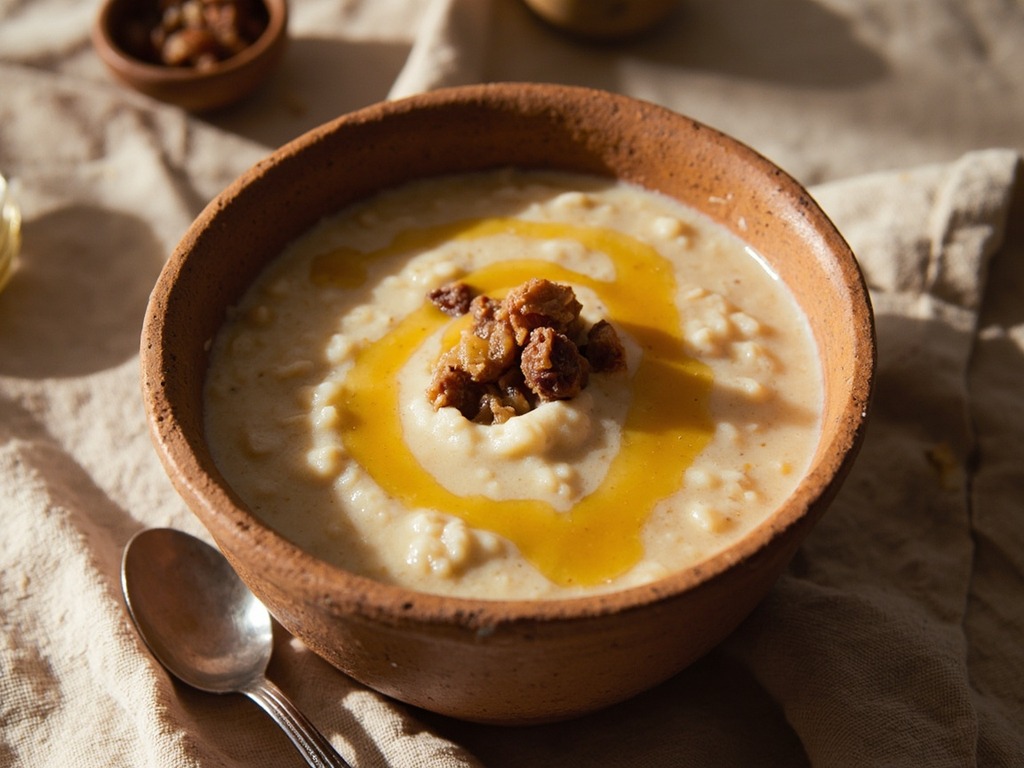
The contemporary twist : Poured into a bowl and drizzled with honey in a spiral with a few chopped dates, talbīna presents itself as an ancestral porridge — the 8th-century version of a comforting Sunday morning bowl of porridge.
Sources : Sahih al-Bukhari and Sahih Muslim, traditions on talbīna given to the sick and bereaved · Nawal Nasrallah (trad.), Annals of the Caliphs' Kitchens, Brill, 2007 · Lilia Zaouali, La grande cuisine arabe du Moyen Âge, 2007
Rābiʿa al-ʿAdawiyya · Charactorium