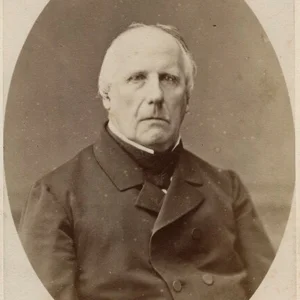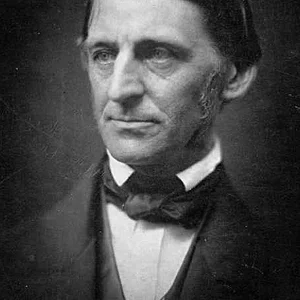

American philosopher, essayist, and poet (1803-1882), a central figure of transcendentalism. He championed self-reliance, intuition, and the spiritual bond between humanity and nature, leaving a lasting mark on American thought.
Ralph Waldo Emerson(1803 — 1882)
Ralph Waldo Emerson
États-Unis
6 min read
Frequently asked questions
Famous Quotes
« To be great is to be misunderstood.»
« Society everywhere is in conspiracy against the manhood of every one of its members.»
Key Facts
- Born in Boston in 1803, educated at Harvard, briefly a Unitarian minister before leaving the ministry in 1832
- Published the foundational essay Nature in 1836, the manifesto of transcendentalism
- Delivered the address The American Scholar in 1837, calling for an American thought freed from Europe
- Published Self-Reliance in 1841, exalting individualism
- Took a stand against slavery and died in Concord in 1882
Works & Achievements
Founding essay of Transcendentalism, in which Emerson presents nature as a path toward the spiritual and the unity of the world.
A call for independent American thought, regarded as the intellectual declaration of independence of the United States.
A speech defending a spirituality grounded in individual intuition, which caused a scandal in religious circles.
Collection containing “Self-Reliance,” a key text on individualism and moral autonomy.
A second collection of essays deepening his themes: the poet, experience, nature, and character.
Emerson's first poetry collection, expressing his Transcendentalist ideas in verse.
A series of portraits of great figures (Plato, Montaigne, Shakespeare, Napoleon) illustrating his philosophy of the exemplary man.
A collection of essays devoted to how one should lead one's life: fate, power, wealth, and culture.
Anecdotes
In 1832, Emerson resigned from his post as a Unitarian minister in Boston: he could no longer bear to celebrate the Lord's Supper, which he felt had been drained of meaning. This break marked the beginning of his life as an independent thinker and lecturer.
In 1833, young and grieving the death of his first wife, Emerson traveled to Europe and met the Scottish writer Thomas Carlyle. Their friendship would last more than forty years through a rich transatlantic correspondence.
In Concord, Emerson took in the young Henry David Thoreau and lent him a plot of land on the shore of Walden Pond. It was there that Thoreau carried out his famous experiment of living in the woods, encouraged by the ideas of his elder.
In 1837, his address “The American Scholar,” delivered at Harvard, called on American thinkers to free themselves from European cultural tutelage. The writer Oliver Wendell Holmes later described it as America's “intellectual Declaration of Independence.”
His 1838 “Divinity School Address” caused such a scandal that Emerson was not invited back to Harvard for nearly thirty years. In it he criticized official Christianity and championed a spirituality grounded in personal intuition.
Primary Sources
Standing on the bare ground, my head bathed by the blithe air and uplifted into infinite space, all mean egotism vanishes. I become a transparent eyeball; I am nothing; I see all.
A foolish consistency is the hobgoblin of little minds, adored by little statesmen and philosophers and divines.
We have listened too long to the courtly muses of Europe. Our day of dependence, our long apprenticeship to the learning of other lands, draws to a close.
Trust thyself: every heart vibrates to that iron string.
Key Places
Emerson's birthplace and the first center of his career as a Unitarian minister at the Second Church.
Emerson studied here and delivered his foundational addresses “The American Scholar” (1837) and the “Divinity School Address” (1838).
The village where Emerson spent most of his adult life and died. It became the home of the Transcendentalist circle gathered around Thoreau and the Alcott family.
On land owned by Emerson, Thoreau carried out his experiment in living in the woods. The site has become a symbol of American Transcendentalism.
During his European journey of 1833, Emerson met major figures including Thomas Carlyle, forming a lasting intellectual friendship.
Typical Objects

For more than fifty years, Emerson kept notebooks in which he jotted down thoughts, readings, and observations. They served as a reservoir of ideas for his essays and lectures.

Emerson made his living by traveling across American towns to give paid lectures (the “lyceum”). The lectern held his handwritten notes as he faced the audience.

The everyday tools of the nineteenth-century writer, with which Emerson composed essays, poems, and his abundant correspondence.

Emerson owned a vast library blending Western philosophy, poetry, and Eastern sacred texts such as the Upanishads. These readings nourished his transcendentalist thought.

Like the notables of New England, Emerson wore a dark frock coat, waistcoat, and cravat. This sober attire suited the former minister who had become a respected lecturer.

For his lecture tours across the United States, Emerson traveled by stagecoach and, increasingly, by the booming railroad.
School Curriculum
Vocabulary & Tags
Key Vocabulary
Tags
Daily Life
Morning
Emerson often began his day early, in the quiet of his Concord home. Mornings were devoted to reading and above all to writing, which he regarded as the heart of his intellectual work.
Afternoon
In the afternoon, he liked to walk through the woods and fields around Concord, observing the nature that nourished his thought. He also received visitors, young writers and friends from the Transcendentalist circle.
Evening
In the evening, Emerson read, conversed with his family and close friends, and recorded his reflections in his journals. During lecture seasons, he spent many evenings giving talks in various towns.
Food
Like the New England middle class, Emerson kept to a simple diet of bread, vegetables from the garden, fruit, dairy products, and meat. Tea and coffee accompanied his meals.
Clothing
He wore the sober attire of the notables of his time: a black frock coat, waistcoat, white shirt, and necktie. This dignified dress reflected his past as a minister and his standing as a respected lecturer.
Housing
Emerson lived in a large wooden house in Concord, surrounded by a garden and close to the countryside. His home became a gathering place for Transcendentalist thinkers and writers.
Historical Timeline
Period Vocabulary
Liens externes & ressources
Références
Œuvres
The American Scholar (discours)
1837
Divinity School Address (discours)
1838
Essays: First Series
1841
Essays: Second Series
1844
Representative Men
1850