 flip
flipVuaka vakaloloté au lovo
Vuaka vakaloloté au lovo
Why this dish? The great *magiti* of Bau, the fortress-island of Cakobau, were demonstrations of political power. After his conversion to Christianity in 1854, pork feasts from the *lovo* replaced earlier ceremonies and served to honor allies, missionaries, and later British representatives. Slow-cooked pork in the earth oven was reserved for high-ranking chiefs.
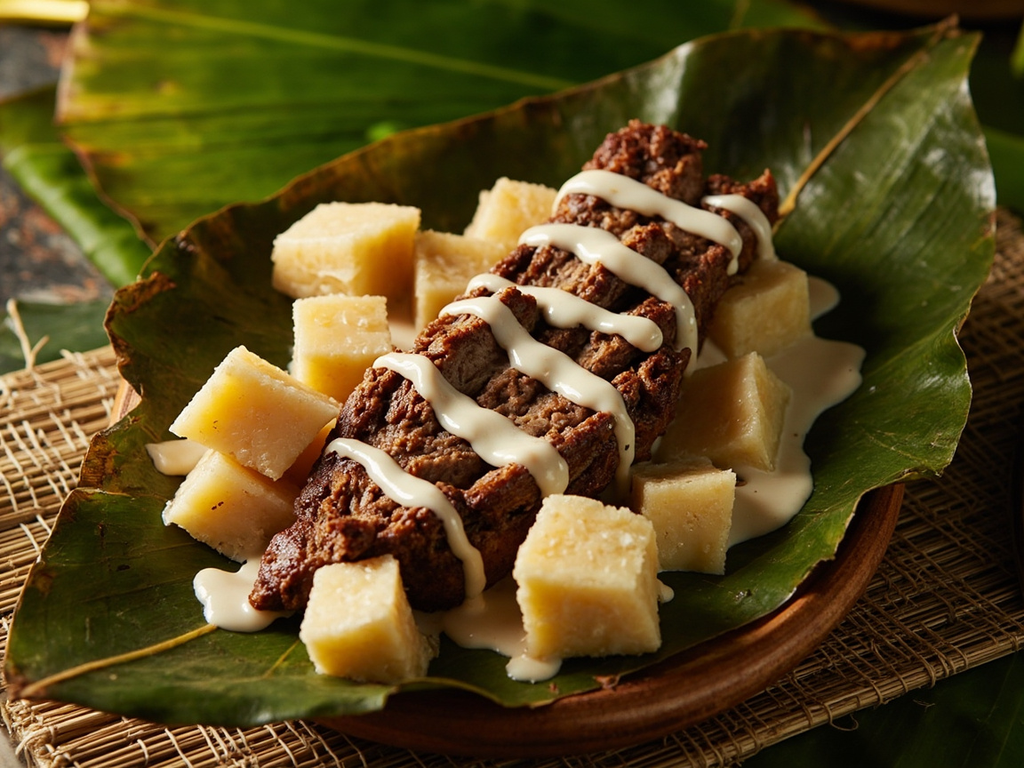
Whole pork wrapped in banana leaves and cooked for hours in a *lovo* — an oven dug into the earth, lined with hot stones. The meat, steeped in smoke and steam, becomes tender and lightly caramelized. It is the royal dish of Fijian ceremonies.
At Bau, when I summoned my chiefs for a war council or to receive an envoy of the Queen, we would dig the *lovo* before dawn. The stones had to glow red like volcanic embers. My men wrapped the *vuaka* in the broadest leaves, and the earth did the rest — slowly, without haste, as a chief must act. When we opened the oven at dusk, the scent alone was enough to say that Bau was prosperous. A chief is judged by the generosity of his table, and no one ever left my mat with an empty belly.
- •Whole pig (vuaka) — One young pig (Main piece)
- •Banana leaves — Generous amount for wrapping (Cooking wrap)
- •Volcanic stones — Enough to line the oven (Heat source)
- •Taro — Several tubers (Starchy accompaniment)
- •Grated coconut — Several coconuts (Coconut cream for basting)
- •Sea salt — To taste (Seasoning)
Vuaka vakaloloté au lovo
Whole pork wrapped in banana leaves and cooked for hours in a *lovo* — an oven dug into the earth, lined with hot stones. The meat, steeped in smoke and steam, becomes tender and lightly caramelized. It is the royal dish of Fijian ceremonies.
Why this dish? The great *magiti* of Bau, the fortress-island of Cakobau, were demonstrations of political power. After his conversion to Christianity in 1854, pork feasts from the *lovo* replaced earlier ceremonies and served to honor allies, missionaries, and later British representatives. Slow-cooked pork in the earth oven was reserved for high-ranking chiefs.
At Bau, when I summoned my chiefs for a war council or to receive an envoy of the Queen, we would dig the *lovo* before dawn. The stones had to glow red like volcanic embers. My men wrapped the *vuaka* in the broadest leaves, and the earth did the rest — slowly, without haste, as a chief must act. When we opened the oven at dusk, the scent alone was enough to say that Bau was prosperous. A chief is judged by the generosity of his table, and no one ever left my mat with an empty belly.
Ingredients (period version)
- Whole pig (vuaka) — One young pig (Main piece)
- Banana leaves — Generous amount for wrapping (Cooking wrap)
- Volcanic stones — Enough to line the oven (Heat source)
- Taro — Several tubers (Starchy accompaniment)
- Grated coconut — Several coconuts (Coconut cream for basting)
- Sea salt — To taste (Seasoning)
Ingredients
- Bone-in pork shoulder — 1.5 kg (Main piece)
- Banana leaves (or aluminum foil) — 4-5 large leaves (Cooking wrap)
- Coconut milk — 400 ml (Sauce and tenderness)
- Taro or sweet potato — 500 g (Accompaniment)
- Onion — 2 (Aromatic)
- Coarse salt — 1 tbsp (Seasoning)
- Garlic — 4 cloves (Aromatic)
Method
- Preheat the oven to 160°C. Generously salt the pork shoulder and rub with crushed garlic.
- Briefly pass banana leaves over a flame to soften, then line a large baking dish or Dutch oven.
- Place the shoulder on the leaves. Arrange sliced onions around it. Pour coconut milk over the meat.
- Fold the banana leaves tightly around the pork. Cover the dish with a lid or aluminum foil.
- Bake for 4 hours. Halfway through, add peeled and chunked taro or sweet potato around the meat.
- Remove from oven. The meat should shred easily. Serve on opened banana leaves, drizzled with coconut cooking juices.
How it was made : The Fijian *lovo* is an underground oven: a pit is dug, volcanic stones are heated over a wood fire for several hours, then leaf-wrapped food is placed directly on the hot stones and covered with earth. Cooking lasted 4 to 8 hours. It was collective work, mobilizing the entire village for great occasions.
The contemporary twist : Serve the shredded pork in individual banana-leaf boats, with a small bowl of fresh *lolo* (coconut cream) on the side for dipping.
Sources : Christina Thompson, Sea People: The Puzzle of Polynesia, Harper, 2019 · Ravuvu, Asesela D., The Fijian Way of Life, Institute of Pacific Studies, University of the South Pacific, 1983
Ratu Seru Cakobau · Charactorium