 flip
flipGame Pie in Pastry, the Larder of Maupertuis Den
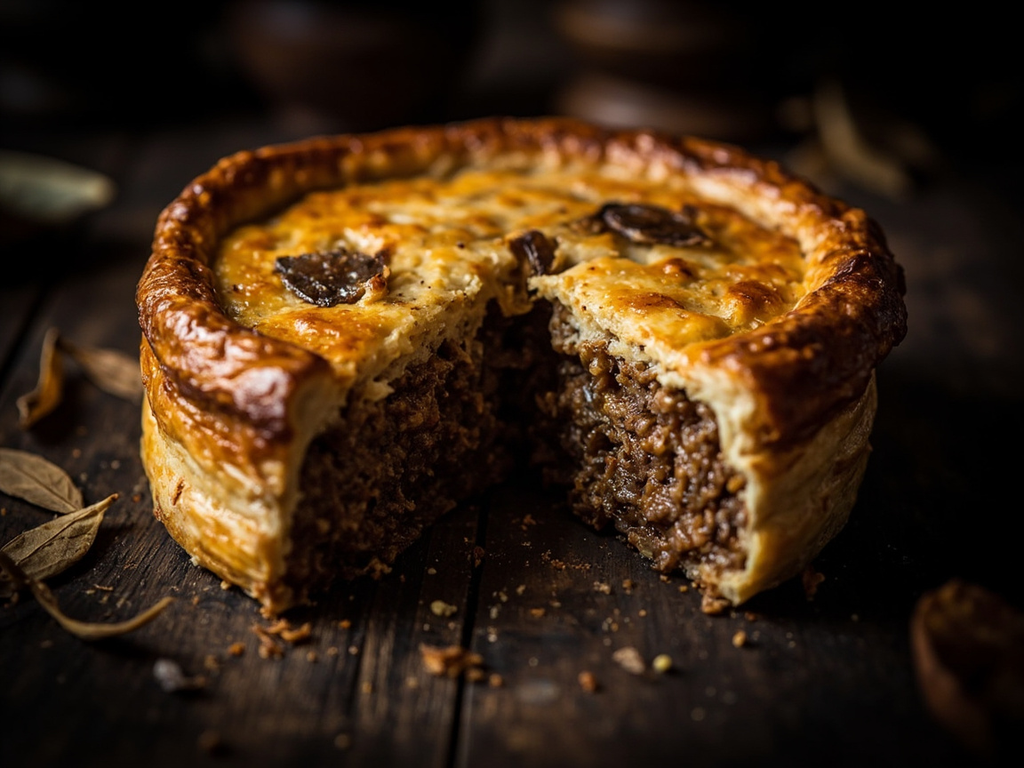
Game Pie in Pastry, the Larder of Maupertuis Den
Why this dish? Maupertuis is Renart's fortress-den, where he hoards his loot. The pie in a thick crust—meat cooked sealed under a sturdy paste that acts as a 'can' for preservation—is exactly the kind of provision a cunning fox stores for lean days or for the road across Flanders.
A game pie (hare, wild boar) baked in a robust crust that protects and preserves it for several days. The crust was not always eaten: it served as an airtight container, a forerunner of canned food.
Do you see this great pie? It is my treasure of Maupertuis, my fortress. Inside, I have packed hare and boar's head, well peppered, well salted, sealed under a crust hard as a dungeon wall. Thus sealed, my meat keeps for eight days without spoiling, and no one suspects the flesh beneath the crust. When hunger overtakes me on the roads of Flanders, I break the roof of my castle of pastry—and I feast alone, without sharing, as a fox knows how to do.
- •Game meat (hare, wild boar) — abundant (filling)
- •Fat bacon — a good part (fat and tenderness)
- •Long pepper — generous (spice and preservation)
- •Salt — abundant (preservation)
- •Grains of paradise — a pinch (heat)
- •Wheat flour and water — for the crust (sealed container)
Game Pie in Pastry, the Larder of Maupertuis Den
A game pie (hare, wild boar) baked in a robust crust that protects and preserves it for several days. The crust was not always eaten: it served as an airtight container, a forerunner of canned food.
Why this dish? Maupertuis is Renart's fortress-den, where he hoards his loot. The pie in a thick crust—meat cooked sealed under a sturdy paste that acts as a 'can' for preservation—is exactly the kind of provision a cunning fox stores for lean days or for the road across Flanders.
Do you see this great pie? It is my treasure of Maupertuis, my fortress. Inside, I have packed hare and boar's head, well peppered, well salted, sealed under a crust hard as a dungeon wall. Thus sealed, my meat keeps for eight days without spoiling, and no one suspects the flesh beneath the crust. When hunger overtakes me on the roads of Flanders, I break the roof of my castle of pastry—and I feast alone, without sharing, as a fox knows how to do.
Ingredients (period version)
- Game meat (hare, wild boar) — abundant (filling)
- Fat bacon — a good part (fat and tenderness)
- Long pepper — generous (spice and preservation)
- Salt — abundant (preservation)
- Grains of paradise — a pinch (heat)
- Wheat flour and water — for the crust (sealed container)
Ingredients
- Game meat (hare saddle, wild boar shoulder, or failing that, pork stew + duck breast) — 800 g (filling)
- Fatty bacon / pork belly — 200 g (tenderness)
- Pepper — 1 teaspoon (spice)
- Salt — 12 g (seasoning and preservation)
- Grains of paradise or nutmeg — 1 pinch (fragrance)
- Flour — 400 g (crust)
- Butter or lard — 180 g (pastry)
- Water — 150 ml (pastry)
- Egg yolk — 1 (glaze)
Method
- Coarsely chop the game meat and bacon, season with salt, pepper, and grains of paradise; let the filling rest in the fridge for 1 hour.
- Prepare a firm dough (flour, melted fat, water, pinch of salt) and let it rest; reserve one-third for the lid.
- Line a deep pie mold with the dough, pack in the filling firmly, cover with the dough lid and seal the edges; cut a steam vent.
- Glaze with egg yolk and bake at 180°C for about 1½ hours, until the crust is amber and the filling is cooked through.
- Let cool completely: the pie keeps for several days in a cool place and is sliced cold, like travel provisions.
How it was made : In the Middle Ages, the thick crust of the pie (the 'coffin' in medieval English) served mainly as a watertight container: the meat was cooked inside, the fat and salt preserved it, and sometimes only the filling was eaten. It was a form of preserved food before canning.
The contemporary twist : Present the whole pie as a little fortress, the lid decorated with pastry battlements: the 'donjon of Maupertuis' opened at the table.
Sources : Le Viandier de Taillevent, pies of meat and game · Le Roman de Renart, Maupertuis and the fox's provisions
Renart · Charactorium