 flip
flipNew herring on rye bread (Hollandse haring)
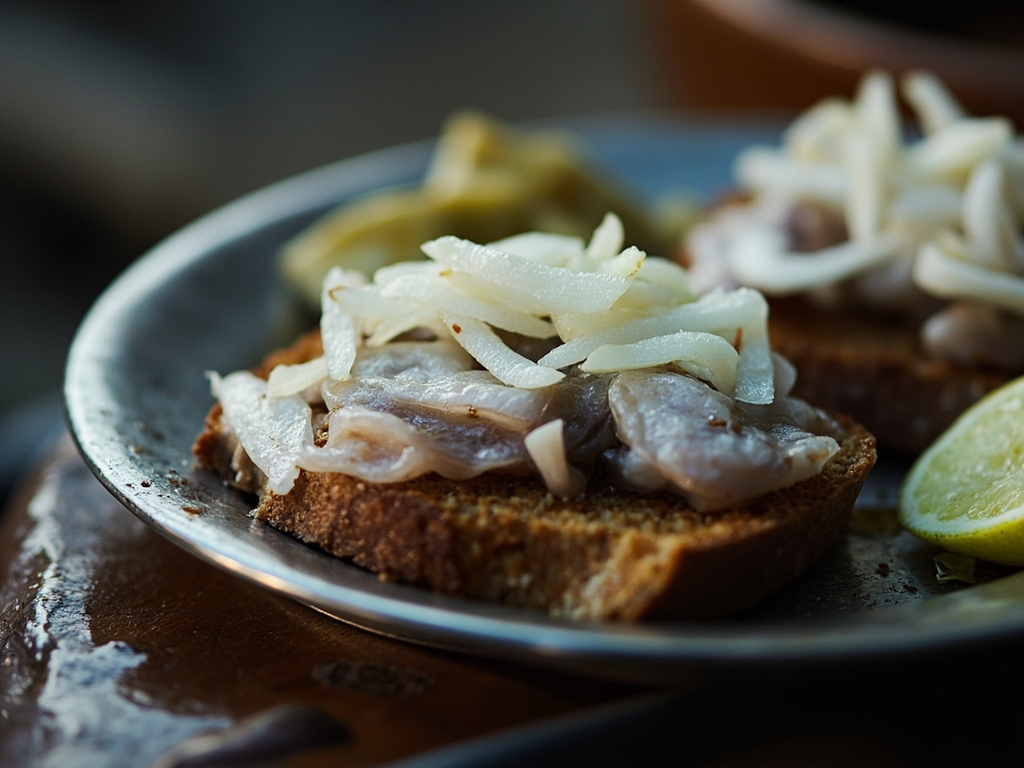
New herring on rye bread (Hollandse haring)
Why this dish? Descartes lived in the heart of Dutch port cities—Amsterdam, Leiden—where lightly matured herring was sold right on the quay, held by the tail. This popular snack, salty and cheap, embodies the daily life of the streets he walked, he who liked to blend anonymously into the merchant crowd.
A fillet of sweet herring, barely salt-matured, laid on a slice of dense rye bread with raw chopped onion. The standing snack of the Golden Age.
You will find me more often on the quays than in salons. I love this city of Amsterdam where no one bothers about my affairs, where I can meditate while walking among the merchants. There, you buy a herring for a few pennies, hold it by the tail and eat it standing, with a bit of onion and brown bread. It is sailor's food, I know; but it has the merit of being quick and not distracting the mind from its thoughts.
- •Lightly salted new herring — one fine fillet per person (heart of the dish, marine umami)
- •Rye bread — one thick slice (base)
- •Raw onion — finely chopped (fresh bite)
- •Butter — a thin layer (binder)
New herring on rye bread (Hollandse haring)
A fillet of sweet herring, barely salt-matured, laid on a slice of dense rye bread with raw chopped onion. The standing snack of the Golden Age.
Why this dish? Descartes lived in the heart of Dutch port cities—Amsterdam, Leiden—where lightly matured herring was sold right on the quay, held by the tail. This popular snack, salty and cheap, embodies the daily life of the streets he walked, he who liked to blend anonymously into the merchant crowd.
You will find me more often on the quays than in salons. I love this city of Amsterdam where no one bothers about my affairs, where I can meditate while walking among the merchants. There, you buy a herring for a few pennies, hold it by the tail and eat it standing, with a bit of onion and brown bread. It is sailor's food, I know; but it has the merit of being quick and not distracting the mind from its thoughts.
Ingredients (period version)
- Lightly salted new herring — one fine fillet per person (heart of the dish, marine umami)
- Rye bread — one thick slice (base)
- Raw onion — finely chopped (fresh bite)
- Butter — a thin layer (binder)
Ingredients
- Sweet herring fillets (maatjes/mildly cured herring) — 2 fillets per person (heart of the dish)
- Dense rye bread — 1 slice per person (base)
- Sweet onion — ½, finely diced (fresh bite)
- Salted butter — a little (binder)
- Gherkin (optional) — 1, sliced into rounds (optional acidity)
Method
- Lightly butter the slice of rye bread.
- Place the drained herring fillets on top.
- Scatter with finely diced onion (and gherkin if desired).
- Eat immediately, by hand, like on the quay—or cut into bite-sized pieces speared with a toothpick.
How it was made : The process of gibben (beheading and partial gutting leaving the pancreas for gentle enzymatic maturation), invented in the 14th century, made Dutch herring a national luxury product exported all over Europe. It was eaten right on the street as soon as the first barrel of the season arrived.
The contemporary twist : Arrange as mini open-faced sandwiches on a wooden board with a dice of onion and a sprig of dill: the 'broodje haring' bistro-style, to pick at as an appetiser.
Sources : De verstandige kock (Amsterdam, 1667) · Tradition of Hollandse Nieuwe haring
René Descartes · Charactorium