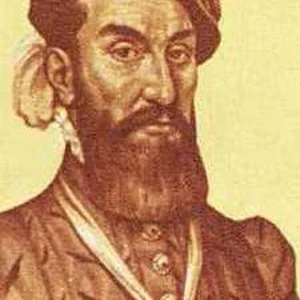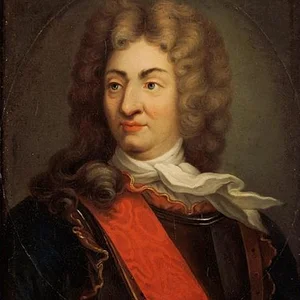

A privateer from Saint-Malo in the service of the King of France, René Duguay-Trouin distinguished himself through daring captures of enemy ships during the wars of Louis XIV. Ennobled for his exploits, he ended his career as lieutenant general of the naval forces after the capture of Rio de Janeiro in 1711.
René Duguay-Trouin(1673 — 1736)
René Duguay-Trouin
France
7 min read
Frequently asked questions
Key Facts
- Born in Saint-Malo in 1673 into a family of shipowners
- Took command of his first privateer ship at just 18 years old (1691)
- Ennobled by Louis XIV in 1709 for his service
- Led the capture of Rio de Janeiro in 1711 during the War of the Spanish Succession
- Became lieutenant general of the naval forces and died in Paris in 1736
Works & Achievements
At eighteen, he takes command of a privateering ship and immediately reveals an exceptional talent for capturing enemy vessels.
Captured by the English, he escapes captivity and makes his way back to France: an episode that became legendary in his youth.
Alongside the Chevalier de Forbin, he seizes escort ships and part of a large English convoy, one of the great successes of privateering.
The king raises the commoner corsair to the rank of nobleman, an official recognition of his services to the State.
A major feat: at the head of seventeen ships, he forces the bay, takes the city, and imposes a considerable ransom on the Portuguese.
He attains one of the highest ranks in the royal navy, crowning a career that began from the humble trade of an ordinary sailor.
An account of his life and campaigns written by himself, a precious source on privateering warfare in the time of Louis XIV.
Anecdotes
Destined by his family to become a priest, young René was so unruly and hungry for adventure that he was eventually sent aboard the ships of the family shipowner. At only eighteen, in 1691, he was given his first command as a privateer — an age when others were still learning the trade of a ship's boy.
In 1694, after a fierce battle against a more powerful English squadron, his ship was captured and Duguay-Trouin found himself a prisoner in Plymouth, England. In his Memoirs, he recounts escaping with the help of local accomplices, crossing the English Channel to return to France and immediately putting back out to sea.
In October 1707, allied with the Chevalier de Forbin, he attacked a large English convoy bound for Portugal off Lizard Point. The two privateers seized several escorting warships and part of the merchant convoy: it was one of the finest feats of French privateering.
His most famous expedition, in 1711, targeted Rio de Janeiro to avenge the failure and death of the privateer Duclerc the year before. At the head of a fleet of seventeen ships financed by private investors but authorized by the king, he forced his way into the bay under fire from the forts, captured the city, and imposed a colossal ransom.
Born a commoner, Duguay-Trouin was ennobled by Louis XIV in 1709 for his exploits and ended his career as lieutenant general of the naval forces, one of the highest ranks in the navy. His Latin motto, “Dedit haec insignia virtus” (“it is valour that gave these arms”), sums up his meteoric rise.
Primary Sources
I was born in Saint-Malo on 10 September 1673. I was intended for the ecclesiastical life, but I felt within me so keen an inclination for the sea and for war that nothing could turn me from it.
After forcing the entrance to the bay despite the fire of the forts, I made myself master of the city, and the inhabitants were compelled to negotiate with me and to pay a heavy ransom to buy back their houses and their goods.
In reward for the distinguished services rendered to the State at sea and for the prizes taken from the enemy, the king grants to René Trouin and to his posterity the title and privileges of nobility, with this motto for his coat of arms: Dedit haec insignia virtus.
Key Places
Fortified corsair city in Brittany where Duguay-Trouin was born and from which the Malouin shipowners set sail. The great port of French privateering in the days of Louis XIV.
Military port in southern England where Duguay-Trouin was imprisoned in 1694 after the capture of his ship. He managed to escape and make his way back to France.
The southernmost point of Cornwall, off which Duguay-Trouin and Forbin seized a large English convoy in 1707.
Portuguese colonial city whose bay Duguay-Trouin forced and which he captured in 1711, imposing a heavy ransom on it. His most famous exploit.
Great port and arsenal of the royal navy in Brittany, the base for preparing and commanding the king's squadrons. Duguay-Trouin served there as a naval officer.
Capital of the kingdom where Duguay-Trouin died in 1736, having become a lieutenant general of the naval forces and a respected figure.
Typical Objects

Official document issued in the king's name that authorized a captain to attack and capture enemy ships. It was what set the privateer, a lawful soldier, apart from the outlaw pirate.

A short, broad and sturdy blade, easy to wield in the cramped space of a ship's decks. It was the supreme weapon of close-quarters combat during boarding actions.

A cast-iron or bronze artillery piece arranged in batteries along the ship's sides. Its broadsides served to cripple an opponent before boarding or to bombard a port's forts.

A telescope that allowed sails to be spotted on the horizon long before the enemy. Essential for choosing one's prey and avoiding warships.

The compass (marine compass), octant and charts made it possible to hold a course and take bearings on the open sea. Without them, crossing the Atlantic to Brazil would have been impossible.

A powerful ship of the line armed with dozens of cannons, flagship of the Rio de Janeiro expedition in 1711. It carried Duguay-Trouin and concentrated the fleet's firepower.

A sealed parchment by which Louis XIV raised the commoner privateer to the nobility in 1709, together with a coat of arms. His motto, “Dedit haec insignia virtus,” recalled that it was courage that had earned him this honour.
School Curriculum
Vocabulary & Tags
Key Vocabulary
Daily Life
Morning
On board, the captain's day began early: observing the sky and the sea, taking a fix with the compass and charts, and inspecting the ship and the crew. The watch at sea marked the passing of time with the ringing of bells.
Afternoon
The afternoon was spent trimming the sails to the wind, scanning the horizon through a spyglass to spot a prize or an enemy vessel, and training the men in the handling of cannons and boarding weapons.
Evening
In the evening, the captain dined in his cabin, sometimes with his officers, recorded the day's events in the logbook, and planned the course. At night, the sea was kept under constant watch, for fear of reefs and enemies.
Food
The everyday fare on board was rough: ship's biscuit (a hard cracker that kept well), salted meat and fish, and dried vegetables, washed down with water and wine or cider. Long crossings used up the fresh provisions and left the crew exposed to scurvy.
Clothing
The privateer wore practical sailor's clothes — a shirt, a wool jacket, breeches, and heavy shoes, or went barefoot on the wet deck. Once an officer and ennobled, Duguay-Trouin donned the braided coat and sword of the king's gentlemen.
Housing
At sea, he lodged in the ship's stern cabin, cramped but reserved for the commander, with a chest, a chart table, and a bunk. On land, his privateer's fortune earned him a comfortable home, in Saint-Malo and later in Paris.
Historical Timeline
Period Vocabulary
Liens externes & ressources
Références
Œuvres
Premier commandement de corsaire
1691
Évasion de la prison de Plymouth
1694
Capture du convoi du cap Lizard
1707
Anoblissement par Louis XIV
1709
Prise de Rio de Janeiro
1711
Lieutenant général des armées navales
1728
Mémoires de Monsieur Du Guay-Trouin
1730 (édition posthume 1740)