 flip
flipShip's Biscuit and Smoked Herring for Crusade
Ship's Biscuit and Smoked Herring for Crusade
Why this dish? To lead his fleet to Acre during the Third Crusade, Richard loaded the holds with what every sailor and crusader knew: twice-baked biscuit that would not mold, and salted-smoked fish. This is the real, rough food of a king on campaign, far from the roasts of his court.
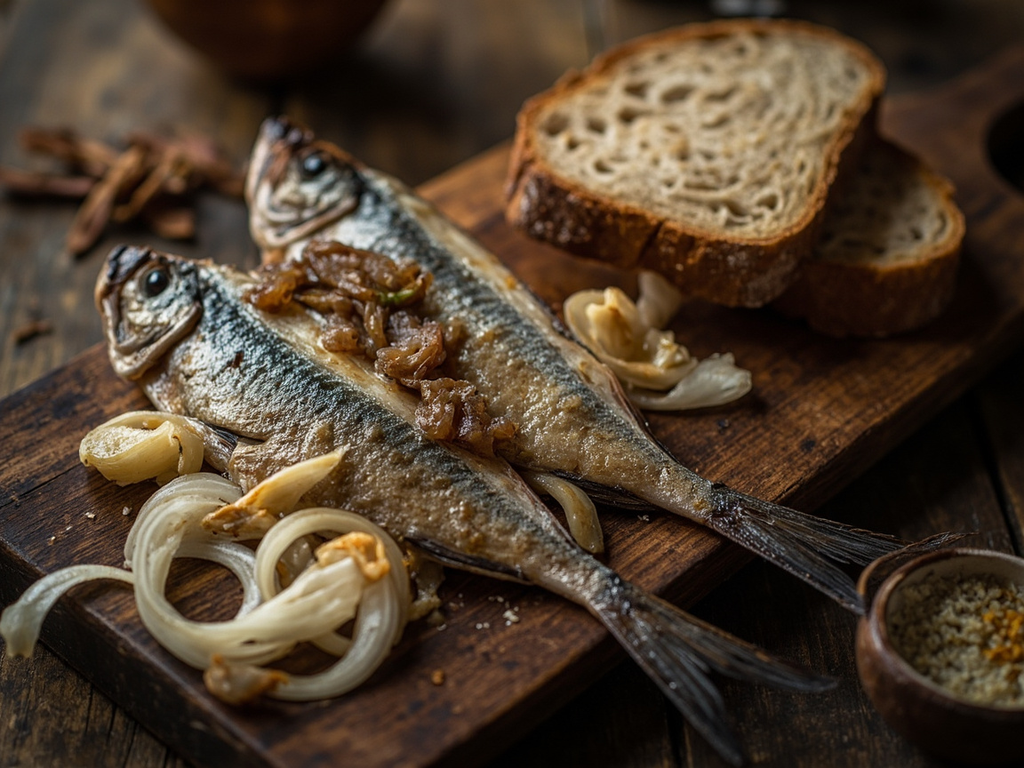
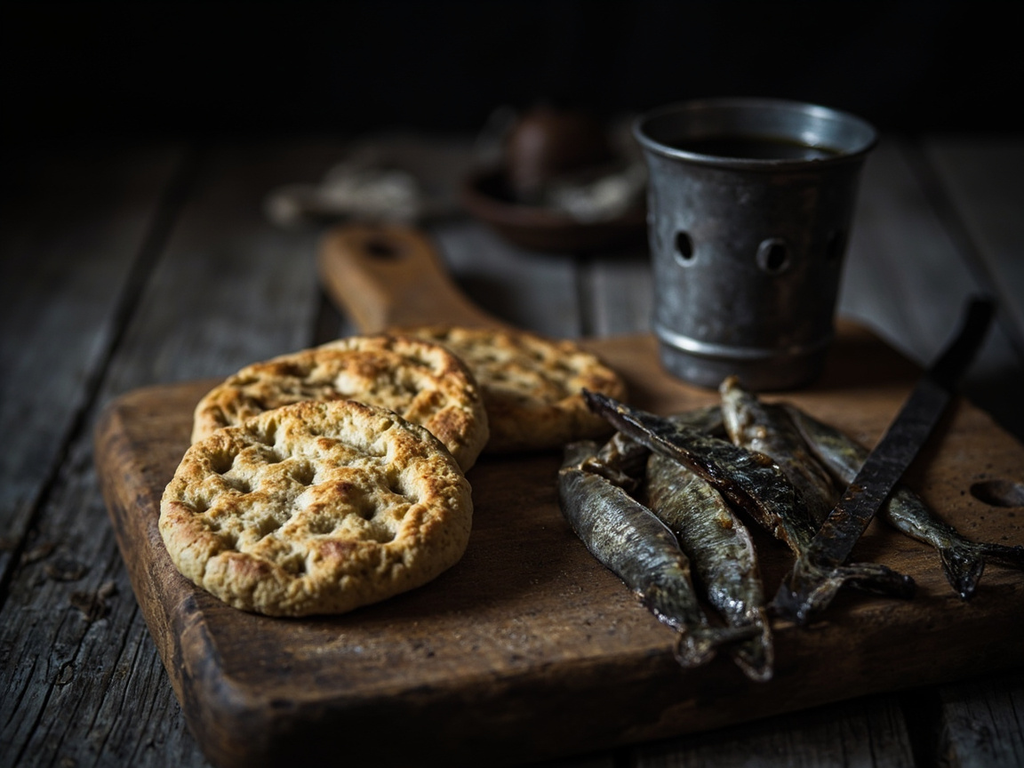
Ship's biscuit (flat bread twice-baked until stone-hard) soaked in water or wine, accompanied by smoked herring (salted then smoked). Survival food for long voyages and sieges, where preservation matters more than pleasure.
When I led my ships to the Holy Land, forget venison and saffron: we lived on biscuit and herring. That bread, my baker bakes twice until it is hard as a pebble, for thus it defies months in the hold without rotting. We break it, let it soften in water or watered wine, and chew the smoked fish atop. A rough fare, indeed, but it is what carries a king and his host right up to the walls of Acre.
- •Wheat flour — for kneading (biscuit dough)
- •Water — just enough to bind (stiff dough)
- •Salt — a little (preservation/flavor)
- •Salted and smoked herring (kippers) — as many as needed (preserved protein)
Ship's Biscuit and Smoked Herring for Crusade
Ship's biscuit (flat bread twice-baked until stone-hard) soaked in water or wine, accompanied by smoked herring (salted then smoked). Survival food for long voyages and sieges, where preservation matters more than pleasure.
Why this dish? To lead his fleet to Acre during the Third Crusade, Richard loaded the holds with what every sailor and crusader knew: twice-baked biscuit that would not mold, and salted-smoked fish. This is the real, rough food of a king on campaign, far from the roasts of his court.
When I led my ships to the Holy Land, forget venison and saffron: we lived on biscuit and herring. That bread, my baker bakes twice until it is hard as a pebble, for thus it defies months in the hold without rotting. We break it, let it soften in water or watered wine, and chew the smoked fish atop. A rough fare, indeed, but it is what carries a king and his host right up to the walls of Acre.
Ingredients (period version)
- Wheat flour — for kneading (biscuit dough)
- Water — just enough to bind (stiff dough)
- Salt — a little (preservation/flavor)
- Salted and smoked herring (kippers) — as many as needed (preserved protein)
Ingredients
- Wheat flour (T65) — 500 g (biscuit)
- Water — about 220 ml (firm dough)
- Salt — 1 tsp (flavor)
- Smoked herring (kippers or mild) — 2 to 4 fillets (salty accompaniment)
- Light red wine or water — a bowl (for soaking biscuit)
Method
- Knead a firm dough with flour, salt, and water, without leavening; roll out thick and cut into rounds pierced with holes.
- Bake once (180°C, 20 minutes), then dry long in a very low oven (110°C, 1 to 2 hours) until completely hard: this is the 'bis-cuit'.
- When serving, soak the biscuit in watered wine or water to soften it.
- Accompany with smoked herring fillets, optionally desalted for a few minutes in milk or water.
How it was made : The 'biscuit' (from Latin bis coctus, 'twice-cooked') was the staple of shipboard diet: its double baking drove out moisture and gave it a shelf life of several months. Salted and smoked herring, a strategic commodity of the North, traveled in barrels. On board and at siege, water was often foul, hence the consumption of watered wine.
The contemporary twist : Serve the biscuit as a 'crusade cracker' with a smoked herring rillette and a touch of mustard, as an aperitif nod.
Sources : John H. Pryor, Logistics of Warfare in the Age of the Crusades · Administrative documents of crusader fleets (historiographic syntheses)
Richard the Lionheart · Charactorium