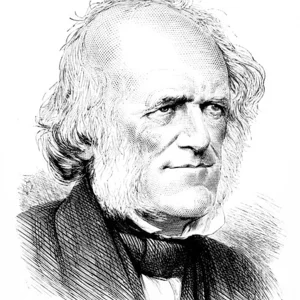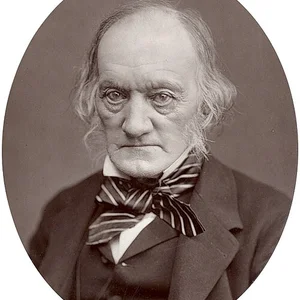

Richard Owen was a 19th-century British palaeontologist and anatomist. He coined the term “Dinosauria” (dinosaurs) in 1842 and was the founder of the Natural History Museum in London. A famous opponent of Darwin's theories on evolution.
Richard Owen(1804 — 1892)
Richard Owen
Royaume-Uni de Grande-Bretagne et d'Irlande
6 min read
Frequently asked questions
Key Facts
- Coined the word “Dinosauria” (dinosaurs) in 1842 to designate a group of giant fossil reptiles
- A recognised specialist in comparative anatomy and vertebrate palaeontology
- The chief architect behind the founding of London's Natural History Museum, opened in 1881
- A scientific adversary of Charles Darwin and his theory of natural selection after 1859
- Described many fossil species, including the moa of New Zealand from a single fragment of bone
Works & Achievements
Owen grouped several giant fossil reptiles under a common name, thereby founding the science of dinosaurs.
From a single bone fragment, Owen predicted the existence of a giant extinct bird, the Moa, demonstrating the power of comparative anatomy.
In this work Owen developed his concept of the archetype, an ideal organizational plan common to all vertebrates.
A major lecture on the unity of plan in the limbs of vertebrates, influential in comparative anatomy.
The world's first life-size depictions of dinosaurs, designed under his supervision for the general public.
A three-volume treatise synthesizing the knowledge of the time on the anatomy of animals with a backbone.
Owen secured the creation of an independent museum dedicated to nature, one of the world's great scientific institutions.
Anecdotes
In 1842, Richard Owen coined the word “Dinosauria,” which means “terrible lizards” in Greek, to describe these extinct giant reptiles. This single word would set the whole world's imagination ablaze: even today, millions of children know about dinosaurs thanks to this term invented by Owen.
For the great Universal Exhibition of 1851, Owen oversaw the creation of the first life-size dinosaur statues, set up in the grounds of Crystal Palace in London. In 1853, a dinner was even held inside the concrete mould of an Iguanodon: some twenty scholars ate their meal seated at a table in the belly of the monster!
Owen was such a renowned anatomist that the carcasses of exotic animals that had died at the London Zoo were sent to him so he could dissect them. It is said that his wife would sometimes come home to find a rhinoceros carcass or some bulky corpse in the hallway, waiting to be studied.
Owen was Charles Darwin's great rival. When “On the Origin of Species” appeared in 1859, Owen published a scathing, anonymous review... in which he repeatedly quoted himself with praise, which ended up making him look ridiculous to his colleagues.
Thanks to his relentless determination, in 1881 Owen secured the creation of an immense museum dedicated to nature: the Natural History Museum in London, nicknamed the “cathedral of nature.” He wanted a grand place where the public could marvel at the skeletons of whales and dinosaurs.
Primary Sources
The combination of such characters... will, it is presumed, be deemed sufficient ground for establishing a distinct tribe or sub-order of Saurian Reptiles, for which I would propose the name of Dinosauria.
A monumental three-volume treatise in which Owen lays out his vision of comparative anatomy and his concept of the vertebrate “archetype”.
Here Owen develops the idea that all vertebrate limbs derive from a single ideal organizational plan, the archetype.
A detailed study of the skeleton of the Megatherium, a giant fossil ground sloth from South America, reconstructed by Owen.
Key Places
Town in northwest England where Richard Owen was born in 1804 and spent his childhood.
Owen began his studies in medicine and anatomy here before continuing in London.
Owen worked here as curator of the Hunterian Museum, where he studied countless anatomical specimens.
Great natural history museum in London that Owen had created and which opened its doors in 1881.
Park where the first life-sized dinosaur sculptures, designed under Owen's direction, were installed in 1854.
Owen lived here in a grace-and-favour house granted by the Queen and died here in 1892.
Liens externes & ressources
Références
Œuvres
Création du terme « Dinosauria »
1842
Memoirs on the Extinct Wingless Birds of New Zealand (étude du Moa)
1840-1879
On the Archetype and Homologies of the Vertebrate Skeleton
1848
On the Nature of Limbs
1849
Sculptures de dinosaures du Crystal Palace
1854
On the Anatomy of Vertebrates
1866-1868
Fondation du Natural History Museum de Londres
1881