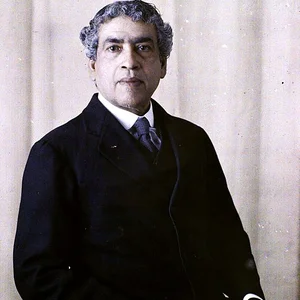

Indian physicist and botanist (1858-1937), a pioneer in the study of radio waves and plant physiology. He demonstrated that plants react to stimuli and invented instruments of remarkable precision.
Jagadish Chandra Bose(1858 — 1937)
Jagadish Chandra Bose
Raj britannique
7 min read
Frequently asked questions
Famous Quotes
« The real laboratory is the mind, where behind illusions we uncover the laws of truth.»
Key Facts
- Born in 1858 in Mymensingh (Bengal, British India, present-day Bangladesh).
- In 1895, he gave a public demonstration of radio wave (microwave) transmission in Calcutta.
- A pioneer in the study of millimeter waves and inventor of the semiconductor detector (coherer).
- From 1900 onward, he demonstrated that plants respond to stimuli and invented the crescograph to measure their growth.
- Founder in 1917 of the Bose Institute in Calcutta; died in 1937 in Giridih.
Works & Achievements
One of the world's first long-distance transmissions of electromagnetic waves, ringing a bell and detonating a charge through walls. A key milestone in the history of radio.
Bose produced and studied waves a few millimeters long, inventing waveguides, horn antennas, and semiconductor detectors. These devices foreshadowed modern microwave technology.
A crystal device for detecting radio waves, a precursor to semiconductor diodes. Bose obtained his only patent for it, reluctantly.
An instrument that amplified the movements of plants up to ten thousand times, proving that they react to stimuli. It founded a new approach to plant physiology.
A major work arguing for the continuity of responses between living and non-living matter. It caused a great stir in the scientific world.
A synthesis of his research on plant sensitivity studied through precision instruments. A landmark in plant physiology.
A science-fiction tale in Bengali, considered one of the first of its kind in the language. It reflects Bose's scientific imagination.
The creation in Calcutta of a research institute dedicated to free, patent-free science. It trained generations of Indian researchers.
Anecdotes
In November 1895, at the Town Hall in Calcutta, Bose performed a spectacular demonstration before the Lieutenant-Governor of Bengal: using electromagnetic waves, he rang a bell and set off a small charge of gunpowder from a distance, through walls. It was one of the very first public wireless transmissions in the world, predating Marconi's famous demonstrations.
Bose refused on principle to patent his inventions: he believed that scientific knowledge should remain free and belong to everyone. Under the persistent pressure of his friends, he filed only a single American patent in 1904, for his galena detector, but never sought to profit from it.
With his crescograph, an instrument able to magnify a plant's movement up to ten thousand times, Bose staged striking experiments: before the Royal Society in London, he showed a plant reacting to a prick, to heat, or to a poison, appearing to shudder and then “die” before the audience's eyes.
In 1896, Bose won a short-story contest organized by a Bengali hair-oil brand with “Niruddesher Kahini” (The Story of the Missing One), in which a cyclone is calmed by pouring a bottle of oil onto the sea. It is considered one of the very first works of science fiction written in Bengali.
His millimeter-wave devices already used waveguides, horn antennas, and semiconductor detectors that physics would rediscover decades later. In 1998, the IEEE engineering institution recognized him as one of the pioneers of radio, long after his death.
Primary Sources
The discoveries made here will become public property. No patent will ever be taken. The spirit of our national culture demands that we remain forever free from the desecration of turning knowledge into a commodity.
I was led to recognize that the boundary between the living and the non-living fades away: metal subjected to repeated stimulation shows fatigue, recovery, and response, just like the muscle of a living being.
By passing electric radiation through a diffraction grating, its wavelength can be measured precisely, which proves that these invisible waves obey the same laws as light.
The plant, seemingly motionless and insensible, possesses a mechanism for responding to stimuli; the crescograph reveals its minute pulsations, until then hidden from our observation.
Key Places
Region where Bose was born in 1858, while his father was a civil servant there; his family came from the Bikrampur district. He received his earliest schooling here, at a Bengali-language school.
Prestigious institution where Bose taught physics from 1885, despite the discrimination he faced as an Indian professor. It was there that he carried out his first research on waves.
College of the University of Cambridge where Bose studied natural sciences in the 1880s. There he was taught by renowned physicists and naturalists.
London scientific institution where Bose presented his work on electric waves in 1897. His lectures there made a strong impression on the European scholarly community.
Research center founded by Bose in 1917 and dedicated to free, patent-free science. It is one of the oldest research institutes in India.
Town where Bose owned a residence and where he passed away in 1937. He liked to continue his observations of plants there in peace.
Typical Objects

Instrument invented by Bose to measure the growth and minute movements of plants, amplifying them up to ten thousand times. It made it possible to prove that plants react to external stimuli.

Electromagnetic wave detector improved by Bose, far more sensitive than the coherers of his time. It was used to pick up wireless telegraphy signals.

Device using a galena crystal (lead sulphide) to detect radio waves, patented by Bose in 1904. It foreshadows modern semiconductor diodes.

Apparatus built by Bose to produce very short electromagnetic waves, on the order of a few millimetres. He paired it with waveguides and horn antennas, well ahead of his time.

Finely ruled plate used by Bose to measure the wavelength of his electric radiation. It proved that these invisible waves behave like light.

Optical bench adapted by Bose to study the reflection, refraction and polarization of his electric waves. He extended the laws of optics to the invisible domain of microwaves.
School Curriculum
Vocabulary & Tags
Key Vocabulary
Daily Life
Morning
A professor in Calcutta, Bose started early, dividing his time between preparing his physics lectures and his laboratory experiments. Meticulous, he devoted his mornings to adjusting his delicate instruments and recording his observations.
Afternoon
Afternoons were often spent giving demonstrations to his students or taking patient measurements with his apparatus. He could spend hours watching a plant's response on the crescograph.
Evening
In the evening, Bose read, wrote his scientific papers, and kept up a rich correspondence, notably with the poet Rabindranath Tagore, his friend. He also enjoyed discussing literature and philosophy.
Food
His diet followed the Bengali cuisine of the time: rice, lentils (dal), vegetables, freshwater fish, and fruit. The meals, simple, were prepared at home according to family customs.
Clothing
Depending on the occasion, Bose wore Western dress — jacket and tie — during his stays in Europe, and traditional Bengali clothing, such as the *dhoti* and the *panjabi*, in everyday life in India.
Housing
He lived in a house belonging to Calcutta's educated middle class, in a lively colonial city, and owned a more peaceful residence in Giridih, where he continued his observations on plants.
Historical Timeline
Period Vocabulary
Liens externes & ressources
Références
Œuvres
Démonstration publique de transmission sans fil (Calcutta)
1895
Travaux sur les ondes millimétriques et la polarisation
1895-1900
Détecteur à galène (brevet américain)
1904
Crescographe
vers 1900
Response in the Living and Non-Living
1902
Plant Response as a Means of Physiological Investigation
1906
Niruddesher Kahini (L'Histoire du disparu)
1896