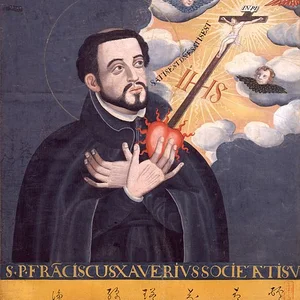

A Navarrese Jesuit and co-founder of the Society of Jesus alongside Ignatius of Loyola, he was the first great Christian missionary in Asia. He evangelized India and Japan, and died at the gates of China in 1552.
Saint Francis Xavier(1506 — 1552)
Francis Xavier
royaume de Navarre, couronne de Castille
8 min read
Frequently asked questions
Famous Quotes
« Give me souls and keep all the rest.»
« There are vast numbers of people here who do not become Christians for one reason only: there is no one to make them Christians.»
Key Facts
- 1506: born at Xavier, in Navarre (present-day Spain)
- 1534: co-founds the Society of Jesus in Paris with Ignatius of Loyola
- 1542: arrives in Goa (Portuguese India) to evangelize Asia
- 1549: first Christian missionary to reach Japan
- 1552: dies on the island of Shangchuan, at the gates of China, while attempting to enter the country
Works & Achievements
122 letters sent from Asia to his fellow Jesuits and to the King of Portugal. They stand as an exceptional testimony to the encounter between Christian Europe and the Asian civilizations of the 16th century.
The first Christian text written in Tamil, intended for the fishermen of the Coromandel Coast. It reflects the missionary method of inculturation: conveying the faith in the language of the people being evangelized.
With the help of Anjiro, Xavier committed the first Catholic prayers in Japanese to writing. These pioneering texts served as a foundation for the Jesuits who continued the mission in Japan after him.
Xavier founded or consolidated lasting Christian communities in South India, Malacca, and Japan, some of which would survive for several centuries in the form of the Thomas Christians and the Japanese Kakure Kirishitan.
Before his death, Xavier drew up a plan to evangelize China through the scholarly elite and the imperial court — a strategy that the Jesuits, most notably Matteo Ricci, successfully put into practice half a century later.
Anecdotes
According to hagiographic tradition, Francis Xavier possessed the gift of tongues: he is said to have preached in languages he did not know, instantly understood by his Indian, Malay, and Japanese listeners. This miracle, reported by his Jesuit companions, earned him the reputation of Apostle of the Indies endowed with supernatural apostolic powers, comparable to those of Christ's first disciples.
A famous legend tells that while crossing the China Sea, Xavier lost his crucifix in the waves during a raging storm. The following morning, as he was praying on the shore, a crab emerged from the waves carrying the intact crucifix between its claws. This account, recorded by his contemporaries, became one of the miracles most frequently depicted in Xaverian iconography and was invoked during his canonization proceedings.
In Goa, Xavier tended to the sick in hospitals and physically touched the wounds of lepers, to the great horror of the Portuguese colonists. Hagiographers attribute to him the resurrection of a child in Coulão whose body had already been prepared for burial — a miracle that contributed to his reputation as a miracle worker and drew crowds of converts.
Francis Xavier died alone on the island of Sancian (Shangchuan), at the very gateway to China, which he never reached, cared for by a single servant. His last words were addressed to Christ: 'Domine, in te speravi, non confundar in aeternum.' His body, buried in quicklime, was found incorrupt several months later — a sign that hagiographers interpreted as a mark of divine holiness.
Primary Sources
From India, September 20, 1542: "There are so many souls here to save and so few workers! If those studying in Paris knew how many peoples are ignorant of the name of Christ, they would abandon their books and fly here."
The Constitutions define the mission of absolute obedience to the Pope, the founding principle that sends Xavier "wherever the need is greatest," even to the farthest reaches of the known world.
A compilation of 122 authenticated letters from Xavier, accounts from contemporaries, and records from the canonization proceedings. It forms the documentary foundation for any serious biography of the saint.
Xavier's companion in Japan, Torres bears witness: "Father Xavier learned our language in less than three months and was already preaching in the streets of Kagoshima, drawing Buddhist monks into debate on the soul and creation."
Key Places
Birthplace of Francis in 1506, born into a noble Navarrese family. The castle was transformed into a sanctuary and international pilgrimage site following his canonization in 1622.
Capital of the Portuguese colonial empire in Asia, Goa served as the base for all of Xavier's Asian missions. He cared for the sick there, evangelized fishermen, and today rests in the Basilica of Bom Jesus.
The first Japanese city where Xavier landed in 1549, accompanied by the Japanese convert Anjiro. He preached there for a year and laid the foundations of the Catholic Church in Japan.
An island off the Chinese coast where Francis Xavier died alone on December 3, 1552, waiting in vain for a passage into China. It is today a Catholic pilgrimage site.
It was in Paris that Xavier met Ignatius of Loyola and took the founding vows of the Society of Jesus in 1534. The University of Paris served as the intellectual and spiritual crucible of the order.
Typical Objects

Francis Xavier always carried a crucifix with him during his preaching. According to legend, it was this very crucifix that a crab retrieved from the bottom of the sea after a storm — a symbol of the divine protection granted to his mission.

To gather children and the poor in the streets of Goa, Xavier would walk through neighborhoods ringing a bell. This simple, direct method became his missionary signature in Asian port cities.

Xavier was a prolific letter-writer: he composed more than 122 letters to his superiors, to the King of Portugal, and to his fellow Jesuits. These letters are invaluable testimonies about 16th-century Asia and his own spiritual life.

The plain black robe signified voluntary poverty and service. Xavier wore it until it was threadbare, refusing garments offered by Portuguese governors throughout his ten years of Asian mission.

Francis Xavier had prayers and articles of faith translated into local languages, producing some of the earliest Christian texts in Tamil and Japanese. These teaching tools were central to his method of missionary inculturation.

After his canonization, Xavier's right arm — the one that had baptized thousands of the faithful — was separated and preserved as a relic in Rome. This symbolic act immortalized the baptismal gesture as the defining mark of his miraculous holiness.
School Curriculum
Vocabulary & Tags
Key Vocabulary
Daily Life
Morning
Francis Xavier rose before dawn to pray the Divine Office and celebrate Mass, often alone in a makeshift chapel or under a tree. He practiced a rigorous asceticism inherited from Ignatius's Spiritual Exercises: examination of conscience, meditation, and silent prayer before any activity.
Afternoon
Afternoons were devoted to visiting the sick in hospitals, engaging in theological debates with Hindu Brahmins and Buddhist monks, and teaching catechism to children. Xavier would walk for hours under the tropical heat to reach the most isolated villages.
Evening
In the evenings, Xavier gathered communities for collective prayers and wrote his famous letters by candlelight. He slept on a mat on the bare floor, refusing the comforts offered by Portuguese nobles in Goa or Malacca.
Food
Xavier observed an almost permanent fast, sustaining himself on rice, local vegetables, and occasionally dried fish. He refused the banquets offered by colonial governors and shared the simple food of the people he was evangelizing.
Clothing
He wore the black Jesuit cassock, unadorned, often worn and patched after months of travel. In the tropical heat of India and Malacca, he refused to dress any differently, viewing physical discomfort as a spiritual offering.
Housing
Xavier lived in spartan conditions: convent cells, fishermen's huts, and makeshift shelters aboard Portuguese trading ships. On the island of Sancian, where he died, he lived in a simple thatched hut, cared for by a single Chinese servant.
Historical Timeline
Period Vocabulary
Liens externes & ressources
Références
Œuvres
Lettres apostoliques (Epistolae Xaverianae)
1540–1552
Catéchisme en langue tamoule
1542–1544
Prières et catéchisme en japonais
1549–1551
Fondation des chrétientés de Goa, Malacca et du Japon
1542–1552
Instructions pour la mission de Chine
1551–1552