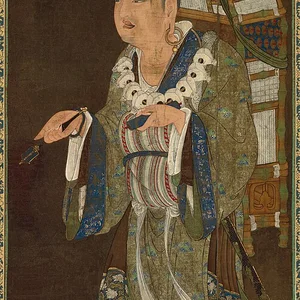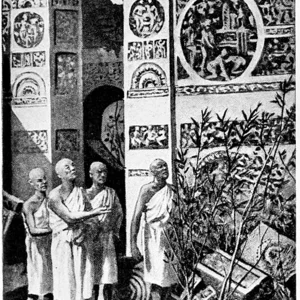

A Chinese Buddhist monk of the 4th–5th century, Faxian undertook a long pilgrimage on foot to India to collect sacred texts. His travel account, titled *A Record of Buddhist Kingdoms*, stands as one of the earliest detailed descriptions of India and Central Asia written by a Chinese traveler.
Frequently asked questions
Key Facts
- Around 399: departure from China on foot toward India
- 399–412: a fifteen-year journey across Central Asia, India, and Ceylon
- 412: return to China by sea via Sumatra
- 413–414: composition of the *Foguoji* (A Record of Buddhist Kingdoms)
- He brought back to China numerous Buddhist manuscripts and relics
Works & Achievements
A travel account written by Faxian upon his return from India, describing the countries he crossed, Buddhist customs, holy sites, and the routes he took. It is one of the earliest Chinese texts to offer a detailed description of India, Central Asia, and Sri Lanka.
A Chinese translation of this major text recounting the final moments and nirvāṇa of the historical Buddha Śākyamuni. The translation proved invaluable to Chinese monks who had no access to the original Sanskrit texts.
A translation of the disciplinary rules of the Mahāsāṃghika school, one of the Vinaya texts Faxian had most sought out during his journey. This translation helped standardize monastic discipline across Chinese Buddhist communities.
A translation of a Buddhist philosophical treatise from the Sarvāstivāda school, enriching the body of doctrinal literature available in Chinese. This work reflects the intellectual breadth of Faxian's mission, reaching well beyond the Vinaya alone.
Anecdotes
At around sixty years of age, Faxian left Chang'an in 399 with a handful of monks to seek Buddhist texts in India. Courageous as he was, most of his companions gave up along the way, frightened by the deserts and mountains. Faxian pressed on alone, convinced that his spiritual mission outweighed all dangers.
To reach India, Faxian had to cross the Taklamakan Desert, one of the most inhospitable in the world. In his account, he describes burning sands, violent winds, and demons raising dust storms to lead travelers astray. The only landmarks were the bones of those who had died on the road before him.
Faxian spent three years in Pataliputra (modern-day Patna, India) learning Sanskrit and copying sacred Buddhist texts he could not find in China. He frequented the great Indian monasteries, attended ceremonies, and meticulously recorded local customs, leaving behind a precious testimony about India as it was in his time.
On the return voyage, the ship carrying Faxian was struck by such a violent storm that the panicked merchants wanted to throw the heaviest luggage overboard. Faxian feared losing the precious manuscripts he had brought back from India; he clung to his texts and prayed fervently. Blown off course, the ship finally reached Java after several months of drifting at sea.
Back in China after fifteen years away, Faxian was over eighty years old. He immediately set about translating the texts he had brought back into Chinese and writing his travel account, the Foguo ji. Completed around 416, this text stands as one of the earliest detailed descriptions of Central Asia and India written by a Chinese traveler.
Primary Sources
The sands are heaped into endless dunes; there is neither bird above nor four-footed beast below. One searches with one's eyes for a path to follow, but no sign marks the way. Only the bones of men who have died there serve as waymarks for travelers.
Faxian was by nature calm and resolute. From childhood, he aspired to devote himself entirely to the Buddhist Law. He undertook this journey to the western lands in search of the vinaya — the monastic discipline rules that were lacking in China.
The texts brought back by Faxian from his pilgrimage to India rank among the most precious ever introduced into China. He notably translated the Mahāparinirvāṇa-sūtra and the Mahāsāṃghika-vinaya, filling major gaps in Chinese canonical literature.
Key Places
Capital of northern China and the starting point of Faxian's pilgrimage in 399. A great metropolis and crossroads of Buddhism in East Asia, it was home to numerous monasteries and translators of Indian texts.
An oasis town at the gateway to the Taklamakan Desert and the last major Chinese stop before Central Asia. Faxian rested here before venturing into the deadly sands and entering unknown territories to the west.
The holiest site in Buddhism, where Prince Siddhartha attained Enlightenment beneath the Bodhi Tree. Faxian stayed here and described with deep emotion the great tree, the surrounding monasteries, and the offering ceremonies.
The ancient capital of the Maurya Empire and a great intellectual center of Indian Buddhism under the Guptas. Faxian resided here for three years to study Sanskrit and copy the Vinaya monastic texts he could not find in China.
The religious capital of Theravāda Buddhism in Ceylon, where Faxian spent two years collecting additional texts. He attended the great festivals of the Buddha's Tooth and precisely described the local ceremonies.
The city where Faxian settled after returning to China to continue his translations and complete the writing of his travel account. He died here around 422, at a very advanced age, after a lifetime devoted to the dharma.
Typical Objects

Long metal staff topped with jingling rings, carried by Buddhist monks while traveling. It allowed Faxian to steady himself in mountain passes and signal his presence to wild animals on the trails of Central Asia.

Monk's bowl used to receive food during the daily alms round. A symbol of monastic life, it reminded Faxian of his dependence on the generosity of the faithful he encountered throughout his fifteen-year journey.

Saffron or ochre-colored garment worn by Buddhist monks, symbolizing renunciation of the world. Faxian wore it in all circumstances, even in scorching deserts and blizzards on the Himalayan passes.

Sacred Buddhist texts inscribed on dried and bound palm leaves, typical of ancient India. Faxian brought back many such manuscripts from India and Ceylon, which he later translated into Chinese upon his return.

Writing materials used by Faxian to record his geographical, cultural, and religious observations throughout the journey. These notes enabled him to write the Foguo ji upon his return, leaving behind an exceptional historical account.

Small Buddhist ritual lamp symbolizing the light of wisdom dispelling ignorance. Faxian describes it in the ceremonies he witnessed, particularly the great nocturnal offering festivals held in Indian monasteries.
School Curriculum
Vocabulary & Tags
Key Vocabulary
Daily Life
Morning
Faxian rose before dawn for morning meditation and the recitation of sutras, as every Buddhist monk did. He then made his alms round (pindapāta) through the villages he passed through, receiving his daily food from the faithful in exchange for prayers and blessings.
Afternoon
Afternoons were devoted to walking when the group was traveling, sometimes ten to twenty kilometers a day on mountain or desert paths. In the monasteries where he stayed, he studied Sanskrit, copied manuscripts by oil lamp, or discussed doctrine with the local monks.
Evening
In the evening, Faxian ate a light meal — Buddhist monks did not eat after noon according to the Vinaya rule — then took part in ceremonies and collective readings. He would then record his observations on wooden tablets, laying the groundwork for his future travel account.
Food
As a Buddhist monk, Faxian followed a strict vegetarian diet, refusing to consume meat or fish. He subsisted on what the faithful offered him: rice, vegetables, fruits, and flatbreads depending on the regions he traveled through. In the deserts and high mountain passes, food sometimes dwindled to the bare minimum needed for survival.
Clothing
Faxian wore the Buddhist monastic robe (kāṣāya) at all times, an ochre-colored fabric assembled from pieces of reclaimed cloth, a symbol of renunciation of material possessions. He added an extra layer of coarse wool in the bitter cold when crossing the snow-covered passes of the Pamirs.
Housing
While traveling, Faxian slept in the monasteries (vihāra) that dotted the trade routes, or under the open sky in deserts and high mountain passes. In the great Indian cities such as Pataliputra, he lived for several years in richly endowed monasteries, with individual cells arranged around a central courtyard.
Historical Timeline
Period Vocabulary
Liens externes & ressources
Références
Œuvres
Foguo ji (佛国记) — Mémoire sur les pays bouddhiques
vers 416
Traduction du Mahāparinirvāṇa-sūtra
vers 418
Traduction du Mahāsāṃghika-vinaya
vers 416
Traduction du Saṃyuktābhidharmahṛdaya-śāstra
vers 420