
Sardanapalus is a legendary king of Assyria, a figure from ancient Greek tradition. Renowned for his extreme luxury and dissolute lifestyle, he is said to have chosen to die in flames rather than surrender to his enemies. His tragic fate inspired numerous works of art, most notably the painting by Eugène Delacroix.
Sardanapalus
Sardanapalus
Assyrie
8 min read
Frequently asked questions
Key Facts
- A legendary figure mentioned by ancient Greek authors, notably Ctesias of Cnidus (5th–4th century BC)
- Sometimes identified with Ashurbanipal, the last great king of Assyria (669–627 BC)
- According to legend, he perished on an enormous funeral pyre along with his treasures and concubines rather than surrender
- His figure became a symbol of Eastern decadence in both ancient and modern Western tradition
- Eugène Delacroix painted *The Death of Sardanapalus* in 1827, an iconic work of French Romanticism
Works & Achievements
An apocryphal inscription supposedly carved on the king's tomb, summarizing his hedonistic philosophy: “I have all that I ate and enjoyed.” This brief text fueled centuries of philosophical debate on pleasure and virtue.
The first detailed Greek account of the life and death of Sardanapalus, written by a Greek physician who lived at the Persian court. Preserved only in fragments, this foundational text transmitted the legend to the entire Western tradition.
A romantic play in five acts in which Byron partially rehabilitates Sardanapalus, presenting him as a peaceful and sensitive king rather than a mere degenerate. The work enjoyed enormous success across Europe.
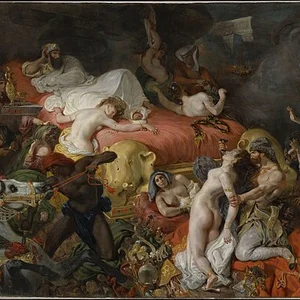
A monumental painting (392 × 496 cm) housed in the Louvre, depicting the languid king on his funeral pyre surrounded by slaughtered women and destroyed treasures. A masterpiece of French Romanticism, it scandalized the Salon but established Delacroix as a grand master of the genre.
A cantata for tenor, chorus, and orchestra composed by Berlioz for the Prix de Rome, which he won with this work. The score depicts the funeral pyre scene with the orchestral power characteristic of Berlioz's style.
Anecdotes
According to Ctesias of Cnidus, a Greek historian of the 5th century BC, Sardanapalus was so secluded in his palace that his own generals had never seen him in person. He ruled from his inner apartments, hidden behind curtains of embroidered linen, surrounded only by his concubines and eunuchs.
When the rebels led by General Arbaces managed to reach his private quarters, they found the king dressed in women's robes, spinning wool among his concubines. This scene, reported by Diodorus Siculus, embodied for the Greeks the very model of a depraved and effeminate ruler.
Besieged in Nineveh for two years, Sardanapalus held out for a long time thanks to the palace's vast stores of provisions. When the walls finally gave way, he organized an enormous funeral pyre: he had all his gold, silver, concubines, eunuchs, and favorites thrown onto it, then cast himself into the flames, choosing to die as a king rather than survive as a conquered man.
A legendary inscription carved on his tomb, cited by the Greek author Athenaeus, supposedly read: “I possess all that I have eaten, what I have enjoyed, and the pleasures of love. All else is forgotten.” This text — a true hedonist manifesto ahead of its time — fascinated philosophers and poets from Antiquity through the Romantic era.
Eugène Delacroix's painting, *The Death of Sardanapalus* (1827), depicts the king reclining on his funeral pyre, watching with indifference the slaughter of his women, his horses, and the destruction of his treasures. This masterpiece of Romanticism caused a scandal at the Paris Salon and remains one of the most celebrated works inspired by the Assyrian legend.
Primary Sources
Sardanapallus, the last king of the Assyrians, surpassed in softness and luxury all those who had come before him. Not only did he live apart from men, hidden away in his palace, but he wore women's robes and sought to imitate the way of life of women.
On the tomb of Sardanapallus, one could read: "I have all that I have eaten and all that I have enjoyed in love; as for the treasures I once possessed, I have left them behind."
Sardanapallus, learning that his enemies had breached the walls of Nineveh, had an enormous pyre built in the royal palace, gathered together his treasures, his women, and his eunuchs, and threw himself into the flames.
It is said that Sardanapallus was the last king of the Assyrians, and that he chose to perish in the flames with all that he possessed rather than fall into the hands of the Medes.
Key Places
The legendary capital of Sardanapale's reign, Nineveh was one of the greatest cities of the ancient world, possibly home to 150,000 inhabitants at its peak. It was in its palace that, according to tradition, the king organized the final pyre rather than surrender to the Medes.
According to Diodorus Siculus, the revolt that threatened Sardanapale was sparked in Bactria by the satrap Arbaces the Mede. This distant province of the empire was the starting point of the coalition that destroyed Assyrian power.
The Persian capital where Ctesias of Cnidus, a Greek physician and historian, composed his *Persica* in the 5th century BCE. It was probably there that the legend of Sardanapale was first codified in the form in which Western tradition received it.
Delacroix's painting, *The Death of Sardanapalus* (1827), is housed in the Louvre and remains today the primary vehicle through which the legend reaches the general public. Millions of visitors discover there each year the tragic fate of the legendary Assyrian king.
Typical Objects

An emblem of Assyrian kingship, adorned with gold and precious stones, it symbolizes an absolute power that Sardanapalus chose to consume in flames rather than surrender to a conqueror. As much an object of display as of authority.

According to Greek tradition, Sardanapalus wore fine linen garments in vivid colors embroidered with gold thread, scandalizing his generals and visitors. This sartorial detail became one of the most famous features of his legend.

The legendary banquets of Sardanapalus were served in solid gold cups filled with precious wines from Phoenicia and Cyprus. These vessels symbolize the boundless opulence of a king who preferred pleasure to war.

According to Diodorus Siculus, Sardanapalus was spinning wool among his concubines when his enemies discovered him. The spindle and distaff, feminine attributes in antiquity, became in his legend the symbol of his rejection of traditional martial virtues.

Rather than fall into his enemies' hands, Sardanapalus had an enormous funeral pyre built in his palace at Nineveh. The torches that set it ablaze became the ultimate symbol of defiance in defeat and the fall of an empire.

The Assyrian empire was administered through thousands of clay tablets covered in cuneiform script. The great library of Ashurbanipal at Nineveh, with which Sardanapalus is associated, held more than 30,000 tablets — one of the largest collections in the ancient world.

Greek chroniclers dwell on the extravagant adornments worn by Sardanapalus: gold necklaces, amber and ivory bracelets, diadems set with lapis lazuli. These ornaments illustrate the legendary wealth of the Assyrian empire at its height.
School Curriculum
Vocabulary & Tags
Key Vocabulary
Tags
Daily Life
Morning
According to Greek sources, Sardanapalus did not rise at dawn like warrior kings. He remained in his inner apartments, attended by his eunuchs and surrounded by Oriental perfumes. Royal audiences, exceedingly rare, were held behind curtains so that subjects could not see his face.
Afternoon
The afternoon was devoted to the pleasures of the court: sumptuous banquets washed down with Phoenician wines, performances of dance and music, and board games. Sardanapalus is also said to have practiced wool spinning among his concubines — an activity Greek moralists considered scandalous for a king.
Evening
Evenings in the palace of Nineveh were endless celebrations: feasts of exotic dishes, the light of thousands of oil lamps reflected in pools, and music from citharas and flutes. The king ended the night surrounded by his favorites in halls whose walls were covered with carved reliefs depicting his ancestors on the hunt.
Food
The table of Sardanapalus was reputed to be the most sumptuous in the known world: roasted meats seasoned with saffron, fish from the Tigris and Euphrates, fresh dates and figs, Phoenician and Cypriot wines served in golden cups. Greek sources mention banquets bringing together several hundred guests.
Clothing
According to Diodorus of Sicily, Sardanapalus wore robes of fine linen in vivid colors embroidered with gold thread, soft leather sandals, perfumed wigs, and cosmetics like the women of his court. These feminine garments, shocking to Greek sensibilities, symbolized his rejection of traditional martial virtues.
Housing
The palace of Nineveh was a vast complex spanning several hectares, adorned with carved bas-reliefs depicting royal hunts and battles, and surrounded by irrigated gardens. The inner apartments, inaccessible to free men, were reserved for the king, his wives, his eunuchs, and his favorites.
Historical Timeline
Period Vocabulary
Liens externes & ressources
Références
Œuvres
Épitaphe légendaire de Sardanapale
Attribuée à l'Antiquité, citée par Athénée (IIe-IIIe s. apr. J.-C.)
Persica — Ctésias de Cnide
Ve siècle av. J.-C.
Sardanapalus — Lord Byron
1821
La Mort de Sardanapale — Eugène Delacroix
1827
Sardanapale (cantate) — Hector Berlioz
1830