
King of Sparta in Greek mythology, husband of Helen, the most beautiful woman in the world. The abduction of Helen by the Trojan Paris leads him to seek the aid of his brother Agamemnon and to unite the Greek kings against Troy.
Menelaus
Menelaus
9 min read
Frequently asked questions
Famous Quotes
« “Return Helen to me and the treasures that were stolen from me.” (words attributed by tradition during the embassy to Troy)»
Key Facts
- Husband of Helen, whose abduction by Paris of Troy triggers the Trojan War
- Brother of Agamemnon, the supreme commander of the Greek coalition
- Participates in the Trojan War, which lasts ten years according to Homeric tradition
- Reunites with Helen after the fall of Troy and returns to Sparta after long wanderings
- Central figure in Homer's *Iliad*, an oral tradition codified around the 8th century BCE
Works & Achievements
Menelaus is the driving force behind the gathering of all Greek kings by invoking the Oath of the Suitors, an obligation undertaken during the courtship of Helen. This political act is the direct cause of the Trojan War and of the greatest military expedition in Greek mythology.
Menelaus proposes to settle the war through one-on-one combat with Paris, thereby sparing thousands of lives. This gesture illustrates his sense of honor and his determination to reclaim Helen without needlessly multiplying the dead.
By finding Helen amid the flames of Troy and choosing not to take revenge, Menelaus fulfills the primary objective of the war. His decision to forgive her enables the reconciliation of the royal couple and their triumphant return to Sparta.
Menelaus's seven years of wandering through Egypt, Phoenicia, Ethiopia, and Libya constitute, in mythological tradition, an exploration of the known world. These journeys endow him with exceptional wisdom and wealth, described with admiration in the Odyssey.
Anecdotes
When Paris, prince of Troy, stays in Sparta as Menelaus's guest, Menelaus is forced to leave to attend his grandfather's funeral in Crete. Taking advantage of this absence, Paris abducts Helen and flees to Troy, carrying off part of the royal treasury. This betrayal of sacred hospitality — *xenia* — is regarded in Greek tradition as the immediate cause of the Trojan War.
During the siege of Troy, Menelaus challenges Paris to single combat to settle the war: the winner would keep Helen and both armies would withdraw. Menelaus is clearly gaining the upper hand when the goddess Aphrodite, Paris's protector, wraps him in a cloud and whisks him safely back to his chamber in Troy. This frustrating duel illustrates the gods' constant meddling in human affairs.
When Troy falls, Menelaus finds Helen and, consumed by rage, prepares to kill her to avenge his dishonor. But according to tradition, all she needs to do is let her garment slip from her shoulder for the sword to fall from his hands: Helen's beauty literally disarms him. He then takes her back to his ships, love winning out over anger once and for all.
Menelaus's return to Sparta is a long ordeal: storms sent by the gods blow him off course for seven years, carrying him as far as Egypt, Phoenicia, Cyprus, and Libya. On the island of Pharos, he captures the immortal Proteus, the "Old Man of the Sea
who reveals to him how to find his way home. These adventures make his *nostos* one of the longest in all of Greek mythology.
Menelaus enjoys an exceptional fate among mortals: because he is the husband of Helen, daughter of Zeus, he is not condemned to die and descend to the Underworld. Homer's *Odyssey* foretells that he will be carried alive to the Elysian Fields to dwell there forever in perfect bliss. This unique privilege stems from his kinship with the gods, not from his military exploits alone.
Primary Sources
Then great Menelaus of the war cry seized Paris by his horse-hair plumed helmet, swung him around and dragged him toward the Greeks. The embroidered chin-strap pressing against his throat gave way, and Menelaus would have covered himself in immortal glory had Aphrodite not seen and cut the strap.
But for you, Menelaus, beloved of the gods, it is not your fate to die in horse-pasturing Argos. The immortals will send you to the Elysian Fields at the ends of the earth, where fair-haired Rhadamanthus dwells, where life is sweetest for men.
Here comes Menelaus after many a shipwreck, barely escaped from the waves. He arrives at the court of the king of Egypt, seeking the wife he believes he carried off after the fall of Troy, not knowing it is a phantom he has brought back.
For the sake of a woman of loose morals, many Greek legs were broken in the mud. It was for Menelaus and for the dishonored pride of the Atreidae that all of Hellas took up arms.
Menelaus, son of Atreus and Aerope, married Helen and reigned over Lacedaemon. When Paris had abducted her, he gathered the Greek kings and sailed for Troy to take her back, invoking the oath that all of Helen's suitors had sworn.
Key Places
Capital of Menelaus's kingdom in the Eurotas plain, in Laconia. This is where he rules alongside Helen, where he receives Paris as a guest, and where he returns after his long wanderings across the Mediterranean.
Fortified city on the coast of Asia Minor (present-day Turkey) where ten years of fighting took place to reclaim Helen. Menelaus battles there, is reunited with his wife, and witnesses the burning of the city.
Sacred hill southeast of Sparta where a sanctuary was built in honor of Menelaus and Helen, venerated as divine heroes by the Spartans. This place of worship reflects the religious significance of Menelaus in the civic piety of Laconia.
Island off the Egyptian coast (near present-day Alexandria) where Menelaus was stranded on his way home. It is here that he captured the sea god Proteus to wrest from him the secrets that would allow him to return to Sparta.
Boeotian port where the Greek fleet assembled before the expedition against Troy. Menelaus and Agamemnon coordinated there the largest military coalition in Greek mythology.
Typical Objects

The emblematic weapon of the Mycenaean warrior, Menelaus brandishes it against Paris during their duel beneath the walls of Troy. In the *Iliad*, it shatters against his opponent's helmet — a sign that the gods can thwart even the strength of a king.

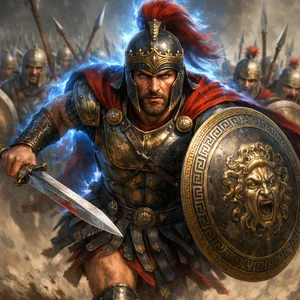
The defensive equipment characteristic of Bronze Age warriors, evoked in the Homeric accounts of the battles around Troy. It symbolizes Menelaus's rank as military commander and king.

The emblem of his kingship over Sparta, the scepter is the object Menelaus raises to summon the Greek kings and demand justice following the abduction of Helen. In the Homeric tradition, the scepter embodies the legitimate authority bestowed by Zeus.

A bronze helmet adorned with a horsehair plume, worn by elite Mycenaean warriors. During the duel, Menelaus seizes Paris by his crest to drag him to the ground, but the chin strap snaps, allowing Aphrodite to spirit her protégé away.

The prestige vehicle and combat platform of the Mycenaean aristocracy, allowing kings like Menelaus to move swiftly across the battlefield and assert their rank. Its use is attested in artistic representations from the Aegean Bronze Age.

Precious gold tableware is characteristic of Mycenaean palaces, as evidenced by the famous Vaphio cups discovered in Laconia. In the *Odyssey*, Menelaus receives Telemachus with lavish hospitality, pouring wine into richly crafted gold cups.
School Curriculum
Vocabulary & Tags
Key Vocabulary
Daily Life
Morning
Menelaus begins his day in the megaron, the great hall of the Mycenaean palace of Sparta, where he presides over the council of nobles and elders. He receives reports from his stewards on livestock, grain reserves, and the affairs of the kingdom. Religion is ever-present: libations and prayers are offered to the gods before any important decision is made.
Afternoon
The afternoon is devoted to military training and hunting, essential pursuits for a Mycenaean warrior king. Menelaus practices javelin throwing, archery, and sword fighting alongside his companions-in-arms. Hunting boar or deer in the forests of Laconia serves at once as training, provisioning, and a display of royal prestige.
Evening
In the evening, Menelaus presides over the banquet in the megaron, where nobles and warriors gather around a central hearth. Roasted meat and wine mixed with water are shared, while a bard sings of the deeds of heroes and gods. The *Odyssey* describes these lavish feasts at the court of Sparta in vivid detail, when Telemachus arrives to seek news of his father Odysseus.
Food
The diet of the Mycenaean aristocracy centers on spit-roasted meat — beef, pork, mutton, and game —, barley or wheat bread, and cheeses. Wine, diluted with water in a large bronze *krater*, is the prestige drink reserved for the elite. Figs, olive oil, and seafood round out this rich diet characteristic of the Mycenaean palaces.
Clothing
In peacetime, Menelaus wears a linen tunic (*chiton*) and a woolen cloak (*himation*), woven and embroidered by the palace women to Mycenaean standards. In war, he dons a bronze panoply consisting of a plumed helmet, a breastplate, and greaves (*knemides*). Royal garments are dyed purple or adorned with geometric patterns embroidered in gold thread — visible markers of his rank.
Housing
The Mycenaean palace of Lacedaemon is a fortified complex organized around the central megaron, a large rectangular hall with a circular hearth and four columns supporting the roof. The walls are decorated with frescoes depicting hunting scenes, processions, and warfare. Storerooms for oil, grain, and wine, along with workshops for metalworkers and weavers, ensure the economic self-sufficiency of the royal estate.
Historical Timeline
Period Vocabulary
Liens externes & ressources
Références
Œuvres
Constitution de la coalition panhellénique
vers -1240 (tradition mythologique)
Duel singulier contre Pâris
Pendant le siège de Troie
Récupération d'Hélène et fin de la guerre
vers -1230 (tradition mythologique)
Exploration de la Méditerranée orientale
vers -1230 à -1223