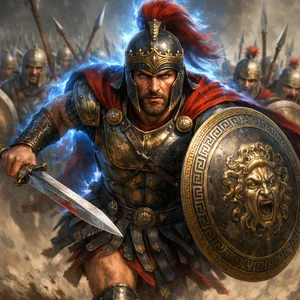
Regent of the Assyrian Empire around 811–808 BC, Sammu-ramat held power in the name of her son Adad-nirari III. A historical figure, she quickly became a legendary character in the Greek world, symbolizing the warrior queen and great builder of the ancient Near East.
Sammu-ramat (Semiramis)
Sammu-ramat, known as Semiramis
8 min read
Frequently asked questions
Key Facts
- Around 811 BC: following the death of her husband Shamshi-Adad V, she assumes the regency of the Assyrian Empire
- Around 808 BC: end of the regency when her son Adad-nirari III comes of age
- Her name appears on a royal stele at Assur, proof of her official authority
- Greek authors (Diodorus Siculus, Ctesias) immortalize her under the name Semiramis
- Legend credits her with founding Babylon and the Hanging Gardens
Works & Achievements
Historically attested achievement: Sammu-ramat governed one of the most powerful empires of the ancient world for several years, leading military campaigns and administering a vast territory — an unprecedented act for a woman in Assyria.
A cuneiform epigraphic document that constitutes the most direct archaeological evidence of Sammu-ramat's existence and status. She is described therein as wife and mother of kings, signaling her exceptional rank.
Greek legend attributes to Semiramis the construction of Babylon's colossal walls, counted among the Seven Wonders of the ancient world. This account, though fictional, reflects a fascination with a superhuman queen-builder.
Greek tradition credits Semiramis with conquests stretching from Egypt to India. These epic narratives, amplified versions of real Assyrian campaigns, made her the archetype of the invincible warrior queen in the ancient imagination.
A masterpiece of bel canto premiered in Venice, this opera tells the tragic fate of Semiramis, haunted by the murder of her husband. It played a lasting role in keeping the myth alive in modern European culture.
Dante places Semiramis among the souls damned for lust in his Inferno, reflecting the ambivalent reputation of the legendary queen — at once admirable and transgressive — in medieval European culture.
Anecdotes
A stele discovered at Assur bears an inscription naming Sammu-ramat, calling her “wife of King Shamshi-Adad, mother of King Adad-nirari.” This is one of the rare archaeological proofs attesting that a woman held real authority over the Assyrian Empire — something extraordinary in a civilization where male power was absolute.
When her husband Shamshi-Adad V died around 811 BC, her son Adad-nirari III was still a child. Sammu-ramat then took the reins of the greatest empire in the world: she commanded the army, dispensed justice, and led military campaigns for at least three years, in the name of a ruler who was not yet old enough to reign.
The Greeks transformed this historical queen into a legendary figure. The writer Ctesias of Cnidus, physician at the Persian court in the 4th century BC, related that Semiramis was born of a goddess and a mortal, abandoned at birth and nursed by doves in the desert, before becoming the most powerful queen of the East.
According to Greek tradition, Semiramis is said to have conquered Egypt, Ethiopia, and even attempted to invade India. She is also credited with building the famous walls of Babylon and, in some versions, the legendary Hanging Gardens. These accounts, though invented, reveal the immense fascination the Mediterranean world held for this figure of an all-powerful Eastern queen.
In many versions of the legend, Semiramis transformed into a dove at her death and flew up to the heavens — an echo of the goddess Ishtar, patron of love and war, whose power and ambiguity she shared. This symbolic detail made her, over the centuries, a figure poised halfway between history and myth.
Primary Sources
Semiramis, surpassing all women in beauty, courage, and intelligence, built Babylon and its walls, dug canals, and led armies to the farthest reaches of India.
It is said that Semiramis was the daughter of the goddess Derceto and a mortal man, that she was abandoned and nursed by doves, then discovered by shepherds who raised her.
Sammu-ramat, wife of King Shamshi-Adad, king of the world, king of Assyria, mother of Adad-nirari, mighty king, king of the world, king of Assyria, daughter-in-law of Shalmaneser, king of the four regions.
The walls of Babylon were raised by a queen named Semiramis, five generations before the more recent one, Nitocris, whose traces can still be seen across the plain.
Semiramis, queen of the Assyrians, governed her people with such valor and authority that she surpassed in glory all the kings who preceded her, and was counted among the most illustrious women of Antiquity.
Key Places
Capital of the Assyrian Empire under Shamshi-Adad V and Adad-nirari III. It was here that Sammu-ramat exercised her regency, at the heart of a colossal palace adorned with sculpted reliefs and precious ivories.
The holy city and first capital of Assyria, where the stele bearing the name of Sammu-ramat was erected — one of the rare archaeological proofs of her historical existence.
A great metropolis of Mesopotamia that Greek tradition credits to the building campaigns of Semiramis. Its massive ramparts and irrigation canals fed the myth of an extraordinary builder queen.
A great Assyrian city on the Tigris, sometimes linked in legendary tradition to the constructions of Semiramis. It would later become the capital of Esarhaddon and Ashurbanipal.
Some versions of the Greek legend place in this region the birth or first palace of Semiramis, on the banks of the Euphrates, at the boundary between the East and the Hellenistic world.
Typical Objects

Assyrian queens and regents owned a personal seal engraved in stone or ivory, essential for authenticating orders and treaties. Sammu-ramat is said to have used one to exercise authority in her son's name.

The administration of the Assyrian Empire relied on thousands of clay tablets inscribed in cuneiform. As regent, Sammu-ramat would have overseen the drafting of decrees and diplomatic correspondence engraved on these surfaces.

A conical headdress adorned with gold and precious stones, symbolizing divine power in Assyria. In legendary iconography, Semiramis is often depicted wearing this tiara, which asserts her sovereign authority.

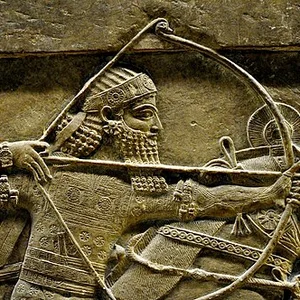
Greek tradition portrays Semiramis as a great warrior. The Assyrian composite bow — a formidable weapon of both infantry and cavalry — is frequently associated with her image as a conquering queen in ancient artistic representations.

The dove, a bird sacred to Ishtar, goddess of love and war, is the mythological emblem of Semiramis. According to legend, doves fed her at birth, and she transformed into a dove at the moment of her death.

Mesopotamian architects used plans engraved on clay to design their buildings. Tradition credits Semiramis with founding or beautifying Babylon, complete with its legendary ramparts, canals, and palaces.
School Curriculum
Vocabulary & Tags
Key Vocabulary
Tags
Daily Life
Morning
The regent begins her day in the palace of Nimrud by receiving reports from provincial governors and generals. Scribes read aloud the cuneiform tablets recording troop movements, tribute collections, and diplomatic correspondence. She then adjudicates matters of justice in the name of the young king.
Afternoon
The afternoon is devoted to audiences and military preparations. At the Assyrian court, decisions regarding campaigns, fortifications, and alliances are made after consulting diviners and priests of Assur. Sammu-ramat, as regent, also oversees the management of the royal storehouses filled with grain, oil, and precious metals.
Evening
In the evening, royal banquets bring together dignitaries and ambassadors around roasted meats, barley beer, and palm wine. Musicians play harp and lute while reciters declaim epics glorifying the kings of Assyria. The regent is careful to uphold the image of power and dynastic continuity that is essential to the authority of the throne.
Food
The Assyrian royal table is lavish: roasted lamb, duck, and beef, fish from the Tigris, vegetables (onions, leeks, lentils), barley and wheat breads, dates, figs, and grapes. Barley beer is the everyday drink, while wine imported from mountainous regions is reserved for feasts. Spices such as cumin and coriander season the preparations.
Clothing
The regent wears long robes of fine wool dyed red or purple, bordered with elaborate fringe in the Assyrian fashion. Gold jewelry — necklaces, bracelets, and lapis lazuli earrings — signals her royal rank. She wears a decorated conical tiara, and her eyes are lined with kohl in the Eastern style, so that she appears both beautiful and formidable.
Housing
The palace of Nimrud is a labyrinth of courtyards, audience halls, and private apartments, its walls covered with carved reliefs depicting lions, warriors, and royal hunting scenes. The floors are paved with stone, and beams of cedar wood imported from Lebanon fill the rooms with fragrance. Irrigated gardens planted with palm trees and pomegranate trees surround the palace enclosure.
Historical Timeline
Period Vocabulary
Liens externes & ressources
Références
Œuvres
Régence de l'Empire assyrien
811–808 av. J.-C.
Stèle de Sammu-ramat à Assur
Vers 808 av. J.-C.
Construction légendaire des remparts de Babylone
Selon la tradition, IXe siècle av. J.-C.
Campagnes militaires légendaires (Égypte, Inde, Éthiopie)
Selon Ctésias, IXe siècle av. J.-C.
Divine Comédie — L'Enfer, chant V (Dante Alighieri)
1314