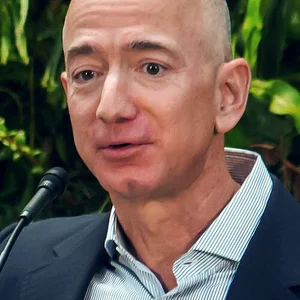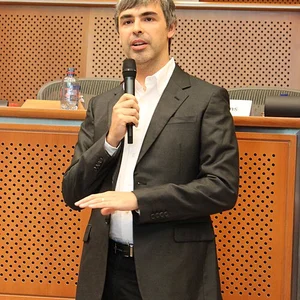

Sergey Brin is an American entrepreneur of Russian origin, co-founder of Google with Larry Page in 1998. He revolutionized Internet search through the PageRank algorithm. He also led the experimental projects of Google X.
Sergey Brin(1973 — ?)
Sergey Brin
États-Unis
9 min read
Frequently asked questions
Key Facts
- 1973: Born in Moscow, in the Soviet Union
- 1998: Co-founded Google with Larry Page in a garage in Menlo Park
- 1998: Developed the PageRank algorithm, the foundation of the Google search engine
- 2004: Google's IPO; Brin becomes a billionaire
- 2015: Google restructures under the holding company Alphabet, of which Brin becomes President
Works & Achievements
Co-invented with Larry Page during their research at Stanford, PageRank ranks web pages based on the number and quality of links pointing to them. It forms the mathematical foundation that made Google superior to every search engine of the era.
Founded in 1998, Google became the world's dominant search engine within just a few years, now processing more than 8.5 billion queries per day. It fundamentally transformed access to information for billions of people.
These mapping and immersive street-level services, developed under Brin's leadership, revolutionized navigation and geographic exploration. Street View required a global fleet of vehicles equipped with spherical cameras.
Led by Brin, this secretive laboratory explores breakthrough technologies: self-driving cars (Waymo), Google Glass, stratospheric balloons (Loon), and delivery drones (Wing). It embodies the idea that technology companies can tackle humanity's greatest challenges.
Born as the Google Car project within Google X, Waymo is today one of the most advanced autonomous driving technologies in the world. It represents Brin's vision of using AI to eliminate road accidents.
Brin and Page restructured Google by creating Alphabet, a technology conglomerate of which Google is just one subsidiary. This structure separates the profitable core businesses (search, advertising) from long-term experimental projects.
Anecdotes
Sergey Brin was born in Moscow in 1973 into a Jewish family. His father, a brilliant mathematician, found his career blocked by Soviet antisemitism. In 1979, the family decided to leave everything behind and emigrate to the United States with two suitcases. Sergey was six years old. This experience of uprooting would shape his lifelong commitment to freedom of information.
In 1995, Sergey Brin was assigned to give a campus tour of Stanford to a prospective doctoral student: Larry Page. The two men argued about almost everything during that first meeting. Yet a few months later they became inseparable and began working together on a wild idea: indexing the entire Web.
The PageRank algorithm, invented by Brin and Page, drew direct inspiration from how academic journals work. In the scholarly world, a paper is considered important if it is cited by many other important papers. Brin transposed this logic to links between web pages, revolutionizing the relevance of search results.
Google's first servers were built from bargain-bin components stored in LEGO casings to make stacking easier. The search engine ran out of Larry Page's university dorm room at Stanford before moving to the now-famous garage of Susan Wojcicki in Menlo Park in 1998.
Brin is known for his unconventional ways of getting around Google's offices: rollerblades, scooters, Segway. He practices acrobatic gymnastics and trapeze. This culture of playfulness and physical daring directly influenced Google's corporate culture, where engineers have access to slides, ping-pong tables, and nap rooms.
Primary Sources
In this paper, we present Google, a prototype of a large-scale search engine which makes heavy use of the structure present in hypertext. Google is designed to crawl and index the Web efficiently and produce much more satisfying search results than existing systems.
We assume page A has pages T1...Tn which point to it. The parameter d is a damping factor which can be set between 0 and 1. We usually set d to 0.85. Also C(A) is defined as the number of links going out of page A. The PageRank of a page A is given by: PR(A) = (1-d) + d (PR(T1)/C(T1) + ... + PR(Tn)/C(Tn)).
Google is not a conventional company. We do not intend to become one. Throughout Google's evolution as a privately held company, we have managed Google differently. We have also emphasized an atmosphere of creativity and challenge, which has helped us provide unbiased, accurate and free access to information for those who rely on us around the world.
I thought there was no ambiguity in the law. The NSA's PRISM program was a serious setback to the freedom and openness of the Internet. It is of great concern.
Key Places
Birthplace of Sergey Brin, born in 1973 during the Cold War under Soviet rule. State-sponsored antisemitism, which stalled his father's career as a mathematician, was the direct reason the family emigrated in 1979.
Where Brin began his PhD in 1995 and met Larry Page. The research project that would become Google was born in the labs and dorm rooms of this university, a symbol of Silicon Valley's technology ecosystem.
Google's first official headquarters in 1998, this garage rented for $1,700 a month has become a legendary landmark in the history of the Internet. Its owner, Susan Wojcicki, would later go on to become CEO of YouTube.
Google's global headquarters since 2004, this sprawling 5.4-million-square-foot campus embodies the company culture envisioned by Brin and Page: game areas, free restaurants, gardens, and colorful bikes. It has become a model copied by tech companies around the world.
The city where the Brin family settled upon arriving in the United States in 1979. This is where Sergey grew up, learned English, and received an American education while maintaining the cultural roots of his Russian-speaking family.
Typical Objects

Google's very first servers — assembled from cheap hard drives and housed in LEGO structures — symbolize the resourceful, frugal spirit of early Silicon Valley. Brin and Page ran their search engine from Page's university dorm room before moving into the Menlo Park garage.

A daily tool for Google's engineers, the whiteboard is inseparable from the work culture Brin helped establish: every idea is modeled, sketched, and debated before a single line of code is written. The key architectural decisions behind PageRank were first outlined on these surfaces.

The flagship prototype from Google X, launched in 2012, these augmented-reality glasses embody Brin's vision of technology that is unobtrusive and worn on the body. Brin wore them himself at public appearances to demonstrate their potential uses.

Sergey Brin regularly skated through the hallways of the Googleplex on inline skates. This small detail captures Google's philosophy at a glance: freedom of movement, rejection of formality, and a playful culture put to the service of creativity.

Born out of Google X, this driverless car is one of Brin's most ambitious projects. It embodies his fascination with disruptive technologies capable of fundamentally transforming society.

It was on the servers and machines of Stanford's computer science lab that Brin and Page developed the prototypes for BackRub and then Google. The university played a decisive role as both the technological and intellectual cradle of Google's story.
School Curriculum
Vocabulary & Tags
Key Vocabulary
Tags
Daily Life
Morning
Sergey Brin starts his day with an intense physical workout — he has a passion for acrobatic gymnastics and trapeze. At the Googleplex, he often arrives on rollerblades or by bike, dressed casually in jeans and a t-shirt. Breakfast is eaten for free at one of the campus's many cafeterias, a perk he introduced in Google's early days.
Afternoon
His afternoons are filled with standing brainstorming sessions at whiteboards, code reviews with engineers, and leadership meetings. Brin is known for diving directly into technical projects. He moves between buildings on a Segway or electric scooter, refusing to use a company car on campus.
Evening
Brin attends major technology conferences (TED, Google I/O) where he sometimes presents Google X projects. His social life alternates between dinners in Silicon Valley with fellow entrepreneurs and sports activities such as kitesurfing or scuba diving. He is known for his personal involvement in philanthropic causes through the Brin Wojcicki Foundation.
Food
Brin has adopted a near-vegetarian diet, driven by health and environmental concerns. He has taken a close interest in alternative food technologies, particularly lab-grown meat — Google X co-funded Mark Post's research into the first synthetic hamburger in 2013. Google's cafeterias offer varied, high-quality cuisine, free for all employees.
Clothing
Sergey Brin embodies Silicon Valley's casual dress code: jeans, t-shirt, sneakers or rollerblades. He wore Google Glass publicly at conferences and media appearances to help normalize its use. This relaxed approach to dress is a deliberate choice, symbolizing a rejection of the formal codes of finance or law in favor of an engineering culture.
Housing
Brin owns several properties in California, including a villa in Los Altos Hills in Silicon Valley. He also owns a mega-yacht and private jets through a shared fleet with other Google executives. Unlike the ostentation of some billionaires, he long maintained a relatively low profile regarding his real estate holdings.
Historical Timeline
Period Vocabulary
Liens externes & ressources
Références
Œuvres
Algorithme PageRank
1996-1998
Google Search — moteur de recherche
1998
Google Maps et Google Street View
2005-2007
Google X (laboratoire de projets lunaires)
2010
Waymo — véhicule autonome
2009-2016
Alphabet Inc. — restructuration du groupe Google
2015