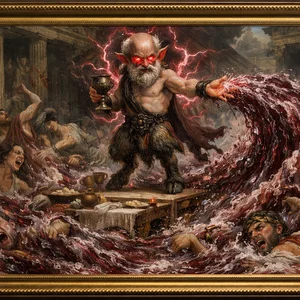

A deity of Greek mythology, Silenus is the old satyr companion and foster-father of Dionysus, god of wine. Perpetually drunk yet reputed for profound wisdom, he is often depicted riding a donkey, unable to stand on his own. His paradoxical figure — drunkenness as a path to truth — resonated throughout Greek and Roman Antiquity.
Silenus
Silenus
9 min read
Frequently asked questions
Famous Quotes
« “The best thing for man would be not to have been born, and next best, to die as soon as possible.” (saying attributed by Aristotle in the Eudemus, from the Greek tradition)»
« “I know that I know nothing of what you think I know.”»
Key Facts
- Foster father and tutor of Dionysus in ancient Greek mythology, according to pre-Homeric oral sources
- Captured by King Midas, who wished to draw on his wisdom — an episode recounted by Herodotus and Theopompus (4th century BCE)
- Depicted in Greek satyr drama, notably in the Cyclops by Euripides (5th century BCE)
- Assimilated to Bacchus in the Roman tradition; his name gives the plural ‘sileni’, designating a class of half-human, half-animal creatures
- His figure inspired Plato’s metaphor of the ‘Silenus of Socrates’ (Symposium, c. 385 BCE): ugly in outward appearance, divine within
Works & Achievements
The only complete surviving Greek satyr play, in which Silenus plays a central comic and cowardly role opposite the Cyclops Polyphemus. This play is our primary direct source on how the Greeks portrayed Silenus on stage.
Although Silenus does not appear in person, his figure is at the heart of Alcibiades' speech comparing Socrates to Silenus statuettes. This metaphor of the divine interior hidden beneath an ugly exterior has resonated throughout Western philosophy.
A Latin poem in which two shepherds bind the sleeping Silenus to wrest from him his songs about the origin of the world and the myths of the gods. Virgil endows Silenus with a cosmic and prophetic dimension that goes far beyond the simple comic character of the Greek tradition.
Ovid recounts how Midas took in the wandering, drunk, and lost Silenus and returned him to Dionysus; as a reward, the god granted the king the fateful gift of turning everything to gold. This tale cements the image of Silenus as a pivotal figure standing between mortals and the gods.
A widely reproduced iconographic model in ancient sculpture, depicting Silenus cradling the young Dionysus in an affectionate pose as a foster father. These representations illustrate his guardian role and are preserved in numerous archaeological museums.
Anecdotes
When King Midas of Phrygia captured Silenus by mixing wine into a spring
he asked him what was the greatest blessing for mankind. Silenus
after a long silence
finally replied:
The best thing for you would be never to have been born; the second best, to die as quickly as possible." This dark and paradoxical answer, mentioned by Aristotle in his lost dialogue Eudemus and later taken up by Cicero and Plutarch, is known as the "wisdom of Silenus" and remained famous throughout Antiquity.
In Plato's Symposium (c. 385 BC), Alcibiades compares Socrates to Silenus figurines sold in Athenian craftsmen's shops: on the outside, these hollow statuettes are ugly and grotesque, but when opened, they contain tiny divine statues inside. For Alcibiades, Socrates resembles Silenus — a ridiculous and repulsive appearance, yet an incomparable inner wisdom. This metaphor is one of the most celebrated philosophical comparisons of Antiquity.
In the only complete satyr play to have survived intact, Euripides' Cyclops, Silenus appears as the slave of the Cyclops Polyphemus, together with his whole troupe of satyrs. Cowardly, buffoonish and burlesque, he tries to claim sole credit for Odysseus's victory, all while scheming to drink as much wine as possible. This humorous portrayal attests to the central role Silenus played in popular Greek theatre.
According to Virgil in his Sixth Eclogue (39 BC), two shepherds came upon Silenus asleep in a cave, still drunk from the night before, and bound him with his own flower garlands to force him to sing. Silenus smiled at their trick and began a cosmogonic song about the origin of the world and the earliest myths of the gods. This poetic text illustrates the prophetic and cosmic dimension that the Ancients attributed to this drunken old man, keeper of secret knowledge.
Primary Sources
Silenus declares: "It is I who followed Dionysus, his servant, when he was still a child, and who watched over the god as he roamed the mountains." He presents himself as the faithful guardian and companion of the god, now reduced to slavery in the cyclops's cave.
Alcibiades says of Socrates: "I claim that he closely resembles those Silenus figures displayed in sculptors' workshops, which craftsmen make holding flutes or pipes; when opened in two, they are found to contain images of gods inside."
"Two boys found him sleeping in a cave, heavy with the previous night's wine [...]. Bound with their own garlands, they compelled him to sing. Silenus smiled at their trick: 'Why these bonds? Free me, children; it is enough that you have seen me. I will sing.'"
"Phrygian peasants brought Silenus, caught drunk and wreathed in flowers, to King Midas. Midas, initiated into the Dionysian mysteries by Orpheus, recognized the god's companion and treated him with honor for ten full days before returning him to Dionysus."
"It is said that Silenus was the first of all the satyrs to accompany Dionysus on his expedition to India, and that the god held him in higher esteem than all his other companions on account of his great age and wisdom."
Key Places
A mythical mountain or valley where Silenus raised the young Dionysus, nurturing him and initiating him into the mysteries. Depending on the source, Nysa is placed in Thrace, Libya, India, or Arabia, underscoring its universal and elusive nature.
A region of Asia Minor (present-day western Turkey) where, according to Ovid, King Midas captured Silenus wandering drunk through the countryside. It was here that Silenus revealed to the king his famous paradoxical answer about human happiness.
At the southern foot of the Acropolis, this theatre is where the satyric dramas featuring Silenus were performed during the Great Dionysia. It is the oldest stone theatre in the Western world and the birthplace of European theatre.
A Greek island strongly associated with the cult of Dionysus, where tradition holds that the god of wine stayed for a long time with his thiasos, including Silenus. The remains of the temple of Dionysus at Naxos attest to the importance of the Bacchic cult in this region.
A region of northern Greece considered one of the cradles of Dionysiac worship. Silenus is said to have accompanied Dionysus there during his earliest wanderings, before the cult spread throughout the Greek world.
Typical Objects

Silenus is perpetually depicted with a wine skin or a cup of wine in hand, a symbol of his chronic drunkenness. Wine is both his main attribute and the paradoxical source of his wisdom: it is in a state of intoxication that he reveals the deepest truths.

In most ancient depictions, Silenus is perched on a donkey because he is unable to walk on his own, too drunk to stand upright. This comic image — the grotesque old sage on his donkey — is one of the most recognizable in Greek mythology.

Like all members of the Dionysiac thiasos, Silenus wears a crown of ivy and vine, sacred plants of Dionysus associated with intoxication and immortality. These plants symbolize ecstatic communion with the god of wine.

The thyrsus, a long staff wrapped in ivy and topped with a pine cone, is the ritual attribute of Dionysus's companions. Silenus sometimes carries it, though it serves him as much as a walking stick to keep from stumbling as a Dionysiac scepter.

Hollow figurines shaped like a grotesque old man, the silenoi, were made and sold in Athenian craft workshops; they opened to reveal a small divine statue inside. It is precisely to these objects that Plato compares Socrates in the *Symposium*.

Silenus is sometimes depicted with an aulos, the double wind instrument that accompanied Dionysiac rituals and thiasos processions. The ecstatic, entrancing music of this instrument was inseparable from the atmosphere of trance it helped to create.
School Curriculum
Vocabulary & Tags
Key Vocabulary
Daily Life
Morning
Silenus awakens in a state of perpetual semi-drunkenness, sprawled among the satyrs and maenads after a night of Dionysiac festivities. His morning invariably begins with a full cup of wine, without which he is barely able to sit upright or form a coherent thought.
Afternoon
In the afternoon, Silenus holds court in the midst of Dionysus's band, dispensing paradoxical pronouncements on life, death, and happiness to those who know how to listen past his grotesque appearance. Though he seems incoherent, his words intrigue philosophers and mortals in search of truth within that prophetic intoxication.
Evening
Evening is Silenus's hour of glory: the Dionysiac processions come alive, the *aulos* players strike up, and torches blaze in the night. Perched precariously on his donkey or propped up by two guffawing satyrs, he leads the *thiasos*, singing and stumbling — a living embodiment of the ecstatic joy that Dionysus promises his faithful.
Food
Silenus lives essentially on wine — his staple food, his drink, his medicine, and his philosophy all at once. To this he adds wild fruits, goat's cheese, and meats offered at Dionysiac ritual banquets, always consumed in great quantity and with not the slightest restraint.
Clothing
Silenus wears an animal skin — the *nebris* — or a short, coarse cloak that reveals his old, squat body. His wild white hair, goat's beard, and horse-like ears complete a deliberately rustic and animal appearance that stands in stark contrast to the wisdom attributed to him.
Housing
Silenus has no fixed dwelling: he lives in forests, caves, and wild hillsides wherever the wanderings of Dionysus's *thiasos* take him. These natural, liminal spaces — between the world of men and that of the gods — suit his nature as an intermediary deity, neither fully divine nor fully bestial.
Historical Timeline
Period Vocabulary
Liens externes & ressources
Références
Œuvres
Le Cyclope (Euripide)
Ve siècle av. J.-C.
Le Banquet — Symposion (Platon)
v. 385 av. J.-C.
Bucoliques, Églogue VI (Virgile)
39 av. J.-C.
Métamorphoses, Livre XI (Ovide)
8 ap. J.-C.
Type sculptural : Silène portant Dionysos enfant
v. IVe siècle av. J.-C.