 flip
flipKiribath — coconut milk rice for special days
Kiribath — coconut milk rice for special days
Why this dish? Kiribath opens every beginning in Sri Lanka: the Sinhalese and Tamil New Year, the first day of the month, a birth, an inauguration. For Sirimavo, the first female Prime Minister in the world in 1960, whose life was a series of thresholds crossed, this rice of beginnings resonates particularly — it was shared in Buddhist homes as a prayer of good omen.
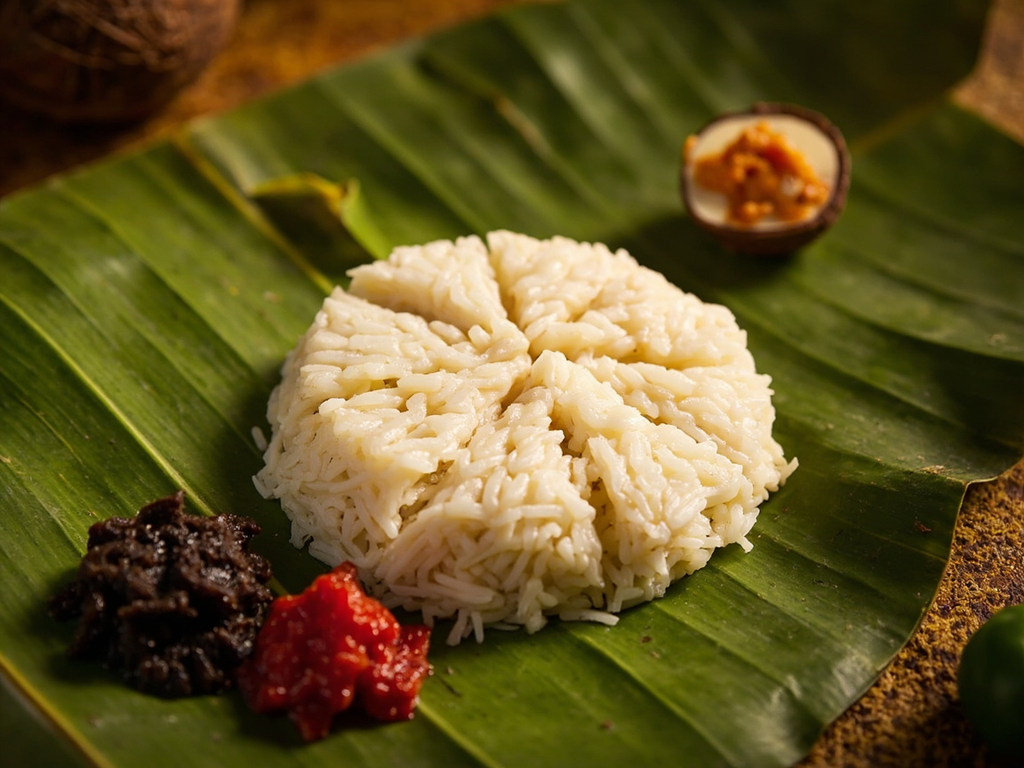
A rice cooked in thick coconut milk until creamy, then pressed and cut into diamonds. Eaten savory with a spicy sambol or sweet with palm sugar (jaggery), at the crossing of a threshold or a festival.
Never should a beginning be made with an empty belly of kiribath. On New Year's Day, before anyone had spoken, I would offer a bite to the elders as a sign of respect. You cook the rice, then finish it in the thickest coconut milk, until it sets and lets itself be cut into diamonds. With a little jaggery for sweetness, or a fiery sambol for bite — thus are the thresholds of life crossed with dignity.
- •White rice (local variety) — one measure (base)
- •Thick coconut milk (first pressing) — to cover (creamy richness)
- •Salt — a pinch (balance)
- •Palm sugar (jaggery / kithul) — for serving (festive sweetness)
Kiribath — coconut milk rice for special days
A rice cooked in thick coconut milk until creamy, then pressed and cut into diamonds. Eaten savory with a spicy sambol or sweet with palm sugar (jaggery), at the crossing of a threshold or a festival.
Why this dish? Kiribath opens every beginning in Sri Lanka: the Sinhalese and Tamil New Year, the first day of the month, a birth, an inauguration. For Sirimavo, the first female Prime Minister in the world in 1960, whose life was a series of thresholds crossed, this rice of beginnings resonates particularly — it was shared in Buddhist homes as a prayer of good omen.
Never should a beginning be made with an empty belly of kiribath. On New Year's Day, before anyone had spoken, I would offer a bite to the elders as a sign of respect. You cook the rice, then finish it in the thickest coconut milk, until it sets and lets itself be cut into diamonds. With a little jaggery for sweetness, or a fiery sambol for bite — thus are the thresholds of life crossed with dignity.
Ingredients (period version)
- White rice (local variety) — one measure (base)
- Thick coconut milk (first pressing) — to cover (creamy richness)
- Salt — a pinch (balance)
- Palm sugar (jaggery / kithul) — for serving (festive sweetness)
Ingredients
- Short-grain or round rice — 300 g (base)
- Thick coconut milk — 400 ml (richness)
- Water — 500 ml (rice cooking)
- Salt — 1/2 tsp (balance)
- Palm jaggery (or whole cane sugar) — for serving (sweetness)
Method
- Rinse the rice and cook it in salted water until tender and the water is absorbed.
- Pour the thick coconut milk over the hot rice, mix and simmer over low heat, stirring, until creamy and homogeneous (10 min).
- Spread the rice 2–3 cm thick in a dish, press with the back of a wet spoon, and smooth the surface.
- Let cool and set, then cut into diamonds. Serve with grated jaggery (sweet version) or a spicy sambol (savory version).
How it was made : Traditionally, kiribath was cooked in an earthenware pot over a wood fire and cut with a cotton thread rather than a knife, for neat diamonds. Offering the first bite to elders or monks marked respect and good omen.
The contemporary twist : Regular diamonds arranged in a checkerboard pattern, melted jaggery drizzled in golden threads and a dot of ruby-red pol sambol for the sweet-heat contrast.
Sirimavo Bandaranaike · Charactorium